

Have you ever found yourself stuck with a problem, waiting for someone to come and fix it? If nothing happens for long enough the waiting becomes unbearable and you decide to just do it yourself. That’s the position I was in around 2010, when I was a researching a condition called PCOS in which elevated testosterone levels can cause psychological and health issues women.
Though I was very focused on PCOS, I was also very aware of issues facing men. I had become increasingly concerned about these issues since the 1990s, especially because extremely serious issues – in particular male suicide - were ongoing but surprisingly overlooked in psychology.
When I had first become aware that men die by suicide three times more than women do, I presumed - like many people – that experts in the field were working on this, and that pretty soon someone was certain to step in and fix this problem. However, after several years of what seemed like the academic equivalent of tumbleweeds, I was hugely relieved to see in the December 2010 edition of The Psychologist magazine a letter from consultant psychologist called Martin Seager. He was calling for the creation of a special section of the British Psychological Society (BPS) to be dedicated to the urgent but overlooked problem of men’s mental health. Immediately I replied to the letter, and eventually with the help of many well-wishers, the rest is history. Sort of. There were one or two obstacles. Let me explain.
All academic research needs to start with a review of the existing literature on the topic. In doing the background research for my first study in this field, which we began in 2011 with clinical psychologist Luke Sullivan, it seemed the most prominent view in the literature was that masculinity put men at risk of suicide. Our attitude was ‘ok, that’s the consensus, let’s get on with it’. But we weren’t very impressed by most of the masculinity scales of the time, which tended to be too general or too negative, so we developed our own and ran the survey with around 500 participants.
Although the results showed some sort of link between masculinity and suicidality, the findings really weren’t as emphatic as I would have expected. We spent some time reflecting on this and discussing the findings with like-minded psychologists, who were mostly therapists working at the coal-face of mental illness rather than academics who dealt more with theories which often were tested mainly on mentally healthy students. I started to realise that the connection between masculinity and mental health was a lot more nuanced than the existing literature suggested, and seemed in places even to contradict the prevailing view. So it was back to the drawing board, and several thought-provoking studies later, we were looking at a very different picture.
“If university and therapy training courses taught male psychology and masculinity in an informed and balanced way – and many institutions barely teach it at all - then this course wouldn’t be necessary.”
The new course from the Centre for Male Psychology is called New Insights into masculinity; theory and practice, and it’s the culmination of over a decade of research, lectures, debates, webinars and discussions. It’s four hours of video material (and an optional hour of exercises, mainly for professionals, for their Continuing Professional Development). Spoiler alert: I believe it’s time the profession of psychology did a major rethink of men’s mental health. That’s because the prevailing narrative about masculinity is too negative, and focusing on masculinity as a contributor to mental health problems is causing us to overlook other much more relevant factors linked to male suicide, such as family breakdown. If university and therapy training courses taught male psychology and masculinity in an informed and balanced way – and many institutions barely teach it at all - then this course wouldn’t be necessary. But if you have been wondering about the links between masculinity and mental health, or just wondering about masculinity in general, I hope this course saves you a lot of time trying to make sense of the huge pile of theories and papers that don’t so much reflect the reality of masculinity as they reflect a morbid fixation on a relentlessly negative view of men.
So what’s in the course? There are two parts: masculinity in theory and masculinity in practice. The ‘theory’ part of the course starts with a world trip, looking at various traits and behaviours to see which ones might be consistently different for men and women internationally. Next we take an anthropologist’s view of similarities and differences in how masculinity is expressed in different cultures across the globe. Next, as a non-historian, one of my favourite stop-offs is the view of masculinity over nearly 500 years of the dramatically changing times of Britain between the 15th and 20th centuries. Then we take a sociological view of masculinity that is rather bleak and dark, but this is balanced out in the section after that which takes a positive psychology view of masculinity.
“Despite the effort throughout the course at cutting through the ideology to reveal the best evidence base, you can be certain that not everyone will agree with material I present or the conclusions I come to. But it’s everyone’s right to disagree, and disagreement is especially important in science.”
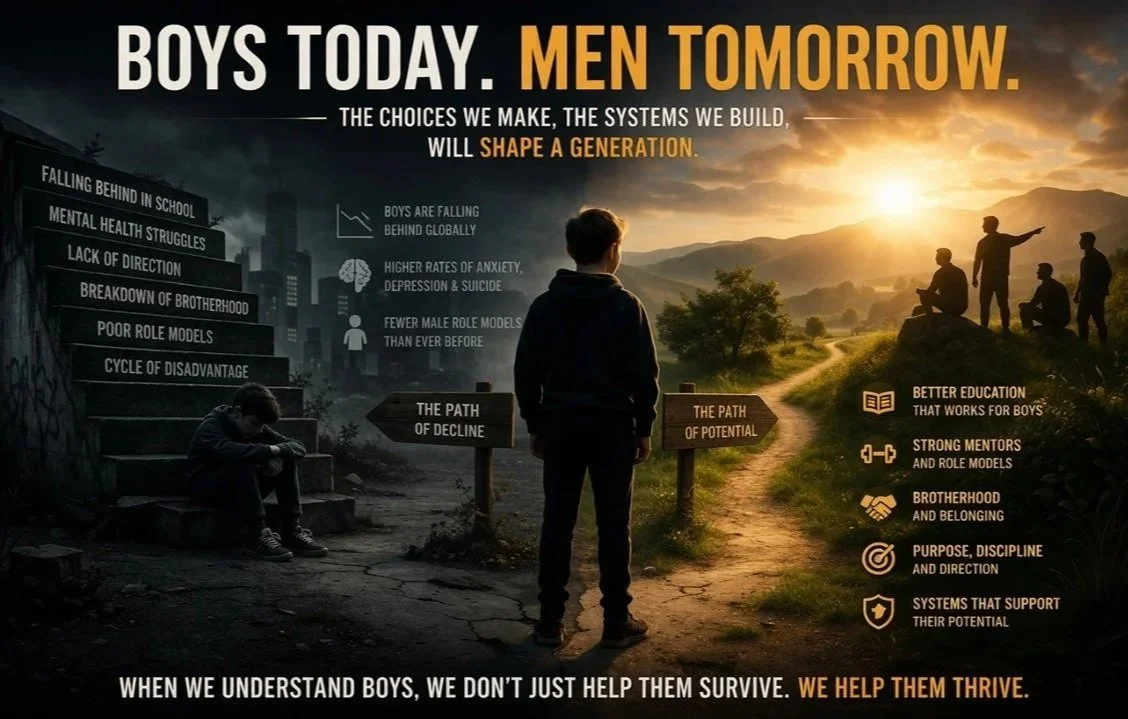
The ‘practice’ part of the course starts by exploring something I have somewhat reluctantly become an expert on over the years, the link between masculinity and men’s mental health. Masculinity and physical health is examined here too, though more briefly. Next we enter the Orwellian world of how presumptions about masculinity lead the media to depict men and women very differently, and the very real implications of this for men and women. Next, and related to the media section, there is the somewhat worrying approach that some governments take towards masculinity. Next we look at the important topic of how boys are learning about masculinity today, how masculinity is viewed in the workplace, and a brief section on how concepts of masculinity impact relationship formation and breakdown. After that we step back and take in an overview of what we’ve seen, and what conclusions we can come to.
If you attended the webinars on this topic in March 2025 you will find much of the content familiar, though there are some differences. For a start, there is new content (e.g. on parenting, government, workplace, DEI, Netflix’s Adolescence, epigenetics, and more). Visually, the course looks somewhat better too, with less clutter and more engaging images, and has an updated concluding section. The webinars were four hours but included Q&A sections and polls within that time, whereas the new course has converted that extra time into new material.
Despite the effort throughout the course at cutting through the ideology to reveal the best evidence base, you can be certain that not everyone will agree with material I present or the conclusions I come to. But it’s everyone’s right to disagree, and disagreement is especially important in science. I hope you can take the course with an open mind, even if you find it challenging, knowing that the more we understand masculinity, the more effectively we can deal with problems related to men and boys. And you can let me know what you think of the course, or if you have a question I can answer. In the end it’s a topic that’s become too big to ignore, or to just take at face value without thinking about for ourselves, so I hope you will join me on this exciting journey.
If you want to learn more about men and masculinity (and earn CPD points), take the new Centre for Male Psychology online course New Insights into Masculinity: Theory & Practice, which is available at a 20% discount for a limited time.
Disclaimer: This article is for information purposes only and is not a substitute for therapy, legal advice, or other professional opinion. Never disregard such advice because of this article or anything else you have read from the Centre for Male Psychology. The views expressed here do not necessarily reflect those of, or are endorsed by, The Centre for Male Psychology, and we cannot be held responsible for these views. Read our full disclaimer here.
Like our articles?
Click here to subscribe to our FREE newsletter and be first
to hear about news, events, and publications.















Have you got something to say?
Check out our submissions page to find out how to write for us.











.