


Those who are familiar with men’s mental health will know that the impact of being falsely accused of abuse, especially sexual abuse, can be overwhelming and catastrophic for the accused and their families. (If you have been falsely accused, see the helplines at the end of this article).
How common are false accusations? Estimates vary quite a bit, but even if you think false accusations aren’t that common and therefore not a serious problem, for those individuals who are falsely accused the effect is hugely significant. A survey by YouGov for DAVIA of over 5,000 people, published in August 2025, found that men are roughly twice as likely as women to be falsely accused of abuse, including “domestic violence, child abuse, sexual assault, or other forms of abuse”. The survey found false accusation rates of 6% of men in the UK, 11% in the US, 16% in Argentina, and 18% in Australia.
This article is not about men who commit abusive acts - there are laws that should deal with them in the appropriate way - this article is about men who are falsely accused of committing abusive acts, and the psychological impact of being falsely accused. The main source of evidence used here is the academic review paper by Dr Samantha K Brooks and Professor Neil Greenberg of the Department of Psychological Medicine, King’s College London. The review, called Psychological impact of being wrongfully accused of criminal offences: A systematic literature review, was published in 2021. In the review, Brooks and Greenberg assess 20 interview studies where people were asked about the experience of being falsely accused. Most of the studies were from the US and UK, and all were of male participants who had spent time in prison before their conviction was overturned.
“regardless of the type of accusation, similarly stressful experiences emerged from all the studies.”
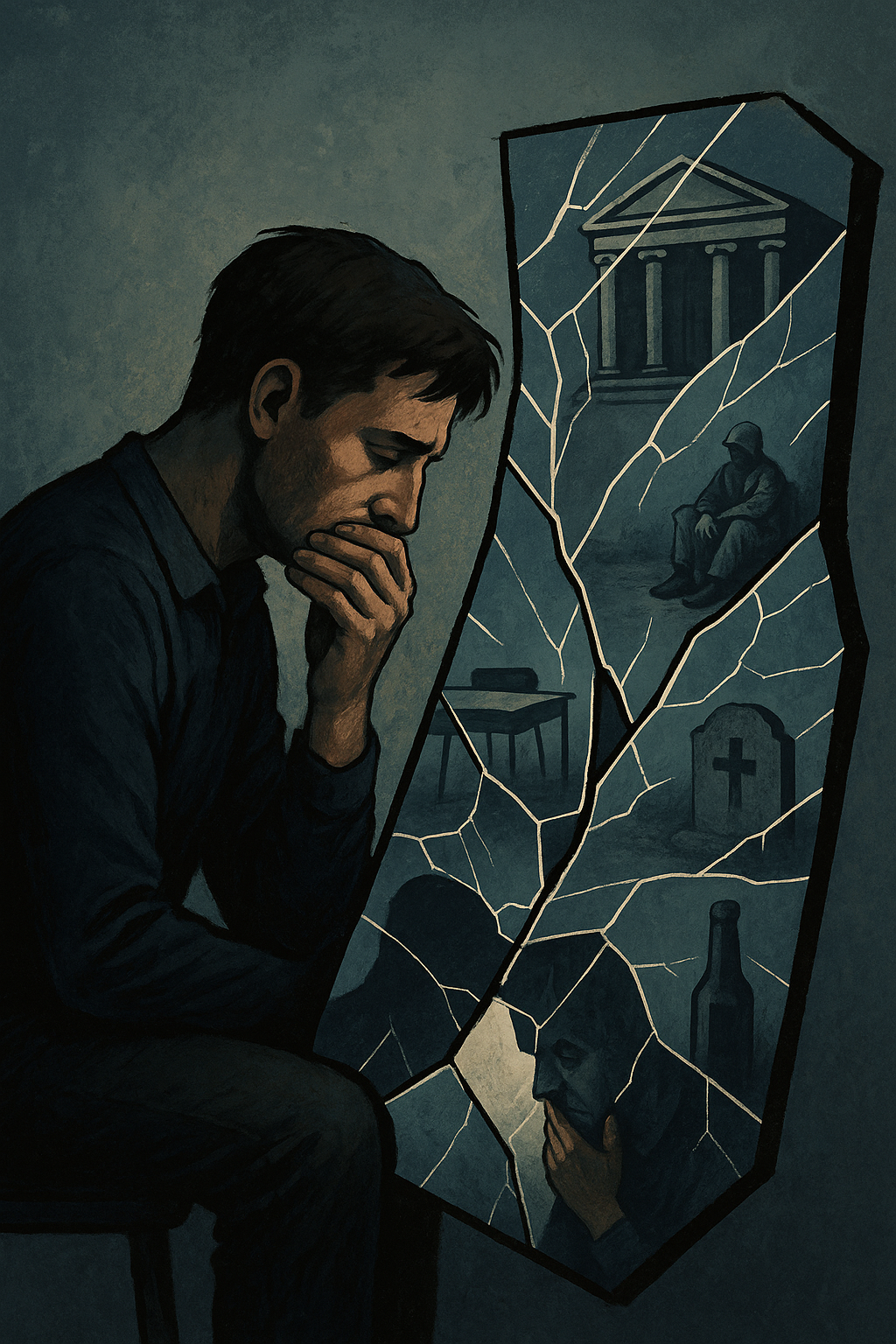
The accusations in the review covered a range of alleged acts, from murder, to sex crimes, to accusations of child neglect, but regardless of the type of accusation, similarly stressful experiences emerged from all the studies. These similarities fell into eight themes, all of which are outlined below. These eight different types of problem tended to compound each other, resulting in complex and difficult psychological difficulties, even if the man was eventually proved innocent. Let’s look at each of the eight themes more closely, with some quotations from the review itself:
1/ Change in self-identity
Many men reported significant changes to their personality, becoming more anxious due to the trauma of their experience. Many also became less trusting and more hostile to others. Many lost a sense of dignity, and a loss of hope and purpose for the future. Receiving a formal apology or public statement of innocence helped remove the stigma to some degree. A minority of men who were exonerated experienced what is called ‘post-traumatic growth’, and developed, for example, “a more positive attitude and not taking things for granted.”
Studies found an “extreme impact on health, particularly mental health, often leaving participants unable to continue their normal work and social activities” [and] “several studies reported ‘secondary trauma’ in the close family members of those wrongfully accused”.
2/ Stigma
Many of the accused felt labelled as guilty by others e.g. “friends avoided them and strangers harassed them”. In some cases the stigma was internalised, and the accused “struggled between wanting to fight the allegations and wanting to isolate themselves due to shame”.
3/ Attitudes towards the justice system
Most of the accused reported a loss of faith in the police, the criminal justice system, and loss of confidence in public opinion.
4/ Psychological and physical health
Even though most of the accused had no psychiatric history, studies found an “extreme impact on health, particularly mental health, often leaving participants unable to continue their normal work and social activities”. Around half the accused experienced clinical levels of depression, and suicidal thoughts were common. Anxiety and panic disorders were also common. Around half had posttraumatic stress disorder (PTSD). Most of the accused experienced problems sleeping. Around half experienced health problems such as pain, high blood pressure, eating problems, and substance abuse. Many felt general feelings of bitterness, loss, hopelessness, emptiness, anger, aggression, helplessness, and “chronic feelings of threat and fear when out in public”. Note that “several studies reported ‘secondary trauma’ in the close family members of those wrongfully accused” with similar symptoms as experienced by the accused.
5/ Relationships
Around half of the men accused became socially withdrawn and isolated. Some reported apathy about maintaining close relationships. Often, friendships, relationships and social networks broke down, even with children or grandchildren. Many felt they were forced out of these relationships. Some felt they could no longer protect their child in the same way they could prior to the false accusation. Some experienced “relationship break-ups, divorce or loss of custody of children”. In some cases where the accused was imprisoned, families adapted to living without them. “Only one study reported a positive impact on relationships [where] 8/100 participants in this study reported the family had been brought closer together after the acquittal as they fought an ‘outside enemy’”.
“One study found 28% had to sell the family home to meet legal costs. Another study around a third of accused became “financially destitute”.”
6/ Impact on finances and employment
Most participants “reported a significant financial burden” even if they received legal aid and damages. This was due to legal fees, loss of earnings, reduced pensions, and loss of homes. In many cases this put financial pressure on family and friends. One study found 28% had to sell the family home to meet legal costs. Another study around a third of accused became “financially destitute”. In some cases, after imprisonment “participants had little sense of the value of money, which led to difficulty budgeting, reckless spending and debt”.
Most of the accused lost their jobs, had their role downgraded, or found barriers introduced e.g. prevented from working with children or vulnerable adults. Having a criminal record was a barrier to further employment, and getting references from employers became difficult.
“Many participants feared being assaulted or killed in prison, and some indeed were subjected to serious violence. […] Ironically, “preoccupation with proving innocence tended to be seen by the prison administration as evidence of a lack of remorse”, negatively impacting their treatment”.
7/ Traumatic experiences in custody
Many participants feared being assaulted or killed in prison, and some indeed were subjected to serious violence. “Several reported having learned to be aggressive and intimidating as a form of self protection.” Police misconduct was reported by many participants, and many found their cross-examination by the police traumatising, as was their courtroom trial and any experiences of prison. Ironically, “preoccupation with proving innocence tended to be seen by the prison administration as evidence of a lack of remorse”, negatively impacting their treatment e.g. privileges such as family visits.
8/ Adjustment difficulties
“Those who had been incarcerated tended to become institutionalised and struggled to adapt to life out of prison. …participants reported difficulty coping with ordinary tasks in the initial weeks after their release but felt humiliated by this and ashamed to ask for help”. Many lost their sense of direction, and struggled to fit back into a world that had in many ways moved on (e.g. technological advances) leaving the accused ‘developmentally frozen’ at the age they had been when they first went to prison.
“This review shows that the consequences of wrongful accusations can be severe. Consequently, it is crucial to identify the best ways to support those who are wrongfully accused and their families.”
These eight themes are a horrific list of degradation and despair, especially when you realise that many falsely accused men experienced not just one of them, but all of them. The authors of the review conclude by saying: “This review shows that the consequences of wrongful accusations can be severe. Consequently, it is crucial to identify the best ways to support those who are wrongfully accused and their families.”
Coping with being falsely accused
If your are falsely accused it is important to reach out and contact people and organisations who can help you (see contact details below). It is also useful to consider some of the strategies, identified in review used by those who are falsely accused, either consciously or spontaneously.
Predictably, support from family and friends was invaluable. However when the stressors related to being falsely accused put too much strain on these relationships, it was useful to reach out to other support networks (e.g. miscarriage of justice organisations). Indeed these organisations were helpful for family and friends too. Having a support network of people e.g. a support group, or attending conferences, was valuable too. (Of relevance to this is the walk in London on International Falsely Accused Day on Tuesday September 9th, 2025). The authors of the review suggest that research is needed to identify what the most helpful elements are of these support networks.
“those falsely accused of sex offences tend to adopt more emotion-focused than task-focused coping strategies, which is less constructive as it deals with the emotional affect rather than trying to problem solve.”
There is some evidence that activism can be helpful e.g. helping others going through similar experiences, or becoming involved policy reform, or generally raising awareness. Such activities can help the falsely accused find meaning in their suffering, and purpose in their life. However, some people are too traumatised by their experience, and just want to move on with their life.
“public perceptions of exonerees tend to be negative and not dissimilar to perceptions of actual offenders, despite knowing they had been exonerated.”
The review authors suggest that “also of importance is improving public perceptions of those wrongfully accused. Research suggests public perceptions of exonerees tend to be negative and not dissimilar to perceptions of actual offenders, despite knowing they had been exonerated. This may be because the public are concerned that the exoneration process itself was flawed”. They say research is needed to identify ways of improving public perception, “Otherwise, the wrongfully accused will continue to be stigmatised by others, which is likely to worsen the psychological impact of their experience… Provision of bespoke, fast-track mental-health services, including vocational rehabilitation, would also be helpful”, though funding is lacking for case management and mentoring of the falsely accused.
Exercise, mindfulness or yoga help for some people, but more research is needed to identify what works best for which people. One study found that “those falsely accused of sex offences tend to adopt more emotion-focused than task-focused coping strategies, which is less constructive as it deals with the emotional affect rather than trying to problem solve.” Future research could explore why this might be and take into consideration the effect of such coping strategies on psychological well-being.
As can be seen from the evidence of the review, the impact of being falsely accused is significantly negative, not only for the person accused, but for their families. The review also highlights the need for more research in this field, particularly on raising public awareness of this issue, and in finding effective strategies to support those who are falsely accused.
If you have been falsely accused of abuse, you can contact one of these organisations for help:
FASO
The FASO helpline number is 03335 779 377, and is for those experiencing false allegations of various types. Their email is support@false-allegations.org.uk
or visit their website http://www.false-allegations.org.uk
The Defendant
The Defendant helpline is 0300 124 5098, which is open Monday to Friday 6-10pm, and is for those experiencing false allegations. For general information email info@thedefendant.org.uk or visit their website https://thedefendant.org.uk/
Disclaimer: This article is for information purposes only and is not a substitute for therapy, legal advice, or other professional opinion. Never disregard such advice because of this article or anything else you have read from the Centre for Male Psychology. The views expressed here do not necessarily reflect those of, or are endorsed by, The Centre for Male Psychology, and we cannot be held responsible for these views. Read our full disclaimer here.
Like our articles?
Click here to subscribe to our FREE newsletter and be first
to hear about news, events, and publications.





















Have you got something to say?
Check out our submissions page to find out how to write for us.















.

people are more aware of the fact men can be victims of this type of violence, but this often isn’t translated into policy, practice or indeed provision of resources