

Why I Became a Male-Centred Therapist: A Personal Journey

My therapy journey didn’t begin in a counselling room. Before becoming a therapist, I spent several years working in the transport industry, a role that unexpectedly exposed me to trauma, violence, loss, and moments of deep human vulnerability. During this time, I also operated as a union representative, and many men told me in confidence about their struggles, personal, emotional, and psychological, that they felt unable to share elsewhere. Over time, I began to notice a recurring theme: many of the men around me were struggling in silence, with little support and even less understanding. These early experiences planted the seed for what would eventually become my path into male-centred therapy, long before I ever entered formal training.
While I was managing a night shift (22 years of age), an employee (HGV driver) rang to inform me that someone had jumped onto the dual carriageway in front of his vehicle. Sadly, it was suicide, and the man did not survive. Understandably, the driver was distraught. Three years before this event, a family member of mine died by suicide due to being domestically abused. Unfortunately, he hung himself. Soon after, a colleague at work ended his life by pouring petrol on himself and igniting it due to losing access to his home & children. Their deaths highlighted to me, at a young age, how deeply pain can be hidden and untreated among men.
A few years later, while driving on a single carriageway, I was involved in a head-on collision. The other driver deliberately swerved into my lane at the last second. His car was filled with petrol containers. The intention was that if the crash did not end his life, he would make sure the petrol did; fortunately, he never removed the lids from the containers. Sadly, he died at the scene, and a suicide note was found at his home. As the emergency services discovered this, they were outwardly angry with the driver, but. I wasn’t; my empathy for him was huge. Later, I learned, he, too, had lost access to his home and children.
“I once attended a male mental health CPC (continued professional development) classroom session. There were 10 therapists present, 9 of whom were female. I couldn’t believe what I was hearing. The message was that men are the problem. They won’t open up. It’s because of stoicism, masculinity, the patriarchy, Andrew Tate, and it’s a man’s world we live in.”
That wasn’t the first suicide crash I had experienced. A few years earlier, another man deliberately crashed into the back of my vehicle at 120 miles per hour. Fortunately, he survived. I personally pulled him from his vehicle, due to the smoke, and he had Catholic rosary beads around his hand. These experiences formed a pattern I could no longer ignore. Men, in different places and stages of life, were reaching breaking points without spaces to express the extremity of their mental state. Ironically, one of my very first clients during my training informed me that they had attempted suicide by driving head-on into an HGV vehicle.
My experience as a male therapist
Having first-hand experience with male suicide and now being a qualified therapist, after years of training and giving therapy, I wanted to learn more about male psychology. I once attended a male mental health CPC (continued professional development) classroom session. There were 10 therapists present, 9 of whom were female. I couldn’t believe what I was hearing. The message was that men are the problem. They won’t open up. It’s because of stoicism, masculinity, the patriarchy, Andrew Tate, and it’s a man’s world we live in. These reasons seemed to be surface-level, too shallow to explain why men were attempting suicide and struggling psychologically.
During one monthly therapist mandatory meeting with other therapists (I was the only male), I was subjected to comments like “all men are perverts,” “have you seen the ridiculous clothes that middle-aged men wear?” (I am middle-aged), and “all men are like Homer Simpson, all that goes through their minds is ‘‘du du du du.’” Whilst training, I received a psychological assessment for a placement/internship. I was explicitly told to refrain from having sex with clients, which is clearly a stereotype and a sexist remark.
When I qualified, a prominent domestic abuse charity, which advertises to adults and children, told me they only wanted female counsellors and refused to offer me a position, thereby excluding men from employment and limiting access to support for male clients. I know they refuse to help men because other trainee counsellors have informed me of this.
“A male client asked me, “Are you going to turn me away, too?” He had already been turned away by four female therapists because he was using sex workers and hated himself for it.”
During my time as an EAP telephone counsellor, I witnessed female-affiliated counsellors signpost male clients back to the EAP provider because they did not want to work with men addicted to pornography. There is no judgment here; everyone has their own personal triggers, but it raised important questions regarding where men receive support
Later, as a male-centred private practitioner, a male client asked me, “Are you going to turn me away, too?” He had already been turned away by four female therapists because he was using sex workers and hated himself for it. Another client informed me that his last therapist told him she was a proud feminist, which destroyed the therapeutic relationship.
I am also hearing from clients that their partners are proclaimed feminists and will not help around the house, as they believe their husbands are part of the problem, such as the patriarchy, when the husband asks for help around the house.
I must emphasise, I place no judgment on my female colleagues, as I know many fantastic female therapists, but it begs the question: if only around 20% of therapists are male, and domestic abuse charities turn men away, and some female therapists feel uncomfortable working with men, where do men go for help?
Recently, I wrote an article for a well-known counselling listing on paternal deprivation, incorporating academic evidence and addressing the pathologising of masculinity. The research I presented was based on systematic analytic reviews, including findings from research by Tania Reynolds. Despite the thorough and evidence-based nature of the article, the counselling listing refused to publish it without providing any explanation. It could appear that, although as therapists, we are highly trained to recognise our own unconscious biases, or confirmation biases, it appears that this isn’t always the case.
I am pleased to say that although I was already advertising myself to male clients, it was after completing training with The Centre For Male Psychology, and watching most of their YouTube
videos, that I developed the confidence to change all my listings and website to call myself a male-centred therapist. When I look back, I genuinely believe I was too worried to change to male-centred because of the subconscious belief that I may be viewed as misogynistic. This feeling as well and truly passed.
Reflections on Working with Male Clients
As a male-centred therapist, my experiences with male clients have been both wide and profound. Giving countless hours of therapy, I have encountered men from diverse backgrounds and circumstances, yet certain patterns and struggles have emerged repeatedly.
One of the most striking themes is the lack of recognition of domestic abuse directed at men. Many male clients I work with either do not see themselves as victims or struggle to accept that the behaviours they are subjected to, whether emotional, verbal, psychological, or physical, constitute abuse. This lack of recognition often stems from societal narratives that frame men solely as perpetrators rather than victims, which can lead to shame, denial, and isolation.
Another common issue I observe is the toll of overwork. Many men work extremely long hours, often not by choice but by necessity, such as the fear of being sacked by their employers, out of a sense of duty to provide or maintain stability. Yet, instead of receiving understanding or support at home, some face verbal abuse, criticism, or emotional neglect when they return. This cycle of external pressure and domestic strain often erodes their self-esteem, relationships, and mental health.
“These experiences have reinforced for me the importance of creating safe, non-judgemental spaces where men can explore their emotions, experiences, and identities.”
A further thread running through much of my work is a deep struggle with purpose. Many men, despite their hard work and dedication, express feelings of emptiness or a lack of direction. Without a sense of meaning or a clear sense of self, they become more vulnerable to stress, resentment, and disconnection from those around them.
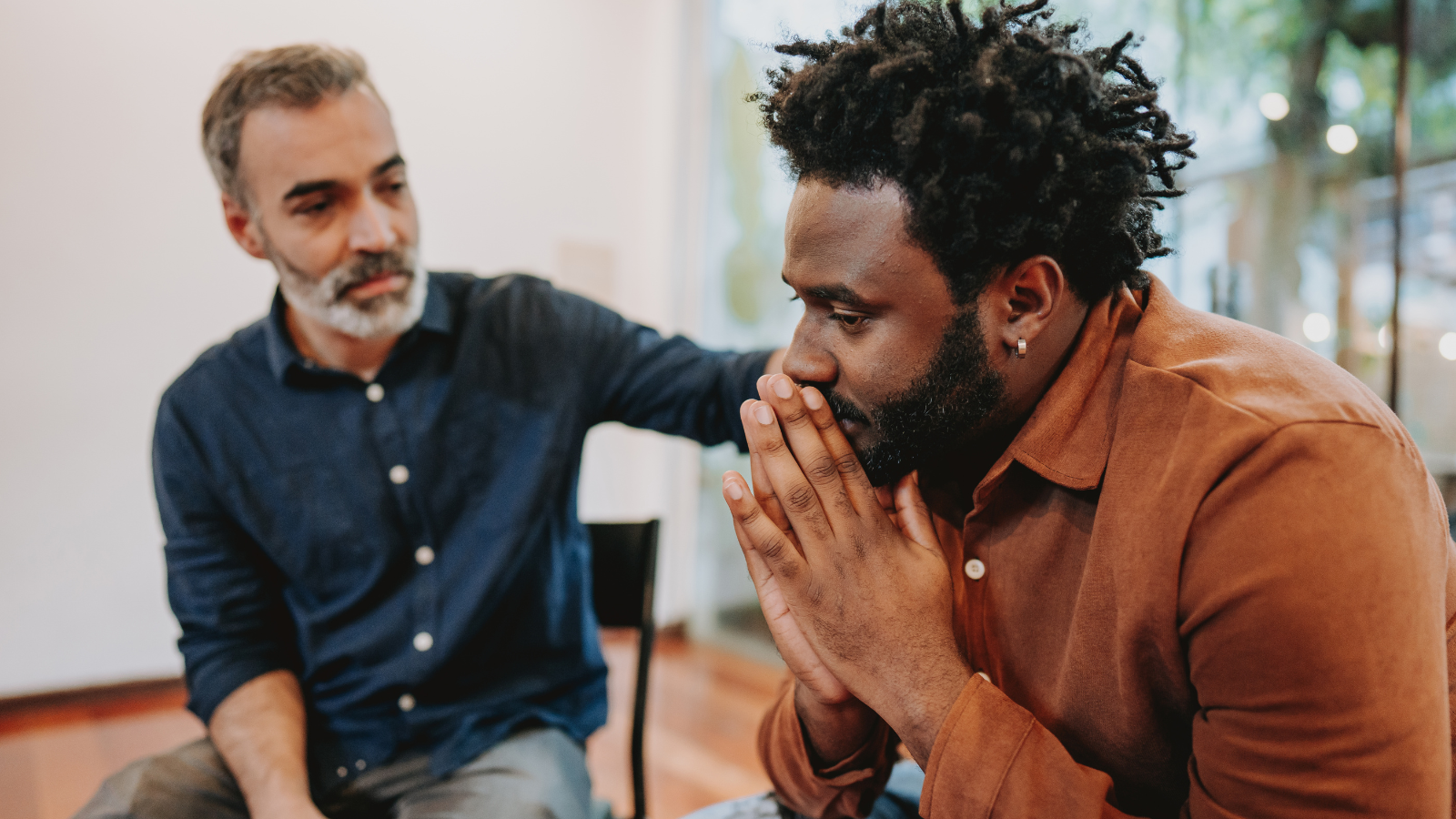
These experiences have reinforced for me the importance of creating safe, non-judgemental spaces where men can explore their emotions, experiences, and identities. Therapy can be a powerful tool to help men recognise patterns of harm, rediscover their own worth, and begin to build lives rooted in purpose rather than mere survival.
While I work with clients of all sexualities and gender identities, I’ve noticed that some men express and process their emotions in different ways. Many aren’t necessarily seeking deep analysis; they’re often looking for practical ways to move forward. Although I’m trained in psychodynamic therapy, which explores how the subconscious influences the present, I recognised the importance of offering more solution-focused approaches. This led me to further train in Solution Focused Brief Therapy, a model that aligns well with the needs of many male clients and supports them in making meaningful, forward-looking changes in their lives.
As a therapist, my aim is to support men not just in understanding their past, but in building a future that feels grounded, authentic, and purposeful. That journey often begins with being heard and continues with being understood.
Disclaimer: This article is for information purposes only and is not a substitute for therapy, legal advice, or other professional opinion. Never disregard such advice because of this article or anything else you have read from the Centre for Male Psychology. The views expressed here do not necessarily reflect those of, or are endorsed by, The Centre for Male Psychology, and we cannot be held responsible for these views. Read our full disclaimer here.
Like our articles?
Click here to subscribe to our FREE newsletter and be first
to hear about news, events, and publications.



















Have you got something to say?
Check out our submissions page to find out how to write for us.













.
