


Picture: Boy holding a sign that reads “Macho, be careful”.
[Editor’s note: the Spanish version of this article can be found here.
“Machete to the Macho.” This isn’t a street slogan nor the chorus of a punk band, but the key message of a set of music videos recorded with primary school children aged 10 to 12 at a state school in the Spanish town of Urduliz. Its title, Matxote, kontuz ibili (“Macho, watch out”), serves as a warning from the girls to the boys. But what psychological effects might this have on the children? And on relations between boys and girls?
In the British TV series Adolescence, the script shapes young characters into mouthpieces for a political discourse, presenting masculinity as a structural problem. Many critics have dismissed it as propaganda disguised as drama. The difference is that, while Adolescence is fiction, what happened in Urduliz was real: real children, in a real classroom, participating in a staged performance that transplanted the same ideological outlook into their everyday lives. The question, then, is not simply whether this was an isolated case, but whether state schools are becoming social laboratories for experiments resembling a TV script.
“The choreography was a dance in which three boys stood in the centre, surrounded by a group of girls who slowly moved in a circle around them. […] closing in on the boys and repeatedly pointing at them.”
“Macho, watch out”
Both videos were uploaded to the school’s YouTube channel in 2016, clearly—and proudly— showing the children’s faces.
The choreography was a dance in which three boys stood in the centre, surrounded by a group of girls who slowly moved in a circle around them. As the song progressed, the girls edged closer, closing in on the boys and repeatedly pointing at them.
At first, the videos went almost unnoticed. Some users on X—then Twitter—mentioned them briefly, but most dismissed them as fake or exaggerated. “That can’t be true” was the most common reaction.
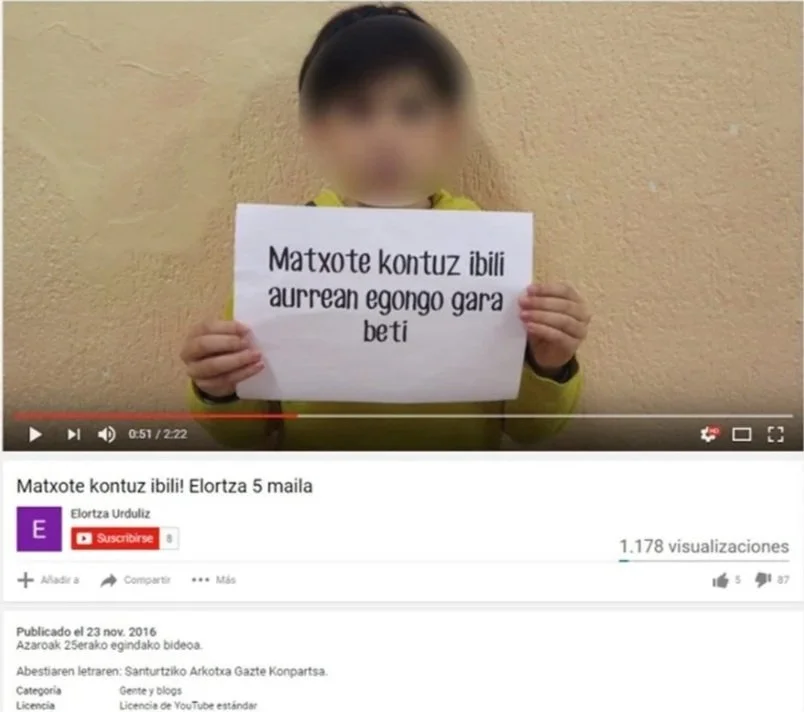
Picture 1: screenshot of a boy holding a sign that reads “Macho, be careful”, from a video uploaded by the school.
After documenting and downloading both videos, I reached out to the school management and the Parents’ Association (AMPA). I received no reply, but just hours later, all the videos had vanished from the internet, as if they had never existed. That reaction raised several questions: were the parents informed? Did the headteacher know what was happening? Was it organised by the teachers, the school’s social worker, or someone else?
“these initiatives exist because legislation provides the legal and financial framework to support them; without it, they would never have reached state schools.”
Follow the money
Elortza School in Urduliz (Spain) has received several awards for its innovative teaching model. The school describes itself as ‘plural, inclusive and co-educational’—with co-education understood here as an approach grounded in feminist principles that seek to deconstruct the patriarchy.”
The videos were recorded in this school setting in 2016 as part of a competition tied to the Beldur Barik (‘Without Fear’) campaign. Children for different schools were doing projects to signal commitment to end “violence against women”.
Promoted by Emakunde—the Basque Institute for Women—and funded with more than €80,000 from the Basque Government (data obtained by the communicator and analyst @JoseCB_Oficial), the initiative aims to encourage young people to adopt attitudes that prevent violence against women.” But the Beldur Barik campaign extends well beyond the Basque Country - it has international reach. In fact, it appears on the website of the Charter of Fundamental Rights of the European Union, described as a “comprehensive programme with activities aimed at engaging young people in the fight against gender-based violence”2—suggesting it may also receive EU funding.
The law “establishes harsher penalties for men for minor offences of intimate partner abuse—solely on the basis of being men—justified by the assumption of a patriarchal system that privileges men”.
The direct execution of the campaign was managed by the association Parean Elkartea, which describes itself as “deeply engaged in the feminist movement.” The association has overseen not only this campaign but at least 36 other projects, receiving hundreds of thousands of euros in public funding.
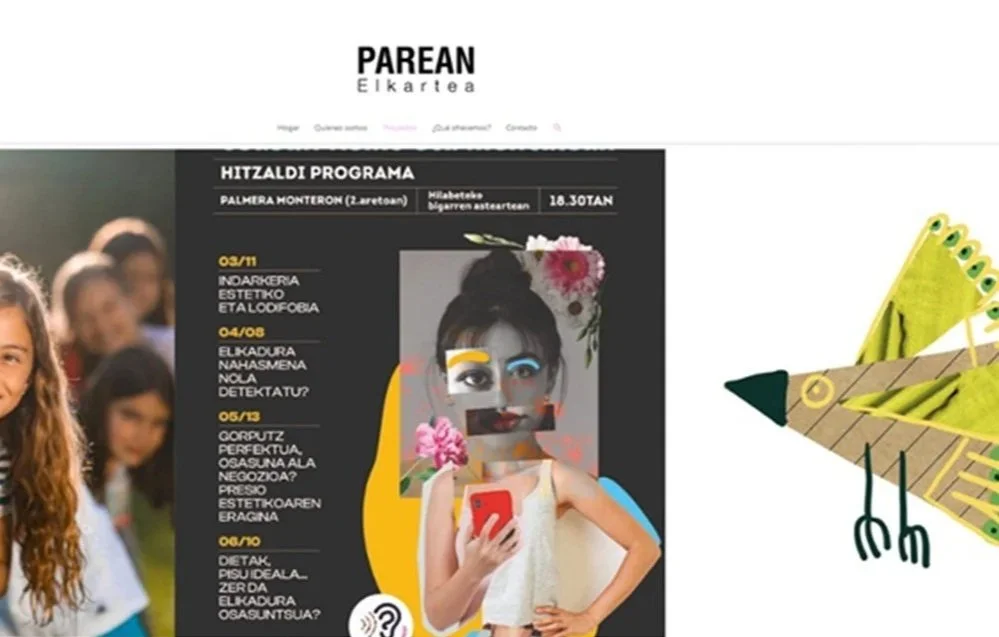
Picture 2: Projects section of the Parean Elkartea association website
Ultimately, these initiatives exist because legislation provides the legal and financial framework to support them; without it, they would never have reached state schools. It is therefore worth examining that framework more closely.
Legal framework
The competition and children’s videos fall under “educational prevention” as defined in Spain’s Organic Law 1/2004 on Comprehensive Protection Measures against Gender Violence.
Known as the LIVG or ley viogen, it draws on feminist legal theory and establishes harsher penalties for men for minor offences of intimate partner abuse—solely on the basis of being men—justified by the assumption of a patriarchal system that privileges men and disadvantages women.
Judges, lawyers and professionals from many fields have denounced the law’s ineffectiveness, its damage to families and couples, and its undermining of men’s presumption of innocence, as their crimes are automatically aggravated without any evidence. An interesting development is that since 2023, if a man legally changes his sex, the LIVG no longer applies.
Context
The melody of Matxote, kontuz ibili (“Macho, watch out”) was instantly recognizable because it was based on one of the big summer hits of 2016, Duele el corazón by Enrique Iglesias. The lyrics were rewritten and performed by Arkotxa Gazte Konpartsa, a youth group describing itself as “an independence-seeking, socialist and feminist youth collective from Santurtzi.”
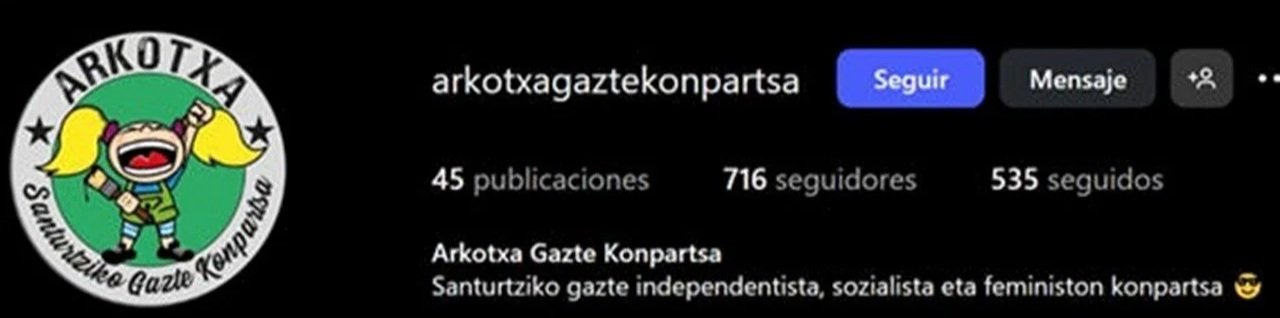
Picture 3: Instagram profile of Arkotxa Gazte Konpartsa, youth group responsible for editing the song and describing themselves as independentist, socialist, and feminist.
The song was played at local festivals and concerts by adults. Media celebrated it as a rhythm that “moves hips and consciences”.
“We dance Matxote kontuz ibili, which denounces sexist aggression and calls for feminist self-defence. Feminist self-defence goes beyond physical or psychological techniques (so-called self-defence); it is a political tool”.
The slogan “machete al machote” was presented as a “call to self-defence,” and praised for transforming lyrics in the original version that supposedly demeaned women, into feminist lyrics that ‘empowered women’. The document Thinking Together about Feminist Alternatives described the performance as follows: “We dance Matxote kontuz ibili, which denounces sexist aggression and calls for feminist self-defence. Feminist self-defence goes beyond physical or psychological techniques (so-called self-defence); it is a political tool that tackles violence at its root”. It was even labelled “the feminist song of the year”.
All this points to a strong political and social reaction of satisfaction—and even pride—at successfully turning a reggaeton hit into a feminist anthem that was later used on children.
Translated lyrics:
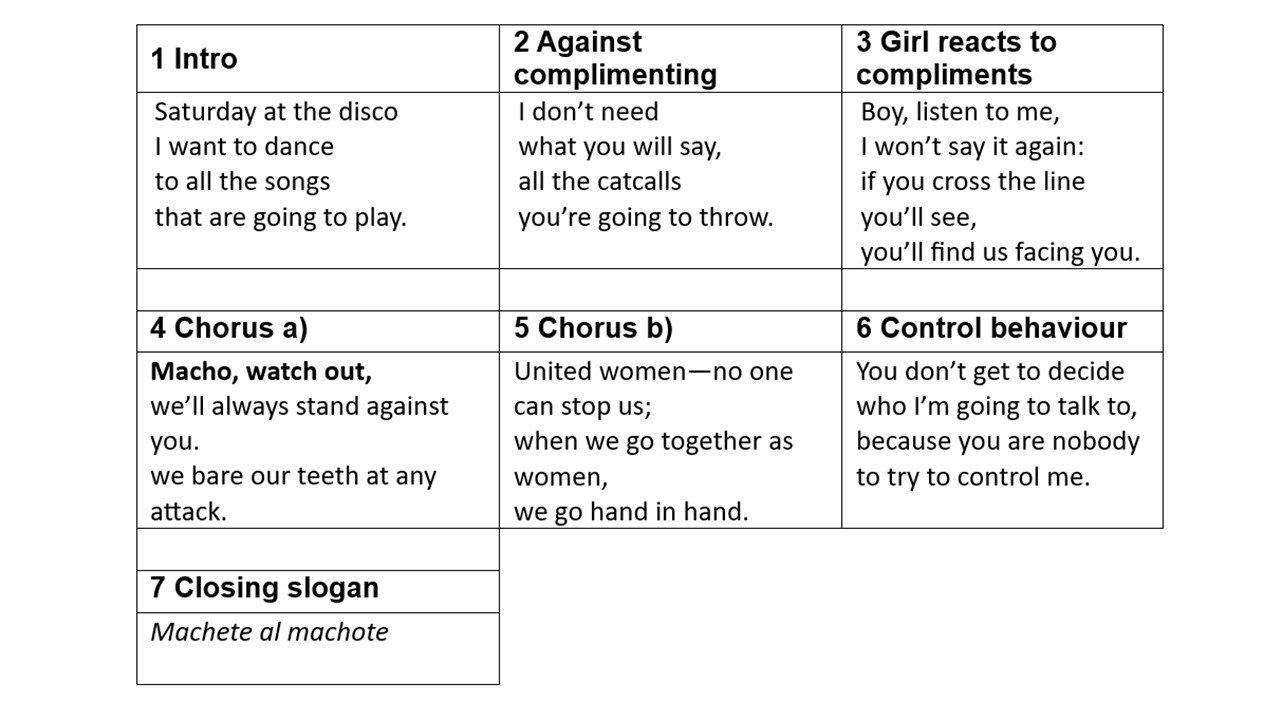
Picture 4: translated lyrics
Lyric analysis
Opening and compliments: festive atmosphere, joy of dancing, while underlining that girls don’t need compliments from boys.
Conflict begins: once the line is crossed—complimenting a girl— a boy wouldn’t face just one girl but all of them: “you will face us.” The conflict is collectivised.
Chorus and confrontation: the boy is cast as a machote (macho) and more aggressive imagery appears, like “showing teeth.” Then: “united women, no one can stop us”—an appeal to feminist sorority, the idea of women uniting against a common enemy: an “Us vs Them” tribalism.
Critique of controlling attitudes: it denounces the controlling behaviour of men telling women, ‘you don’t get to decide who I speak to.
Violent climax: “Machete al machote” closes the song as a final slogan, glorifying violence against machotes—not as an abstract category but as boys and men embodying a so-called toxic masculinity, or who commit “gender-based violence”—which could be something as minor as paying a compliment to a girl.
In Spain, the government claims that ‘gender-based violence’ affects one in every two women, a definition that can encompass “lewd looks that made her feel intimidated” or ‘sexual jokes’, “inappropriate sexually explicit emails, WhatsApp messages, or text messages that made her feel offended, humiliated, or intimidated“, and rape.
We can all agree that women and girls should be protected from harm, but it is more difficult to protect them from the subjective feeling of being harmed, offended, humiliated, or intimidated. We know that different people have different thresholds for being offended, which might vary depending on their mood and recent experiences, meaning that what is considered welcome in one situation might be extremely unwelcome in another. This ambivalence extends to compliments as well. When even a simple gesture of appreciation can be reinterpreted as aggression, the consequences for children’s development and relationships deserve careful consideration.
Potential psychological effects
Research published in 2023 by Dr John Barry, based on a sample of 4,000 men in Germany and the UK, found that associating masculinity with negative behaviours was significantly correlated with poorer mental health outcomes. These findings suggest that the systematic pathologisation of masculine traits may be detrimental to men’s psychological well-being. Extrapolating from this evidence in adults, one may hypothesise that similar dynamics could manifest in children, particularly given that they are in the process of identity formation and are especially susceptible to both peer influence and broader environmental pressures.
Possible effects on boys:
Deteriorated self-esteem: associating masculinity with aggression or dominance may lead boys to internalise a negative self-image.
Insecurity in relationships with the opposite sex: criminalising gestures such as giving a compliment creates uncertainty and pressure, making spontaneity in relations with girls more difficult, and even lead boys to abandon relationships with girls —fomenting both voluntary and involuntary celibacy.
Rebound effect: the few boys who display clumsy or inappropriate behaviour may feel excluded, which can generate frustration and resentment.
More difficult affective relationships: the above factors may contribute to a decline in the formation of couples and, in the long term, become a factor in the drop in birth rates.
Identity confusion: criminalising or devaluing what is masculine can encourage a defensive reaction of adopting alternative roles. For example, it could lead a boy to identify with transsexuality, a protected identity which is celebrated and considered worthy of admiration.
Reinforcement of gamma bias: it consolidates a distorted view of the sexes, where the male is seen as the perpetual aggressor and the female as the perpetual victim.
Possible effects on girls:
Difficulties in relating to the opposite sex: potential obstacles to establishing healthy affective and interpersonal relationships.
Encouragement of victimhood: compliments may be reframed as attacks under a political or ideological lens, reinforcing a sense of grievance.
Reinforcement of individualistic and narcissistic attitudes: with an emphasis on subjective interpretation of social situations and personal experience, which may in turn hinder the development of empathy toward others.
Misunderstanding and negative attitudes toward masculinity: including the stigmatisation or censorship of boys and male traits.
Promotion of tribalism and collectivisation of problems: difficulties may be externalised and addressed not individually but through reliance on the collective identity of girls or women, under the framework of sorority.
Reinforcement of social shaming and virtue signalling: potentially fostering a culture of cancellation and moral exhibitionism.
Reinforcement of gamma bias: consolidating the dichotomous view in which men are constructed as aggressors and women as victims.
These interventions “are planned actions framed by Spain’s Organic Law 1/2004 on Gender Violence. Examples of application include: banning football in schools as “patriarchal,” punishing boys by denying them break time on International Women’s Day, [and] rejecting celebrations of Father’s Day”.
Broader implications: what is link between compliments, machetes, macho men, and gender-based violence?
According to feminist theory, the personal is political. Everything is political. Children’s and teenagers’ relationships are just another battleground in the struggle for power between Men and Women. Compliments, far from being esteem-boosters, are cast as forms of control by which men occupy public and private space with their voices and intentions, limiting women’s freedom.
These educational interventions have political origins and aims. They are not grounded in science, lack measurable objectives, and rarely analyse either effectiveness or unintended consequences. In practice, they function as social experiments—conducted on minors unable to consent, often without informing parents.
These are not impulsive decisions by individual teachers. Rather, they are planned actions framed by Spain’s Organic Law 1/2004 on Gender Violence. Examples of application include:
banning football in schools as “patriarchal,”
punishing boys by denying them break time on International Women’s Day,
Such measures may appear incoherent, but they are consistent with the feminist legal theory underpinning the law: boys and men must lose spaces of power (such as playgrounds), while girls and women gain them, with feminist organisations channelling the funding to implement change.
At its core, Law 1/2004 and the interventions it enables are about combating “patriarchy.” Courses at Spain’s Judicial School explicitly teach judges feminist theory, framing violence against women as an expression of structural inequality. That same “patriarchal violence” is precisely what Machete al machote and its lyrics were designed to fight.
And yet, research on Spanish teenagers in schools and universities confirms a global trend: at young ages, boys report suffering more dating violence than girls—who are more often the perpetrators.
Taken together, these dynamics highlight a striking paradox: while the stated goal of such interventions is to reduce violence and inequality, the evidence suggests that they may, in practice, generate new forms of division and harm—especially among the very children they were supposed to help.
Ultimately, instead of treating compliments as offences, schools could encourage teenagers to reflect on them: boys learning to value themselves more and, as a result, to give compliments selectively and with meaning rather than indiscriminately; and girls exploring reciprocity—whether by acknowledging, returning, or even initiating compliments. Such reflections would foster respect, confidence, and healthy relationships between boys and girls, rather than hostility and suspicion.
Scroll down to join the discussion
Disclaimer: This article is for information purposes only and is not a substitute for therapy, legal advice, or other professional opinion. Never disregard such advice because of this article or anything else you have read from the Centre for Male Psychology. The views expressed here do not necessarily reflect those of, or are endorsed by, The Centre for Male Psychology, and we cannot be held responsible for these views. Read our full disclaimer here.
Like our articles?
Click here to subscribe to our FREE newsletter and be first
to hear about news, events, and publications.




















Have you got something to say?
Check out our submissions page to find out how to write for us.

















.