
Misinformation Among Experts in Psychology and Law
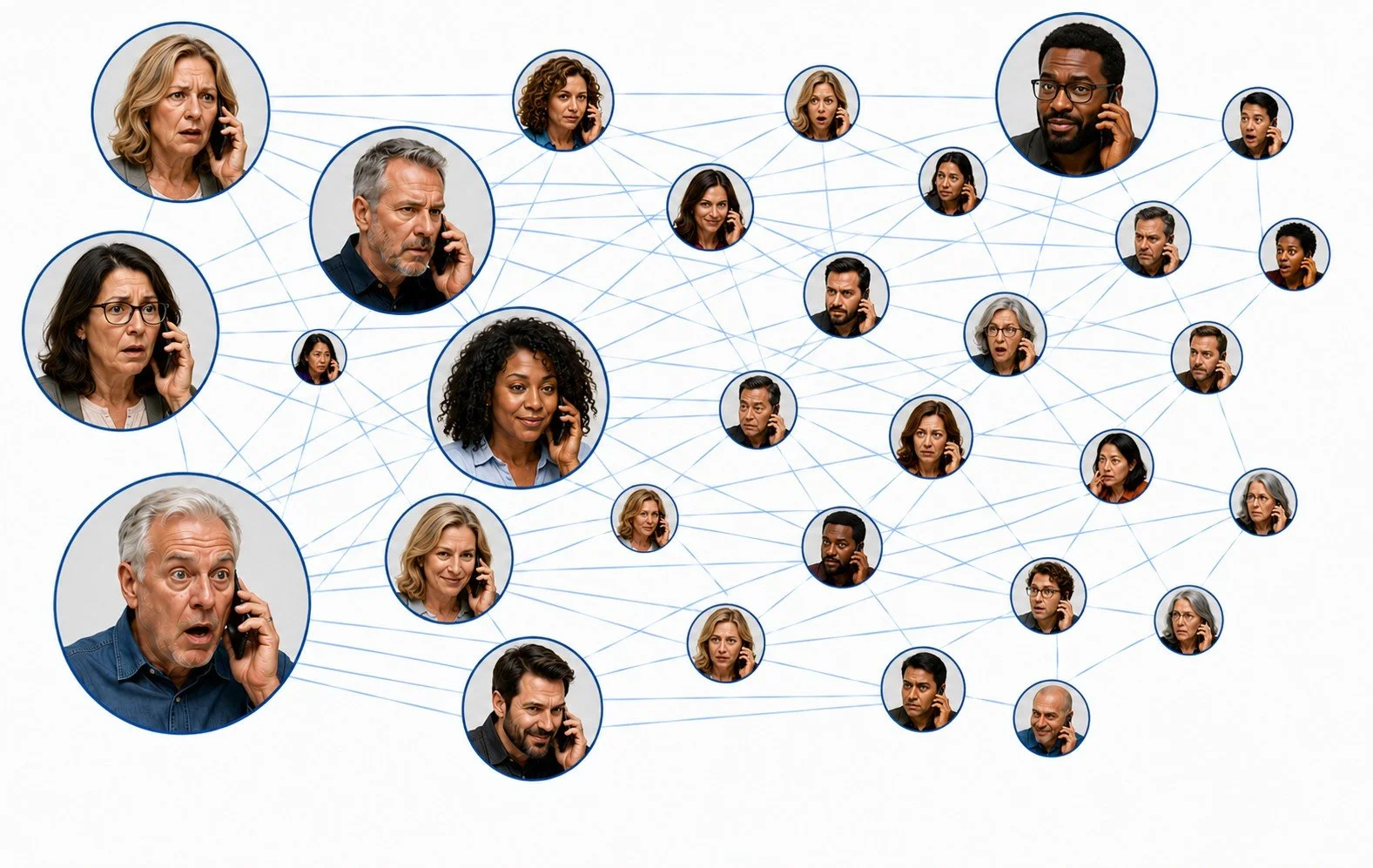
Image: A Web of Misinformation. Created using AI image generation (ChatGPT) with prompts, by John Barry
Several years ago, Dictionary.com chose “misinformation” to be the Word of the Year. Other recent selections were “pandemic,” “allyship,” and “hallucinate.” Many current examples of misinformation come from the hard sciences (“Climate change is a hoax.”), controversial topics in medicine (“Vaccines cause autism.”), and politics (“XYZ won the 2024 election by a landslide.”) As an indicator of the importance of this topic, the Harvard Kennedy School of Government introduced a professional journal, Misinformation Review; recent articles featured COVID-19, conspiracy theories, and artificial intelligence. Many writers predict that generative AI will launch to new heights the frequency of misinformation.
In journals and newsletters regarding psychology and psychiatry, misinformation appears with some regularity. When it occurs in these publications, false information is frequently related to controversial methods for the treatment of mental disorders. For example, facilitated communication is a bogus intervention for nonverbal children, in which a therapist directly guides a child’s hands to spell out words and phrases. An intervention called “holding therapy” was suggested for children with severe attachment disorders, but it reportedly resulted in several deaths when poorly implemented. Pseudoscience in Child and Adolescent Psychotherapy (Hupp, 2019) describes dozens of published treatments that are ineffective and perhaps dangerous, such as: chiropractic manipulations for motor and verbal tics, past life regression for obsessive compulsive disorder, and psychoanalysis for bedwetting.
Parental Alienation
Parental alienation (PA), a term in both child psychology and family law, has generated an unusual amount of misinformation. What is PA? PA is a disturbing phenomenon that sometimes occurs when parents are embroiled in high-conflict separation or divorce. The child—who is caught in the crossfire of parental warfare—gets out of the danger zone by gravitating to the side of one parent and rejecting or avoiding a relationship with the other parent. Typically, the favored or alienating parent has influenced the child over a period of time to fear or despise the rejected or alienated parent. In legal settings, such as child custody disputes, alienation is a term of art that refers to a child’s rejection of a parent without a good reason; and estrangement refers to a child’s justified rejection of a parent for a good reason, due to a history of abuse, neglect, or simply very poor parenting skills (Parental Alienation Study Group, 2025).
A child might reject or avoid a relationship with a parent for various reasons, even though they previously had a satisfying, mutually enjoyable relationship. For example, a child with separation anxiety disorder might be so fearful of leaving the favored parent that they refuse opportunities to spend time with the rejected parent. A child with autism spectrum disorder might find it difficult and distressing to transfer from one household to another. Thus, PA is only one of several possible explanations for a child’s contact refusal. Also, many children are exposed to alienating behaviors by Parent A, but never become alienated from Parent B.
“Professional discussions regarding PA are unusual because they have evolved to a level of polarization in which both sides accuse the other of promoting misinformation and even publishing pseudoscientific journal articles and book chapters.”
In child custody disputes that reach a legal hearing or trial, however, the most common debate is whether the child’s contact refusal is a result of alienation or estrangement. That is, Parent A says it is obvious that the child avoids Parent B because of a history of child maltreatment by the now-rejected parent. On the other hand, Parent B claims the child refuses to spend time with them because of persistent brainwashing or indoctrination by Parent A. It is considered a highly malicious activity for Parent A to methodically undermine the child’s loving relationship with Parent B. Every day, mental health professionals who conduct child custody evaluations, guardians ad litem, and judges must sort out whether a particular case of contact refusal is a result of alienation or estrangement.
Polarization Among Professionals
Professional discussions regarding PA are unusual because they have evolved to a level of polarization in which both sides accuse the other of promoting misinformation and even publishing pseudoscientific journal articles and book chapters. The two sides may be referred to as PA-proponents and domestic violence or DV-proponents. In the territory of most extreme opinions, DV-proponents say the great majority or perhaps all cases of contact refusal are caused by obvious maltreatment by the rejected parent; in the same territory, extreme PA-proponents say alienation should always be considered first before all the other possible causes of contact refusal. Of course, all extremist opinions are incorrect, and most mental health and legal experts agree that some cases of contact refusal are caused by alienation, some are caused by estrangement, and some are caused by a combination of both factors and perhaps other circumstances in the family.
Blatant Misinformation
Scholarship regarding PA theory is plagued by recurrent blatant and subtle misinformation. Some of the blatant misinformation is ludicrous but may be taken seriously by DV-proponents and psychology graduate students who are new to this field of study. For example, anti-PA extremists frequently promote the ad hominem argument that Richard Gardner (1985) was an advocate of pedophilia and that he invented PA simply as a legal strategy to protect fathers who sexually abuse their children. Also, critics say that testimony regarding PA is unacceptable in court because PA is not scientific enough—even though the topic of PA has been accepted more than 1,000 times in trial and appellate courts in the U.S. Finally, critics claim that PA theory has not been endorsed by any professional organization in the U.S.—even though the American Psychological Association, the American Academy of Child and Adolescent Psychiatry, the American Academy of Pediatrics, and the Association of Family and Conciliation Courts have published practice guidelines that recognize the reality and importance of PA theory.
Subtle Misinformation
Subtle or ambiguous misinformation regarding PA theory is dangerous because it may mistakenly be included in expert opinions in legal proceedings and wrongly influence courts’ ultimate decisions. A good example of subtle misinformation is a statement such as the following:
PA theory assumes that the favored parent has caused PA in the child simply because the child refuses to have a relationship with the rejected parent, without identifying or proving alienating behaviors by the favored parent.
That is a false statement because no PA-proponent has written in a journal article or a book chapter that all children who manifest contact refusal do so because they were influenced by the favored parent. And no PA-proponent has written in an article or chapter that an evaluator can diagnose PA without identifying alienating behaviors by the favored parent. Hundreds of peer-reviewed journal articles and almost 200 books have been published regarding PA theory; none of those publications by PA-proponents contains that example of misinformation.
“These publications with false information can be located by starting with a known example of pertinent misinformation and examining the references that were cited in that publication; and also searching for subsequent publications that cited the known example of misinformation.”
That particular example of PA misinformation or a close version of it has been found in more than 100 journal articles, book chapters, presentations, and legal documents written by PA-critics—originating with a student’s law review article in 1994 and continuing to the present time. These publications with false information can be located by starting with a known example of pertinent misinformation and examining the references that were cited in that publication; and also searching for subsequent publications that cited the known example of misinformation.
A Scholarly Echo Chamber
Citation analysis is a form of bibliometric research used by research librarians and other scholars to track the flow of information from one author to another over many years or decades of published material. For example, Bernet and Xu (2023) used citation analysis to vividly demonstrate the relationships among the 94 publications that repeated the same misinformation regarding PA theory, i.e., that we assume that any child who manifests contact refusal was influenced to do so by an alienating parent.
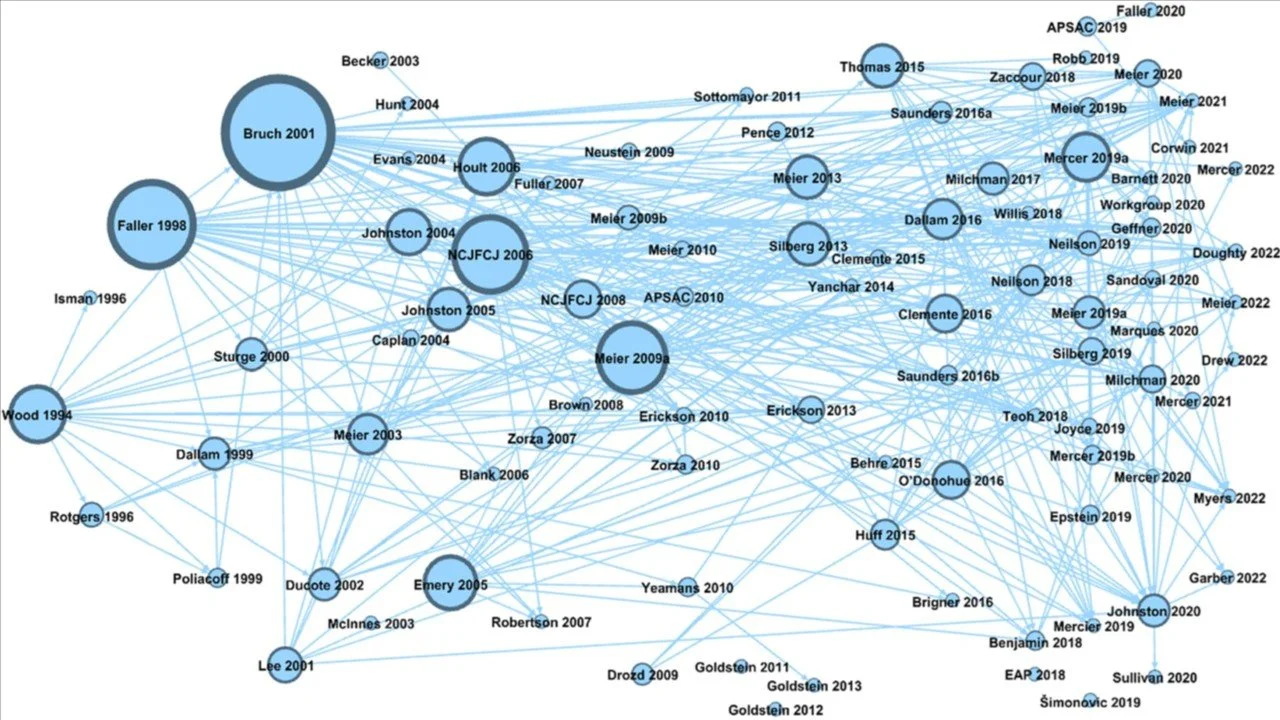
Figure 1. Citation analysis of misinformation in 94 journal articles, book chapters, presentations, and legal documents by critics of parental alienation theory. The node size indicates the number of documents that subsequently relied on each citation. Reprinted from Behavioral Sciences and the Law; used with permission of Parental Alienation Study Group.
In Figure 1, the 94 publications with the same misinformation are indicated by circles, the size of each one representing the influence of that particular publication in propagating the false information. The circles are arranged chronologically, from 1994 on the left to 2022 on the right side of the graph. Connecting lines show the flow of information from each publication to subsequent publications. This proliferation of false information is dramatic, in that a single law review article led to more than 90 journal articles and book chapters with the same error.
“We propose that PA-proponents and DV-proponents participate in a process of ‘adversarial collaboration’ [where] writers and researchers with conflicting opinions should try to work together in conducting research and writing articles, with the goal of resolving disagreements”.
What are the factors—among the authors themselves and also in the broader scope of scientific publishing—that have driven this epidemic of misinformation? There are several reasons for this worrisome phenomenon. (1) In this research, false information was not randomly distributed through mental health and family law literature. Instead, a relatively small group of writers and journals were responsible for the majority of this epidemic of misinformation. This is called a scholarly echo chamber, a well-known phenomenon in articles regarding misinformation. That is, writers who collaborate in publishing articles tend to quote each other in future articles and chapters. While this process broadcasts and propagates both factual information and false information, it becomes problematic when a clique of writers cite each other and reinforce misunderstandings and errors. (2) Although we do not know the precise mindset of PA-critics, they may have preconceived unfavorable opinions about this topic. When writing about children of divorced parents, they tend prematurely to put a negative spin on some aspects of PA theory. (3) The recurrent misinformation described in this article—that PA proponents routinely assume that all children who manifest contact refusal are victims of indoctrination by the favored parent—appears to result from sloppy research and lackadaisical writing. That is, reliance on secondary and tertiary sources, which contain the same misinformation, rather than seeking out authoritative articles and chapters by legitimate PA-proponents.
Searching for Basic Truth
The polarization among mental health and legal professionals regarding this aspect of child psychology is counterproductive, dangerous, and disappointing. For example, it is hard to conduct and publish research regarding clinical and legal perspectives of PA theory if there are fundamental disagreements about definitions and other basic principles of this topic. We hope that PA-proponents and DV-proponents will come together and search for common ground, rather than continue to misquote and misrepresent each other. We realize that PA-proponents are not perfect in their writings and court testimony. Warshak (2019) wrote how false positive identifications of PA may occur, i.e., concluding that PA exists in cases where it really does not. He commented that “mistaken conclusions fuel concerns about the application of parental alienation in family law cases and contribute to skepticism about the concept” (p. 54).
We propose that PA-proponents and DV-proponents participate in a process of “adversarial collaboration” as a way to reduce the polarization and ultimately the amount of misinformation in scholarly literature. Adversarial collaboration was described and encouraged by Daniel Kahneman, saying that writers and researchers with conflicting opinions should try to work together in conducting research and writing articles, with the goal of resolving disagreements and creating a united front. Kahneman’s approach seems particularly suitable for understanding PA theory, an important feature of contemporary child psychology and family law. For the sake of the children and families, many believe this kind of collaboration is badly needed. Less finger-pointing, more fact-finding—that’s the goal.
Acknowledgments
Richard A. Warshak, Ph.D., and Shenmeng Xu, Ph.D., offered valuable feedback on a draft of this article.
References
Bernet, W., & Xu, S. (2023). Scholarly rumors: Citation analysis of vast misinformation regarding parental alienation theory. Behavioral Sciences & the Law 41(5): 231–245.
Gardner, R. A. (1985). Recent trends in divorce and custody litigation. Academy Forum 29(2): 3–7.
Hupp, S. (Ed.) (2019). Pseudoscience in Child and Adolescent Psychotherapy: A Skeptical Field Guide. Cambridge, U.K.: Cambridge University Press.
Parental Alienation Study Group (2025). Parental Alienation Theory: Official Synopsis. Springfield, IL: Charles C Thomas.
Warshak, R. A. (2019). When evaluators get it wrong: False positive IDs and parental alienation.Psychology, Public Policy, and Law 26(1): 54–68.
Scroll down to the comments section to join the conversatoin
Disclaimer: This article is for information purposes only and is not a substitute for therapy, legal advice, or other professional opinion. Never disregard such advice because of this article or anything else you have read from the Centre for Male Psychology. The views expressed here do not necessarily reflect those of, or are endorsed by, The Centre for Male Psychology, and we cannot be held responsible for these views. Read our full disclaimer here.
Like our articles?
Click here to subscribe to our FREE newsletter and be first
to hear about news, events, and publications.






















Have you got something to say?
Check out our submissions page to find out how to write for us.















.