

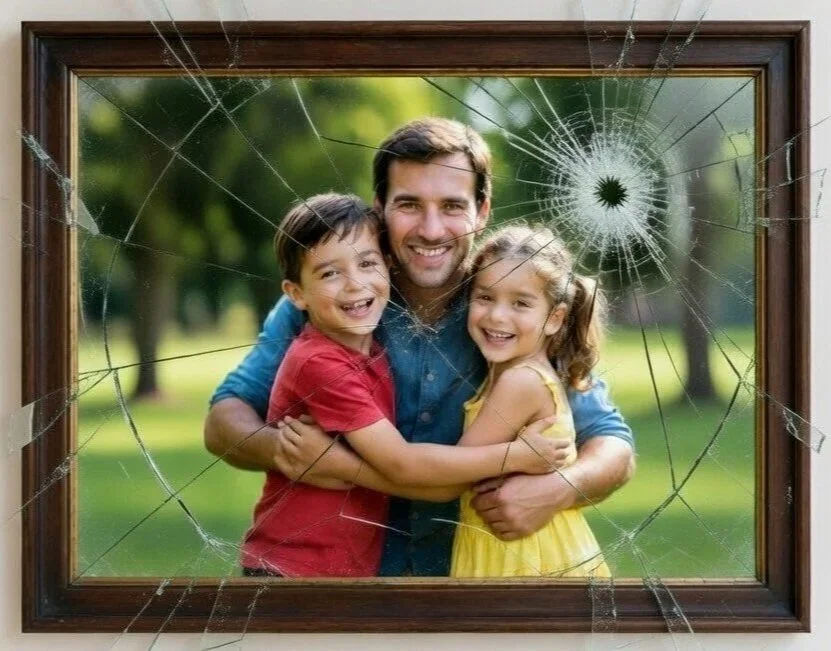
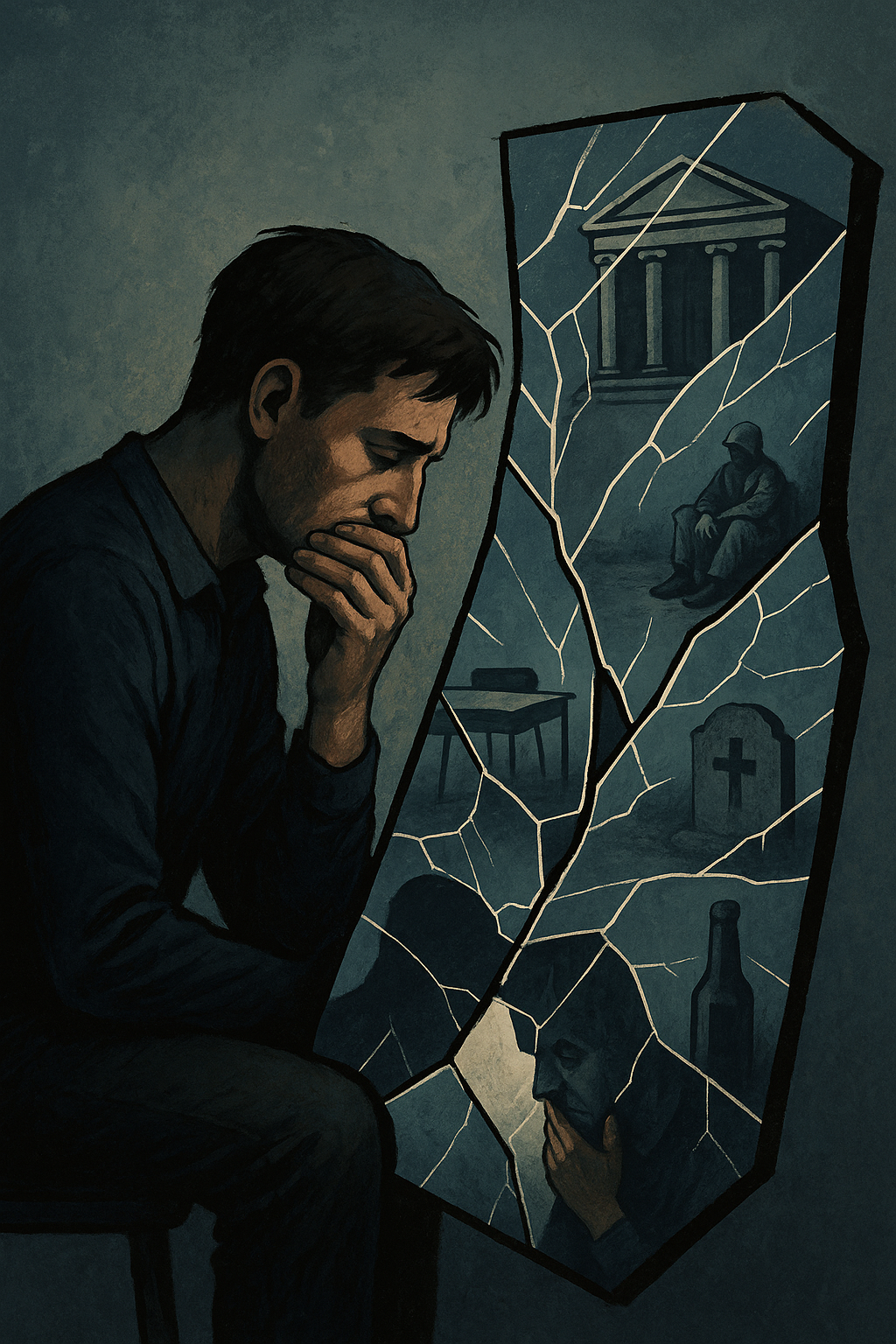
Image: ‘Lives shattered by repeal of the Presumption of Parental Involvement Act. Original concept by John Barry, created using AI image generation (Grok).
This article is the evidence submission of Zac Fine to the UK government’s inquiry regarding the proposed repeal of the Presumption of Parental Involvement within the Children Act.
Summary
My evidence argues that repealing the Presumption of Parental Involvement in the Children Act 1989 risks serious harm to children and fathers. Clinical experience shows parental alienation, ruptured attachments, and PRAS are widespread. The Presumption supports child welfare, balanced judicial reasoning, and meaningful parent-child relationships, which the repeal undermines.
Introduction
I am submitting evidence regarding clause 17 in The Courts and Tribunals Bill, namely the repeal of the Presumption of Parental Involvement within the Children Act 1989. I submit this evidence as a business (Zac Fine Therapy) and give permission for publication. Since 2020 I have worked as a BACP-accredited counsellor, psychotherapist and group facilitator with fathers in high conflict family separation where domestic abuse and violence is a concern. I've worked as clinical supervisor since 2025 and in 2026 I started working as domestic violence risk assessor in public law cases about child custody.
Psychological Impact of Ruptured Bonds
"The breaking of a love bond... through enforced and unwanted ruptures that cannot be controlled, reversed, or eased through personal effort is one of the greatest sources of strain upon the human heart and psyche."
Martin Seager, 2024
There is a very small base rate of children who should be prevented from having a relationship with a parent because they are abusive or neglectful. About one in 250 children in England (0.4%) were the subject of child protection plans in March 2025 (UK Government, 2025), a total of 49,420 children. In these cases children need the authorities to intervene on their behalf in good time and the Children Act 1989 enables this.
That said, a large number of children are harmed each year by losing key attachments, and where this is preventable I believe the legislature and Family Court should work on behalf of children to minimise harm where possible.
In the year to March 2025, Cafcass statistics show there were 39,182 new private law children’s cases concerning arrangements for children in England and Wales — this is the category that includes disputes about where a child lives and contact with a parent.
There are 13.5 million children in England and Wales (ONS 2024). Based on a calculation of 1.95 children per family (ONS 2023), this means a total of 76,404 children in England and Wales are involved in private family law cases per year, a rate of 0.56%.
Challenges in Family Court
Unfortunately the reality of private family law proceedings in England and Wales in my professional experience is that if a mother decides to prevent her children from seeing their father, there is little the court can do. Based on my clinical experience, false allegations may be strategically used, and if these are proven untrue there is no punishment. There are no fines or imprisonment for mothers breaching court orders. This is not to say that there are not cases where mothers are victims, only that many allegations of abusive behaviour and unsafe parenting are questionable and many are made cynically as tactical or strategic plays in an adversarial system. Any family law professional will attest to this off the record.
Evidence from Kentucky
A useful illustration comes from the US. After Kentucky House Bill 528 introduced a rebuttable presumption of 50:50 parenting time, court-linked domestic-violence filings declined. Analysis of Kentucky family-court data shows that domestic-violence claims filed alongside custody cases fell about 80% between 2010–2024, and the annual decline accelerated from 5% per year before the reform to 16% per year afterward. This evidence is cited by commentators arguing that removing the 'winner-takes-all' custody incentive reduces strategic or conflict-driven abuse allegations.
Supporting Non-Resident Parents
My clients require resilience, grit and determination to remain in the fight for their children's wellbeing after contact has been refused. This is the work I support them with, often for years at a time, as well as in identifying and addressing any abusive behaviours on their part that has caused harm to their children and ex-partner. I help them understand their own unhealthy patterns in relationships, realise where it comes from (often their own early trauma and difficult attachments growing up), take responsibility for the mess, and do what they can to improve the situation by being respectful and cooperating with the court and their ex-partner.
An interested and loving parent only has to be 'good enough' to be an extremely valuable asset in a child's healthy development. They should only be removed from the child’s life where there is unacceptable risk of harm. However, the proposed repeal of the Presumption of Parental Involvement offers no improvement to child protection because the Presumption is rebuttable, and does not apply at all if there is any risk of harm to the child.
Critique Of Proposed Repeal
One can only conclude therefore that the repeal is not intended to improve the protection of children. Indeed the government's press release confirms this: "While the current law contains safeguards that allow involvement to be restricted where it harms a child’s welfare, repealing this provision and legislating through the Courts and Tribunal Bill sends a clear message that the Government is putting children’s welfare and safety first.
This is politicising an essential and hard won principle in children's rights that represents basic family values and human decency — the Presumption is the only statutory provision enshrining a child’s right to a relationship with both parents, where safe. It is an important starting point for balanced judicial reasoning and parental expectations.
I view the proposed repeal as an attack on traditional family values and fatherhood, because the overwhelming majority of victims of this Bill, apart from the children, will be fathers. At least nine out of ten non‑resident parents are fathers because family courts and societal norms usually assign residence to the mother after relationship breakdown.
Judicial Recognition of Procedural Harm
There is longstanding acknowledgment by senior judges that much of the time these ruptured attachments — extraordinarily painful for fathers but developmentally devastating for children — are caused by procedural problems rather than child safety motives.
Sir Andrew McFarlane, a senior British judge who has served as President of the Family Division of the High Court of England and Wales since 2018, has said:
On lack of feedback: Judges decide cases “like someone throwing darts over his shoulder… without sight of the dartboard,” meaning courts rarely learn what happens to families afterward.
On delay: He has repeatedly warned that delay in family proceedings harms children, stressing that justice delayed can permanently damage family relationships.
On transparency: McFarlane has argued the system must become more open to public scrutiny to maintain trust, while still protecting children’s privacy.
Reform Over Repeal
Reform is desperately overdue, and this 2022 paper by the Family Law Reform Coalition which I contributed to, sets out carefully thought through, child-centric reforms. The Repeal goes in the opposite direction. It can only intensify the problems described by McFarlane and scale up the avoidable harm being done to tens of thousands of children per year. The consequences to children and parents would be disastrous, because there is no real punishment for abuse of legal process by parents in family court, while the emotionally driven incentives of revenge and control — even when that harms one's own children — can be powerful.
Parental Alienation
Professor Ben Hine et al (2025) conducted a survey of over 1,000 separated parents to see how common parental alienating behaviours (PABs) are and how they impact families. About 39.2% of people said they had experienced PABs, and when measured using specific examples of behaviours, almost 60% (59.1%) seemed to have faced PABs. This difference shows that PABs can be hard to identify, but they are widespread.
The survey also found that those affected by PABs show greater signs of serious mental stress, like PTSD symptoms, depression and suicidal thoughts. To my knowledge the family courts in England and Wales are only beginning to understand the public health crisis of parental alienation, yet the Repeal would magnify the harm it causes.
For context (from Professor Ben Hine interview with me, also referenced in this paper):
· About 55,000 couples separate per year in the UK with a child under 16
· 40% of fathers have suicidal thoughts within 12 months of family separation, 11 times higher than mothers
· That equates to 22,000 men
· 35-40% of separations have parental alienation behaviours
· That equates to at least 19,250 child victims per year
Prolonged Ruptured Attachment (PRAS)
The pain of a ruptured love bond is made far worse when the rupture is indeterminate and open ended, and when the individual has no control over it. I explored this in a 2024 paper called Prolonged ruptured attachment syndrome (PRAS) – A fate worse than trauma or grief. The concept needs large scale research but it fits with my clinical experience and that of my co-authors Martin Seager (Consultant Clinical Psychologist) and Valerie Sinason (Child Psychoanalyst).
The defining characteristics of PRAS reflect its pervasive impact on mental health. These features encompass a range of psychological and emotional responses that arise from unresolved and indeterminate ruptures in attachment. PRAS might be said to contain every single core mental health symptom in one syndrome:
1. Aspects of loss, mourning and grief but without closure or resolution
2. Aspects of trauma through emotional damage that may have elements of perpetration and
victimhood if involving deliberate separation or alienation
3. Lack of control, helplessness, depression, low mood
4. Fear and anxiety arising from uncertainty, risk of loss and powerlessness over the future
5. Stress arising from constant conflict, constant reminders, anxiety, or despair
Surviving Family Separation
My clinical work with separated fathers centres around staying sober, keeping working, keeping up social connections, keeping physically fit — all with the aim of remaining alive while experiencing the harrowing symptoms listed above in order for their children to one day realise, hopefully, that they do still have a loving and interested father.
The proposed repeal of the Presumption of Parental Involvement likely increases the risk of PRAS. In many cases it could be a crushing blow to separated parents' will to fight for their children's wellbeing in the event of contact being refused by the other parent. It is hard enough now — too hard for many, who resort to suicide.
In Volume II: Separation (1973), John Bowlby described typical child responses to prolonged absence of an attachment figure:
Protest – distress, crying, searching
Despair – withdrawal and sadness
Detachment – emotional distancing or defensive independence
These patterns were observed particularly in long separations from a parent with whom the child already had a bond. Bowlby argued that repeated or prolonged ruptures can influence a child’s ‘internal working models’ of relationships — expectations about whether others are reliable, responsive, and safe. Consequences may include:
· insecurity in relationships
· mistrust of caregivers
· difficulty regulating emotions
· defensive self-reliance
Long Term Effects On Children
These consequences fit recent research into Adverse Childhood Experiences (ACEs), where individuals reporting four or more ACEs show markedly higher risks of depression, poorer mental wellbeing, and a range of adverse life outcomes in adulthood (Bellis et al., 2015; Hughes et al., 2017).
Parental separation often co-occurs with other ACEs, including parental depression, substance misuse, economic hardship, frequent house or school moves, inter-parental conflict, and emotional neglect.
Additional ACE-related risks commonly seen alongside father absence include:
· Household mental illness
· Domestic conflict or violence
· Economic instability/poverty
· Reduced parental supervision
· Emotional neglect or inconsistent caregiving
There are also well known links between fatherlessness and incarceration — covered in detail in this article written by myself, Martin Seager and Valerie Sinason, which finds that a lack of fathering, not the reverse, is behind much crime and punishment: The male experience of Prolonged Ruptured Attachment Syndrome (PRAS) in prison life.
Bowlby acknowledged that fathers can play distinct developmental roles (eg exploration, confidence, social learning). Two other thought leaders in psychology said:
"It is hardly possible to begin to describe the ways in which a father enriches the life of his children, so wide are the possibilities."
DW Winnecot, The Child, The Family And The Outside World 1964: 116
"I cannot think of any need in childhood as strong as the need for a father’s protection." Attributed to Sigmund Freud
Conclusion
The Presumption is an important signal and benchmark that a non-resident parent is an equally valuable parental figure, not an optional extra. Repeal of the Presumption will likely increase conflict, delay and uncertainty and result in more children unfairly losing meaningful relationships with a parent, even when no risk exists — making the UK an outlier on shared parenting. It would probably trap many more thousands of fathers per year in a state of powerless despair leading to suicidal thoughts and actions.
Repeal will do nothing to deal with genuine issues of abuse (the stated reason for the need for repeal) with safeguarding issues having been caused instead by poor risk assessment and systemic failure. As such the repeal of the Presumption in my professional judgement is not child-centric. Furthermore it risks causing avoidable harm to children by enabling and legitimising the prolonged ruptured attachment of children from one of their parents.
Scroll down to join the discussion
Disclaimer: This article is for information purposes only and is not a substitute for therapy, legal advice, or other professional opinion. Never disregard such advice because of this article or anything else you have read from the Centre for Male Psychology. The views expressed here do not necessarily reflect those of, or are endorsed by, The Centre for Male Psychology, and we cannot be held responsible for these views. Read our full disclaimer here.
Like our articles?
Click here to subscribe to our FREE newsletter and be first
to hear about news, events, and publications.






















Have you got something to say?
Check out our submissions page to find out how to write for us.















.

people are more aware of the fact men can be victims of this type of violence, but this often isn’t translated into policy, practice or indeed provision of resources