

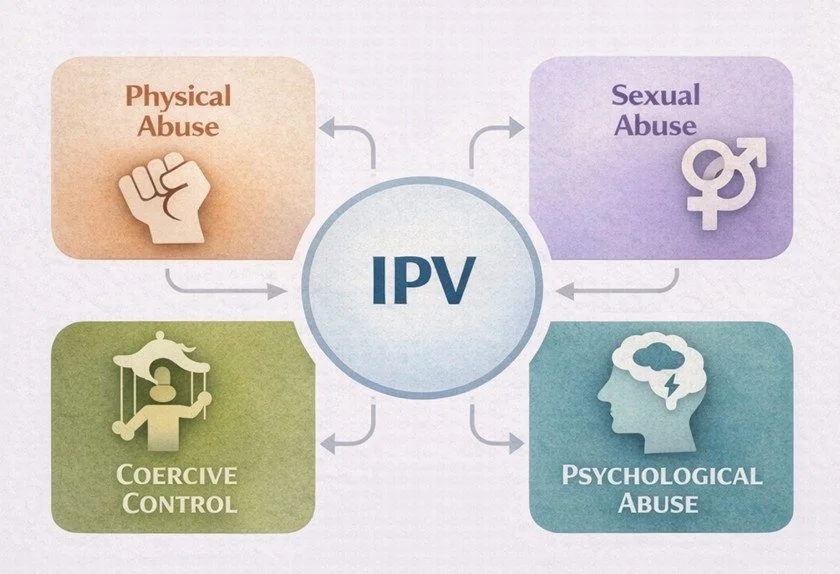
Intimate Partner Violence (IPV) is recognised as a significant social and public health issue, associated with adverse physical and mental health outcomes, including self-harm and suicidality, and affecting approximately one-fifth of the population across their lifetime (McManus et al., 2022). Despite its apparent simplicity, IPV encompasses a wide range of behaviours, including physical aggression, sexual coercion, psychological abuse, and controlling behaviours within intimate relationships (McManus et al., 2022).
Why Theory Choice Matters in IPV
During the 1970s, research across multiple disciplines gave rise to competing theoretical frameworks and measurement approaches, resulting in divergent explanations of IPV (Follingstad & Rogers, 2013; Woodin et al., 2013). These differences have important implications for policy, intervention programmes, and legal frameworks. This article traces the historical development of IPV research, examining how these frameworks emerged and shaped contemporary institutional responses.
Early Empirical Origins of IPV Research
Research on IPV emerged from studying family conflict and marital breakdown during the 1970s. Prior to this, violence within relationships was rarely examined and was treated as a private matter. John E. O’Brien (1971) examined relationship dynamics among couples experiencing severe conflict who were attending a family counselling centre.
Physical aggression appeared as one element within broader patterns of escalating disputes. Aggression was associated with communication breakdown, emotional distress, and relationship instability. Findings also suggested that intergenerational patterns of relational behaviour may contribute to the emergence of partner violence.
Nevertheless, early research was based on samples drawn from counselling services or divorce proceedings and relied heavily on retrospective self-report accounts, raising concerns about recall bias, selective reporting, and difficulty of verifying events (Follingstad & Rogers, 2013). Research developed across several overlapping disciplines, including family sociology, counselling psychology, and criminology (Woodin et al., 2013).
As academic attention expanded, researchers increasingly recognised the need for clearer definitions and more reliable measurement strategies. Disagreements emerged regarding which behaviours should be included and how different forms of aggression — physical, psychological, or coercive — should be categorised.
The Refuge Movement: Practice Before Ideology
Alongside academic research in the 1970s, practical responses to IPV developed outside universities, most notably the establishment of domestic violence refuges. In 1971, Erin Pizzey founded a shelter for women and children in Chiswick, London, in response to the absence of formal support services. The refuge model expanded rapidly, contributing to the formation of the Women’s Aid Federation and the wider institutional recognition of domestic violence as a social policy issue.
Pizzey’s later writings introduced claims that some violent relationships involved patterns of mutual aggression rather than exclusively one-sided abuse (Pizzey, 1982). Critics rejected this interpretation, arguing that it obscured the role of gendered power structures, a position later formalised in critiques of the “sexual symmetry” thesis (R. P. Dobash et al., 1992). These disagreements reflected emerging theoretical tensions within IPV research.
Academic Uptake and Divergence
During the late 1970s and 1980s, IPV research shifted from small clinical samples toward large-scale population studies, particularly through the work of Murray Straus and colleagues. The development of the Conflict Tactics Scale (CTS) enabled systematic measurement of conflict behaviours within relationships and was widely used in national surveys (Straus, 1979). Findings suggested that partner violence was more prevalent and widespread than previously assumed, leading to its interpretation as part of a broader pattern of family conflict (Straus et al., 2006).
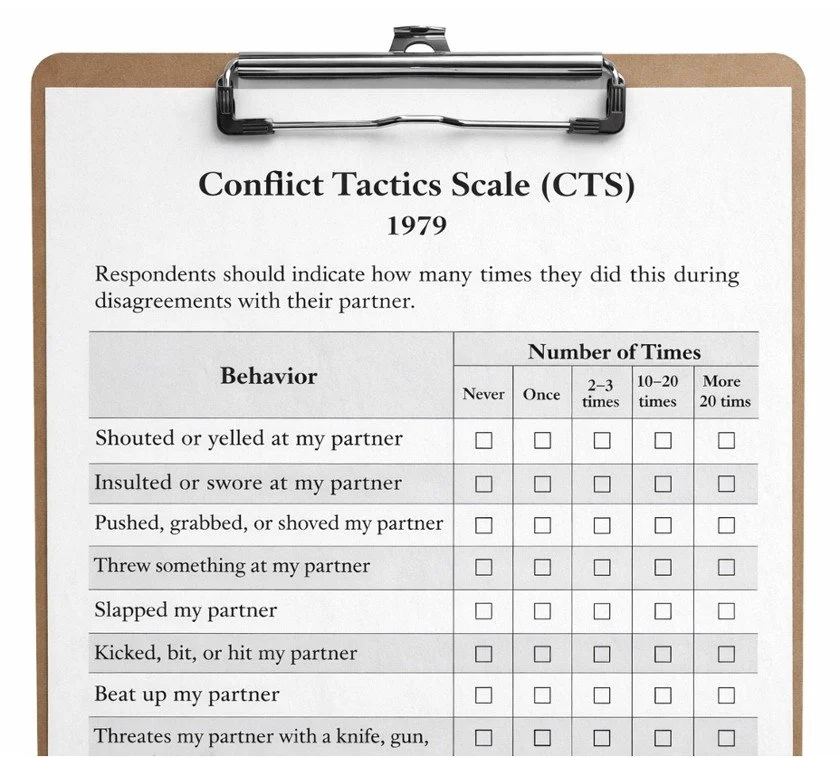
Image: Conflict Tactics Scale (CTS) items, created by Murray Straus (1979).
For example, early CTS-based surveys reported comparable rates of self-reported aggression among men and women, contributing to debates regarding "gender symmetry" in IPV. At the same time, alternative perspectives emerged within sociology, criminology, and feminist scholarship, emphasising structural explanations, particularly gender inequality and power dynamics (Woodin et al., 2013). These competing approaches — conflict-based and gendered — produced divergent explanations of IPV and became central to subsequent academic and policy debates (R. E. Dobash & Dobash, 1992).
The Major IPV Frameworks
As IPV research expanded, three broad frameworks emerged to explain the causes and dynamics of partner violence: (1) family conflict models, (2) feminist power-control approaches, and (3) typological models. These differ in their explanations of IPV, the behaviours they prioritise, and their implications for measurement and policy.
(1) Family Conflict / Situational Couple Violence
The family conflict tradition, associated with Straus and colleagues, conceptualises violence as one possible outcome of escalating conflict within relationships and examines it using behavioural measures such as the Conflict Tactics Scale (Straus, 1979). Findings from this approach suggest that aggression can occur across a wide range of relationships and social contexts.
For instance, situational couple violence typically arises from specific conflicts, whereas coercive control involves sustained patterns of domination across the relationship.
(2) Feminist, Patriarchal, Power-Control Model
Conversely, feminist approaches interpret domestic violence primarily as an expression of gender inequality and power imbalance, emphasising patterns of coercive control, intimidation, and structural dynamics within intimate relationships (R. E. Dobash & Dobash, 1992; Pence & Paymar, 1993).
(3) Typological Models
Typological models seek to reconcile these perspectives by distinguishing between different forms of IPV. Johnson’s typology differentiates situational couple violence from coercive, controlling forms, while other models incorporate psychological and relational factors (Dutton, 2006; Johnson, 1995). These approaches treat IPV as a heterogeneous phenomenon comprising multiple underlying patterns.
Crucially, these theoretical differences extend beyond academic debate, shaping how domestic abuse is defined, measured, and interpreted in institutional settings.
Theory to Policy: Funding, Legislation, and Models
As IPV research expanded, theoretical frameworks increasingly shaped public and institutional responses. Services that began as grassroots initiatives became integrated into state-supported welfare and criminal justice systems, supported by legislation, funding programmes, and coordinated interventions.
A key example is the Violence Against Women Act (VAWA) (1994), which established substantial funding for domestic violence services and influenced the development of coordinated responses internationally, including in the United Kingdom.
Alongside victim services, perpetrator interventions such as the Duluth Model became widely adopted. Grounded in a power-control framework, these programmes shaped intervention strategies and professional practice across multiple jurisdictions (Pence & Paymar, 1993; Shepard, 1999).
However, evaluations have produced mixed evidence regarding their effectiveness, reflecting ongoing debate about appropriate intervention models. More broadly, these debates illustrate the continuing challenge of aligning intervention strategies with the diverse patterns and dynamics observed across IPV research (Babcock et al., 2004; Dutton & Corvo, 2007; Gondolf, 2012).
Together, these perspectives support a plural, evidence-led approach that recognises IPV as a heterogeneous phenomenon comprising multiple pathways and relational dynamics. Such an approach does not require treating all theoretical frameworks as equally valid or equally evidenced but instead focuses on calibrating interventions to the specific pattern of violence being observed. This may provide a more coherent basis for scientific understanding and policy responses.
Coercive and Controlling Behaviour
In recent decades, coercive control has become central to both IPV research and legal frameworks. Rather than focusing on discrete incidents of physical violence, it emphasises sustained patterns of behaviour through which one partner seeks to dominate or restrict the autonomy of the other, including intimidation, surveillance, isolation, and financial control (Stark, 2007; Stark & Hester, 2019).
For example, patterns of monitoring, financial restriction, and social isolation may individually appear minor, but collectively constitute coercive control.
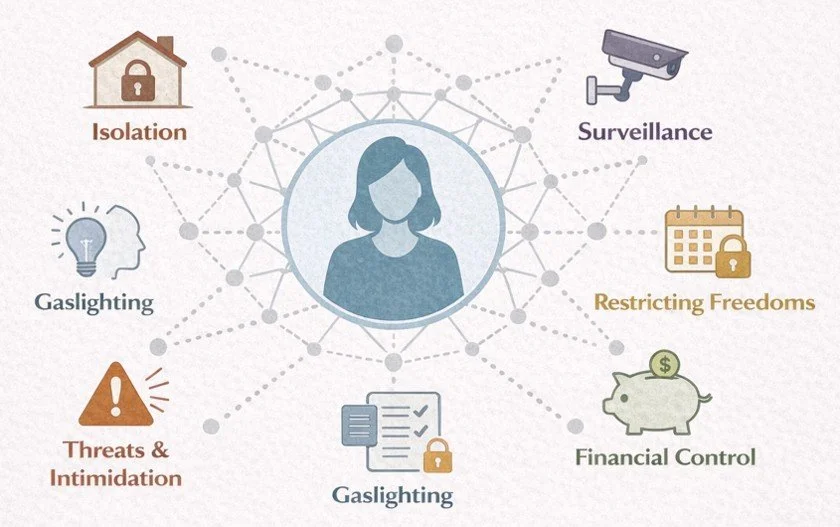
Image: Aspects of coercive and controlling behaviour
Empirical work links such dynamics to trauma and adverse mental health outcomes, although definitions and measurement remain contested (Lohmann et al., 2023).
The incorporation of coercive control into legal frameworks reflects an attempt to capture non-physical forms of harm, including through the Domestic Abuse Act 2021 and the Serious Crime Act 2015. However, operationalising the concept in practice is difficult: unlike discrete acts of violence, coercive control involves patterns that are context-dependent and challenging to evidence. This highlights a broader tension in IPV research and policy: complex relational constructs must be translated into legal standards that require clarity and evidential precision (Follingstad & Rogers, 2013).
The Contemporary IPV Industry: Structural Consequences
As domestic violence services have expanded, a substantial institutional infrastructure has developed around IPV. While this has improved recognition and support, it has also embedded particular conceptual frameworks within policy, training, and practice. These frameworks can shape how practitioners interpret cases, including what is prioritised, recognised, and treated as evidentially significant (Hans et al., 2014; Haselschwerdt et al., 2011).
This influence is evident in family justice contexts, where competing models of IPV can affect how allegations are framed and evaluated. Some forms of harm, particularly those occurring through administrative or legal processes, may be less visible within incident-based frameworks (Berger et al., 2016; Hines et al., 2015). More broadly, this illustrates that debates in IPV research are not merely theoretical but have direct implications for institutional decision-making, particularly within legal and family justice contexts (Watson & Ancis, 2013).
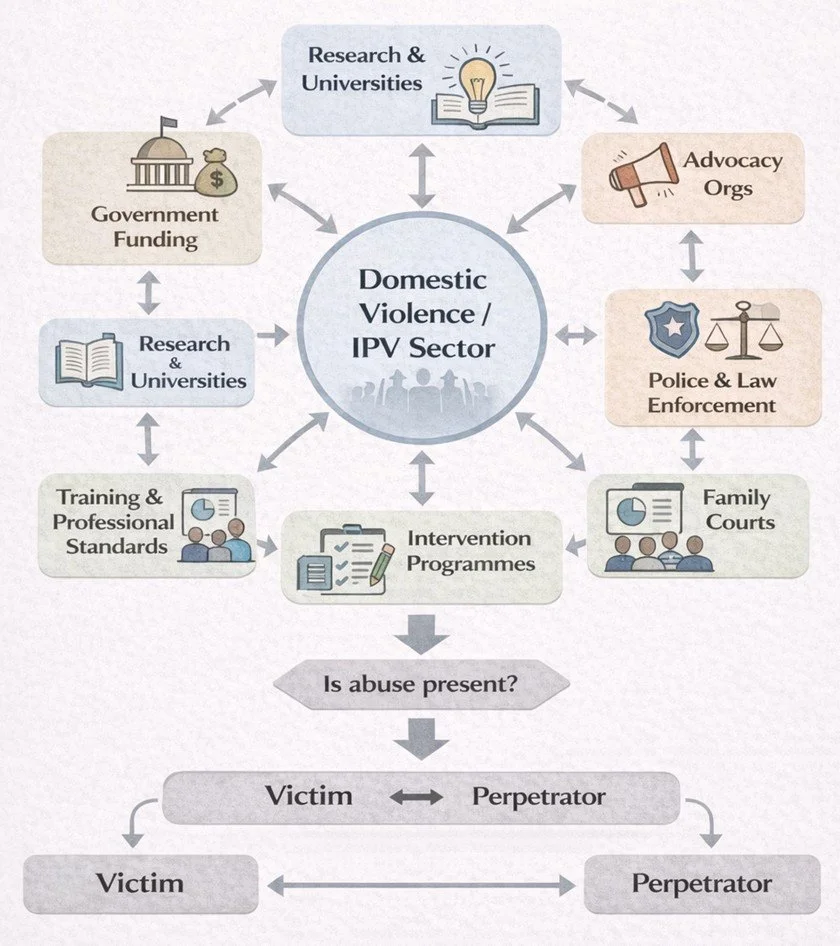
Image: The contemporary IPV industry
The development of IPV research has produced multiple frameworks offering differing explanations for the causes and dynamics of partner violence. While these perspectives have shaped both academic debate and institutional responses, the diversity of findings suggests that no single model fully captures the complexity of IPV (Follingstad & Rogers, 2013; Woodin et al., 2013).
Emerging research indicates that developmental, relational, psychological, neurodevelopmental, and neurobiological processes may contribute to distinct patterns of violence. This aligns with broader research examining the long-term effects of adverse childhood experiences, trauma, attachment disruption, emotional regulation, and addiction-related processes on interpersonal functioning across the lifespan.
From this holistic perspective, typological models can be understood not as competing explanations, but as descriptions of different pathways through which IPV may emerge (Dutton, 2006; Johnson, 1995).
This supports a plural, evidence-led approach that recognises IPV as a heterogeneous phenomenon comprising multiple pathways and relational dynamics. Such an approach does not require treating all theoretical frameworks as equally valid or equally evidenced, but instead focuses on calibrating interventions to the specific pattern of violence being observed. This may provide a more coherent basis for scientific understanding and policy responses.
Acknowledgements
This article was inspired by an X post by @BlueBlur_23 and draws on both an earlier undergraduate assignment and the author’s subsequent postgraduate research on IPV theory.
References
Babcock, J. C., Green, C. E., & Robie, C. (2004). Does batterers’ treatment work? A meta-analytic review of domestic violence treatment. Clinical Psychology Review, 23(8), 1023–1053. https://doi.org/10.1016/j.cpr.2002.07.001
Berger, J. L., Douglas, E. M., & Hines, D. A. (2016). The mental health of male victims and their children affected by legal and administrative partner aggression. Aggressive Behavior, 42(4), 346–361. https://doi.org/10.1002/ab.21630
Dobash, R. E., & Dobash, R. P. (1992). Women, Violence and Social Change. Routledge. https://doi.org/10.4324/9780203450734
Dobash, R. P., Dobash, R. E., Wilson, M., & Daly, M. (1992). The Myth of Sexual Symmetry in Marital Violence. Social Problems, 39(1), 71–91. https://doi.org/10.2307/3096914
Dutton, D. G. (2006). Rethinking Domestic Violence. UBC Press. https://www.amazon.co.uk/Rethinking-Domestic-Violence-Donald-Dutton/dp/0774810157
Dutton, D. G., & Corvo, K. (2007). The Duluth model: A data-impervious paradigm and a failed strategy. Aggression and Violent Behavior, 12(6), 658–667. https://doi.org/10.1016/j.avb.2007.03.002
Follingstad, D. R., & Rogers, M. J. (2013). Validity Concerns in the Measurement of Women’s and Men’s Report of Intimate Partner Violence. Sex Roles, 69(3), 149–167. https://doi.org/10.1007/s11199-013-0264-5
Gondolf, E. W. (2012). The Future of Batterer Programs: Reassessing Evidence-Based Practice. UPNE. https://www.amazon.co.uk/Future-Batterer-Programs-Northeastern-Gender-ebook/dp/B007S0CYHM
Hans, J., Hardesty, J., Haselschwerdt, M., & Frey, L. (2014). The Effects of Domestic Violence Allegations on Custody Evaluators’ Recommendations. Journal of Family Psychology. https://doi.org/10.1037/fam0000025
Haselschwerdt, M. L., Hardesty, J. L., & Hans, J. D. (2011). Custody Evaluators’ Beliefs About Domestic Violence Allegations During Divorce: Feminist and Family Violence Perspectives. Journal of Interpersonal Violence, 26(8), 1694–1719. https://doi.org/10.1177/0886260510370599
Hines, D. A., Douglas, E. M., & Berger, J. L. (2015). A self-report measure of legal and administrative aggression within intimate relationships. Aggressive Behavior, 41(4), 295–309. https://doi.org/10.1002/ab.21540
Johnson, M. P. (1995). Patriarchal Terrorism and Common Couple Violence: Two Forms of Violence against Women. Journal of Marriage and Family, 57(2), 283–294. https://doi.org/10.2307/353683
Lohmann, S., Cowlishaw, S., Ney, L., O’Donnell, M., & Felmingham, K. (2023). The Trauma and Mental Health Impacts of Coercive Control: A Systematic Review and Meta-Analysis. Trauma, Violence, & Abuse, 15248380231162972. https://doi.org/10.1177/15248380231162972
McManus, S., Walby, S., Barbosa, E. C., Appleby, L., Brugha, T., Bebbington, P. E., Cook, E. A., & Knipe, D. (2022). Intimate partner violence, suicidality, and self-harm: A probability sample survey of the general population in England. The Lancet Psychiatry, 9(7), 574–583. https://doi.org/10.1016/S2215-0366(22)00151-1
O’Brien, J. E. (1971). Violence in Divorce Prone Families. Journal of Marriage and Family, 33(4), 692–698. https://doi.org/10.2307/349443
Pence, E., & Paymar, M. (1993). Education groups for men who batter: The Duluth model. In Education groups for men who batter: The Duluth model (pp. Chapter xiv, 198 Pages). Springer Publishing Company (New York, NY, US). https://doi.org/10.1891/9780826179913
Pizzey, E. (1982). Prone to Violence. Hamlyn. https://www.amazon.co.uk/Prone-Violence-Erin-Pizzey/dp/0600205517
Shepard, M. F. (Ed.). (1999). Coordinating community responses to domestic violence: Lessons from Duluth and beyond. Sage. https://www.amazon.co.uk/Coordinating-Community-Responses-Domestic-Violence-ebook/dp/B00YFRQ6PW
Stark, E. (2007). Coercive control: The entrapment of women in personal life. Oxford University Press. https://www.amazon.co.uk/Coercive-Control-Entrapment-Interpersonal-University/dp/B00SLUA6H8
Stark, E., & Hester, M. (2019). Coercive Control: Update and Review. Violence Against Women, 25(1), 81–104. https://doi.org/10.1177/1077801218816191
Straus, M. A. (1979). Measuring Intrafamily Conflict and Violence: The Conflict Tactics (CT) Scales. Journal of Marriage and the Family, 41(1), 75. https://doi.org/10.2307/351733
Straus, M. A., Gelles, R. J., & Steinmetz, S. K. (2006). Behind closed doors: Violence in the American family (Transaction ed.). Transaction Publishers. https://www.amazon.co.uk/Behind-Closed-Doors-Violence-American/dp/1412805910
Watson, L., & Ancis, J. (2013). Power and Control in the Legal System: From Marriage/Relationship to Divorce and Custody. Violence Against Women, 19. https://doi.org/10.1177/1077801213478027
Woodin, E. M., Sotskova, A., & O’Leary, K. D. (2013). Intimate Partner Violence Assessment in an Historical Context: Divergent Approaches and Opportunities for Progress. Sex Roles, 69(3-4), 120–130. https://doi.org/10.1007/s11199-013-0294-z
Scroll down to the comments section to join the discussio
Disclaimer: This article is for information purposes only and is not a substitute for therapy, legal advice, or other professional opinion. Never disregard such advice because of this article or anything else you have read from the Centre for Male Psychology. The views expressed here do not necessarily reflect those of, or are endorsed by, The Centre for Male Psychology, and we cannot be held responsible for these views. Read our full disclaimer here.
Like our articles?
Click here to subscribe to our FREE newsletter and be first
to hear about news, events, and publications.



























.