

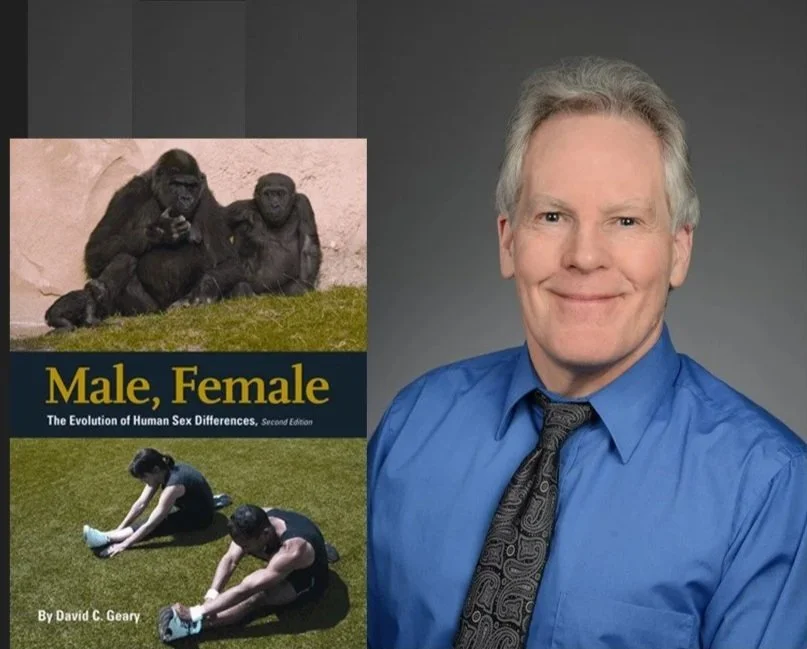
Image: Professor David Geary and one of his books, ‘Male, Female’.
David Geary is an American professor of cognitive developmental and evolutionary psychology. Since gaining his PhD in 1986 he has had a long and distinguished career with the University of Missouri. Professor Geary is renowned for his work on children's mathematical development, including subtypes of maths disabilities (such as dyscalculia), evolutionary psychology, the biological bases of sex differences in cognition and vulnerability, and evolutionary educational psychology. His publications include around 400 articles and book chapters, as well as several books including Male, Female: The Evolution of Human Sex Differences, (3rd ed. 2021) The Origin of Mind (2005), Evolution of Vulnerability (2015), and The Evolved Mind and Modern Education (2024). His co-authored books include the massive Sex Differences: Summarizing More than a Century of Scientific Research (2009),and co-edited a five-volume series on mathematics cognition. His research appears in media outlets such as Discover, Forbes, and CBS. He has served on high-level policy bodies on education for the US government. He has been awarded various honours, including the National Institutes of Health (NIH) MERIT Award for his longitudinal work on mathematical education, and the George A. Miller Award, presented by the American Psychological Association (APA), for his distinguished contribution to developmental psychology.
John Barry (JB): Thank you Professor Geary to agreeing to this interview. I’ll start with a question you will have heard before, but that might be useful to get out of the way first. Evolutionary psychology often faces criticism for being unfalsifiable or overly adaptationist. Rudyard Kipling’s Just So stories are fun little tales for children about how various animals developed specific traits. For example, one of them explains the elephants trunk was caused by an incident long ago where an elephant got his nose stretched out and elongated in a fight with a crocodile. All good fun, but these stories are better known now as a criticism of evolutionary psychology as a Just So way of explaining natural phenomena. How do you address these critiques in your own research, and what standards of evidence do you prioritize when linking evolved mechanisms to modern behaviours?
Prof David Geary (DG): Well, yeah, I've heard the argument about evolutionary theories or hypotheses being Just So stories many times. In my experience, they come from individuals who don't really understand much about evolution, frankly, and take Just So stories as a way to dismiss things that they don't want to deal with, or they don't want to believe are true. Now, empirically, there's an article out just recently in the American Psychologist by William Costello and his colleagues, including David Buss, that goes through evolutionary theories related to humans and points out that there are hypotheses that have been tested and disconfirmed, and there are hypotheses that have been tested and largely confirmed, and so there is a lot of empirical work there, and there are alternative evolution-related views on a variety of things, and they do get tested empirically.
“if anything, I think the Just So stories apply more vigorously to areas like social psychology with a 10% to 25% replication rate, where they've just been making things up”.
The other thing is with the evolutionary approach you have a huge foundation in evolutionary biology that stretches back 150 years or more, and so you can look at basic patterns across primate species, across mammals, across a variety of species, and say, okay, well, males generally do this under these conditions, or you've evolved to do this under these conditions, and females do these things. How does it mesh with what we see in humans? And then in humans also, we can look across cultures, we can look at hormonal factors, and so forth. So, if anything, I think the Just So stories apply more vigorously to areas like social psychology with a 10% to 25% replication rate, where they've just been making things up.
JB: I like that answer [Edit: my first degree is in Social Psychology and I realise that, sadly, the replication crisis in this field is second to none]. I never thought about it like that, but yeah Patriarchy Theory is such a Just So story. It’s just cherry picking examples of where women are victims and men are perpetrators and spinning it into a one-sided version of global history [Edit: it’s also an example of gamma bias].
Moving on, you co-authored perhaps the largest set of evidence about sex differences, with Lee Ellis a social anthropologist, and 8 others who are experts in various fields, mainly neuroscientists. I want to say a bit about this book because it is so impressive. It’s called ‘Sex Differences, Summarizing More Than A Century of Scientific Research.’
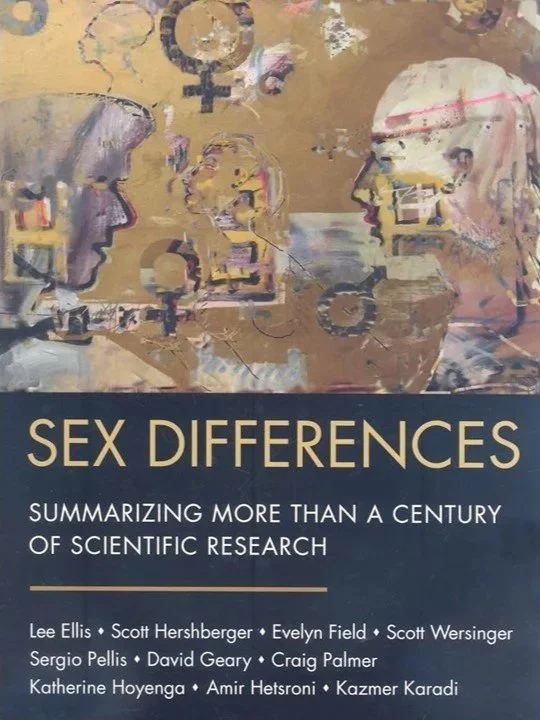
Image: Book cover of ‘Sex Differences…’, by Ellis, Geary and colleagues (2008).
The project took 11 years and the resulting book is over 1000 pages long. It reviewed over 18,000 studies from around the world and had been published over a period of more than 100 years. A couple of questions here: What was it like being part of such a huge project? Did any of the findings surprise you? Did you regret having to take on so much at any point, did anybody get burned out, go insane due to all of that work…?
DG: Sure, yeah, I regretted it at multiple points, but glad we got it done. We picked topics, and then the goal was to do literature searches and try to go back to the late 19th century, or whatever, when articles were first starting to be published in scientific journals, and just catalogue all those articles in associated sex differences and put them all together. It's basically a compilation of research across a wide, wide variety of topics, and as you know, it's not theoretically driven, like my Male-Female book, which is based on theoretical understanding of sexual selection, and evolutionary-based sex differences related to reproductive things. But yeah, it was a massive task. Glad it's done.
JB: In one of the modules on our Masculinity course, we do a synopsis of the sex differences you found and then discuss how well the sex differences map onto ideas about masculinity.
DG: There have been other studies published since then, like that one that Alice Eagly published not too long ago in Perspectives in Psych Science that looked at sex differences in agentic versus communal traits. Agentic meaning masculine, taking charge, get things done, action-oriented types of things, versus communal and relationship-development things, like developing social networks. The sex differences are very large, and so although the term ‘masculine’ is interpreted different ways at different times, the actual male typical behaviours and female typical behaviours are on average are very large.
JB: Yeah, whatever happened to the definition of masculinity based on behaviours and traits that are more typical of men than women? Definitions have drifted off into some really crazy and pejorative places… that’s a topic that I could go on for ages, but let’s move on. You’ve published work with Prof Gijsbert Stoet on the gender-equality paradox. He is someone I have known for years and who has presented his excellent work at Male Psychology Section events and written for Male Psychology magazine. For those who don’t know, the gender-equality paradox describes how many sex differences become more pronounced in more gender-equal societies. What mechanisms explain the gender-equality paradox?
DG: We co-authored an article together in Psych Science two years ago, actually about a year and a half ago, with then graduate student in the University of Turku in Finland, and we have one under review together looking at international differences in promotion of STEM fields for girls in secondary school or high school, and then international differences in going into inorganic STEM domains in college. It turns out preparing girls with a rigorous science curriculum in high school - which I think is a good idea for both boys and girls - doesn't change academic preferences after high school.
JB: Yes, that whole thing has been a huge diversion of time and funding. the gender equality paradox is a bit counter-intuitive the first time you hear it, saying more equal countries having greater sex differences. I guess it’s because we are often told that in more affluent countries – which often means countries with more regulations about gender quotas in the workplace – old fashioned things like gender differences will disappear. Can you outline what the mechanism is behind the gender equality paradox please?
DG: Right? The gender equality paradox is related to mores, formal laws, women's participation in the labour market politics, and so forth, and the more that you get of those types of things, women engaging in what was traditionally male biassed professions, the larger sex differences get in many domains, including the sex differences in inorganic STEM fields like engineering, physics, and so forth. So, the most gender-equal countries, like Sweden, Norway, have proportionately fewer women in those fields than countries that are more ‘patriarchal’, if you want to say that, that are more restrictive. Lewis Halsey and I had an article on this in Biology Letters last year, and we argued that there's a couple of mechanisms going on, one of them is that as countries get healthier and wealthier, their citizens become physically healthier, and physical sex differences get larger, so we found that height, lean muscle mass differences, for example, are bigger in these gender equal countries as well, and there's probably a lot of other physiological and cognitive types of things. We just published an article showing that men's advantage in visual spatial abilities is larger in these countries as well, probably related to early developmental health. We also argued that as countries get wealthier and safer, social mores become more liberal, laws become more relaxed, so forth, so life, everybody chills out, so to speak, and as you reduce those social constraints, you get a fuller expression of individual differences in preferences, including sex differences and occupational choices, for example.
JB: That explanation relating to biology is very interesting. I haven't heard it before, but it makes sense. I suppose in countries with better nutrition, men would grow larger, but women would also grow larger, but not as large as men. So they both grow but the relative difference stays the same…?
DG: So, both in both men and women get taller, but men get taller at about twice the rate of women.
JB: Fascinating. Staying with the topic of STEM, in his new book (reviewed by me here) Prof Steve Stewart Williams comments on how girls are encouraged into STEM, and are sometimes given better grades than boys in STEM topics, probably in an effort to redress what are seen as historical imbalances. He describes this as delta bias i.e. the tendency to encourage men and women into activities that are non-typical for their gender, and discourage behaviours that are typical of their gender (e.g. boys being competitive). An example is the call for more female fighter pilots and more men teaching kindergarten, which are occupations that most men and women don’t typically gravitate to. What kind of impact would you say delta bias has on the lives and futures of boys and girls?
“…pushing individuals to go into areas that they would not prefer, and perhaps not excel in, is manipulative. […] in the long run, nature wins, and it's a waste of time, waste of money, and it is aggressive political social manipulation, in my opinion”.
DG: Yeah, so this is in a top-down attempt by activists to manipulate the behaviour of other people. In my opinion, it comes from a general belief, I think, that most sex differences are socialised through something called gender roles, or something to that effect, and therefore, if you change the narrative, you will eventually change the behaviours, and the differences between boys and girls, and men and women will shrink over time. That was the hypothesis of a lot of gender activist types, or gender studies academics, in the 80s, 90s, 70s, and so forth, and it hasn't happened, as exemplified by the gender equality paradox; as things get better, women enter politics, and so forth, sex differences in a lot of areas actually get bigger. So, imposing these things, I think, is immoral. For one, pushing individuals to go into areas that they would not prefer, and perhaps not excel in, is manipulative. It's been tried in Sweden primarily, where they bought the gender roles theory and decided to push young boys, like kindergarten, to play more girl-typical types of things, and young girls to do more male-typical types of things, like run outside in the snow with their shoes off, stuff like that, to toughen them up. From what I've read, it just made everybody miserable, the kids and the teachers, because the kids didn't really want to do it, and so there's a lot of pushback, and so, and the teachers, of course, couldn't pull it off, because in the long run, nature wins, and it's a waste of time, waste of money, and it is aggressive political social manipulation, in my opinion.
JB: Yes, and thank you for making the point that it's immoral. In the social sciences we talk a lot about ethics, but there is an assumption that gender equality is infallibly a good thing. If you question that assumption, people treat you as if you are bad.
DG: It's social top-down social engineering, which is immoral in a supposedly liberal society, where individuals should be free to make their own choices.
JB: Yeah, well, liberal is one of the words that has changed its meaning, like the definition of masculinity, right? Anyway, your book Evolution of Vulnerability explores how traits important for competition and mate choice are more sensitive to environmental stressors. Do you see this as implicated in the problems with population decline, and lack of dating, relationship breakdown in the West?
“for traits where there are larger sex differences, those sex differences become smaller under stressful conditions and larger under more optimal conditions, basically fitting the gender equality paradox perfectly.”
DG: Well, I think it's a bit different. The vulnerability basically says that something like the peacock's tail or train, it grows to five feet and has a lot of nice colours on it and symmetry and all of that, that that is an indicator of the male's physical health, and if he, and there's a large sex difference there, obviously, and if he is sick, poorly nourished during development, or whenever that's growing, that trait will be more compromised than other traits. Same thing with height in men, as you reduce nutrition, calories, and so forth, especially prenatally in the first few years of life, it affects men's growth in adult height more than it affects women's growth in adult height. So the basic hypothesis is, for traits where there are larger sex differences, those sex differences become smaller under stressful conditions and larger under more optimal conditions, basically fitting the gender equality paradox perfectly.
The marriage issue is, I think, a little bit different. Marriage rates have collapsed, especially among the blue-collar population, the working class, the folks that two generations ago would have had - at least in the US, probably in the UK, and parts of Europe as well - very high paying manufacturing jobs, and so they were marriable men. A lot of those jobs have disappeared, and so the wages of a segment of these guys has dropped as well, which makes them less attractive as marriage partners, and at the same time we have the influx of women into the labour market, which will necessarily lower wages of men, because more workers, depending on what field they go into, just a supply demand type of thing, and as women gain more status educationally, work position and salaries, their expectations for a marriage partner go up. So now a lot of these guys, who in a few generations ago, would have made good money, and been a good partner and able to support a family, now a lot of those guys are struggling. At the same time, you have women who are wanting guys who are going to make more than they do, and more than these blue-collar guys do, and so a lot of the marriage rates really vary with men's income historically.
“I think it's a more macro pattern where we have international trade, automation, migration, a variety of things, that's reducing the number of high paid blue-collar jobs, and that is really, really devastating marriage dynamics.”
JB: So, would this thing of wages qualify as an environmental stressor, or is it a different type of thing?
DG: An environmental stressor in terms of the vulnerability type of thing. I think it probably is a little bit different if it affected health, which I suppose it could, and you know the development of kids, you know the environment that they're exposed to when they're growing up, because there's not as much money. Yeah, it could, but I think it's a more macro pattern where we have international trade automation, migration, a variety of things, that's reducing the number of high paid blue-collar jobs, and that is really, really devastating marriage dynamics for that part of the population, which is the majority of the population, since most people aren't college educated.
JB: I am sometimes surprised at how hostile people are to the ideas of gender roles e.g. that women shouldn’t be housewives, or that men shouldn’t be protectors of women. Steve Stewart Williams says "let people be themselves" and accept - or not - gender roles. What is your take on this?
DG: Yeah, I agree with you and Steve, that I think people should have free choices. I think a lot of the arguments against gender roles or people behaving in natural sex-specific ways comes from the segment of the women's population that are work-focused rather than family-focused or a mixed preference for those coming from the competitive work-focused women who are competing directly with men. I think they have driven this narrative for the last 60 plus years, and women in general don't like other women disagreeing with their narrative. There is a push for social cohesion, and I think they do that in a way to reduce conflict, and if they can manipulate the narrative in ways in their own self-interest, and everybody goes along with it, they don't have to work hard to do it, because it automatically happens. So I think that these women are pushing that narrative that there's no real sex differences, or if there are any sex differences - it is due to bias, misogyny, whatever. And then you see women saying, well, I'd like to stay home and take care of my kids, or that's about 15 - 20% of women. And then, the vast majority of women are in-between, they want to have kids and get married, but they also want to work a bit outside of the home and have a more of a mixed life. Then you get these competitive work-focused, competing directly with men, seeing women do that, it disrupts their narrative. It's like, ‘no, all the other women need to be like me, they're not like me, I'm going to attack them, basically socially, reputationally’, and so forth. Same dynamic you see in women's groups and relational aggression.

Image: Book cover of ‘The Origin of Mind’, by Professor David Geary (2004). This book comprises a comprehensive theory of how the human mind evolved through motivational, affective, behavioral, and cognitive systems which process experience e.g. face recognition. Prof Geary is currently working on the new edition of this book.
JB: True enough, there's too much of that. I want to ask you about your work on the sex differences in mental rotation ability. I did some research which found that testosterone is positively correlated with mental rotation ability in women who had naturally elevated levels of testosterone. How much is this ability related to ecological pressures for example, hunting, foraging, and social complexity, and how much do those pressures promote this type of sex difference?
DG: Yes, that’s something I covered in Male, Female. Men generally have advantages in areas that I call ‘folk physics’, and that involves dealing with the physical world, such as navigation, visual discrimination of things at a distance, understanding how objects can be used as tools, mentally rotating objects in your head in order to make tools, or physically rotating them. Men have advantages in all those areas, and across traditional cultures, like hunter gathering, 90% or so of the tools are constructed by men, many of those tools are weapons, and so, yes, it's related, I think, to tool construction, conceptual understanding of how objects can be used as tools, has a very clear evolutionary history in hominins, going back millions of years in spatial navigation and visual detection of things at a distance, all of that relating to male competition, raiding warfare, as well as hunting.
JB: I like the phrase ‘folk physics’. Can you tell me a bit more please?
DG: So for biologically primary or evolved abilities, I came up with a taxonomy separating these into different domains related to survival and reproductive prospects in natural environments, and that includes folk psychology, which would be language, theory of mind, sensitivity to body posture, demarcating groups into in groups and out groups, kin bias, self-awareness, all of that would be folk psychology related to the self and dynamics, relationships with other people. Folk biology in the real world, relates to how people actually have considerable knowledge of local plants and animals that would be used for foods and medicines, so they have a natural system for acquiring all of this knowledge, and they need a lot of experience with it, but there's also a built-in bias to get it. As to folk physics, that is about dealing with the physical world, so navigating, walking from one place to another without running into a wall, remembering where you parked your car, getting home the next day, remembering where you put your car keys, but also related to - as I said before - tool use, tool construction, and so forth. I outline in chapter nine of Male, Female the basics of folk psychology, and folk physics. In chapter 12, I cover brain and cognitive sex differences related to folk psychology. In chapter 13, brain and cognitive sex differences related to folk biology and folk physics.
JB: Fantastic. You mentioned how constructing tools was a predominantly male activity, especially constructing weapons. This reminds me of something strange I noticed when myself and colleagues did a meta-analysis on sex differences in children’s toy preferences. We found that – very predictably - boys played with male‐typed toys more than girls did and girls played with female‐typed toys more than boys did. No surprise there, but one of the things that struck me when I was looking through the literature was that almost none of the studies assessed preferences for toy guns. There were lots of other toys, like dolls and toy cars, and swords in a couple of cases, but almost none of them looked at toy guns. I remember as a kid almost all of us – boys I mean - used to run around playing with toy guns, and water pistols, ‘cops and robbers’ etc. So why do you think toy guns have been overlooked in decades of studies on sex differences in toy preference?
Play fighting “occurs more frequently in the sex that engages in more physical aggression and competition in adulthood, typically males. There are some species, like spotted hyenas, where the females are really aggressive due to competition for food in adulthood, and they engage in as much rough and tumble play as the males do, so it's not just a sex-specific thing”.
DG: Yeah, well, that's another one of these nonsense luxury beliefs that goes around with gender roles. If we give boys guns, they're going to grow up to be violent and abusive and toxically masculine, which is nonsense. The correlation between gender role beliefs in kids and their parents and kids' actual behaviour is around zero point one. It's very small. In Male, Female, the first third of the book is just non-human sex differences, and one of the sections reviews sex differences in play, and one common form of play in mammals as in some other species is rough and tumble play. We see play fighting in mammals, and it occurs more frequently in the sex that engages in more physical aggression and competition in adulthood, typically males. There are some species, like spotted hyenas, where the females are really aggressive due to competition for food in adulthood, and they engage in as much rough and tumble play as the males do, so it's not just a sex-specific thing, it’s which sex is has more physical competition, in intra-sexual competition in adulthood, and in humans it's males, absolutely no question about that. Given the history of male-male competition in the use of weapons during human evolutionary history, there's no question about that. I just finished reviewing evidence on skeletal remains and hominins like australopiths, humans during the Neolithic Age, early modern humans, Neanderthals and so forth, there’s lots of blunt force trauma, head injuries, broken forearms, which is a defensive type of thing, so lots of violence there. It is not surprising that boys would then be attracted to things like rough and tumble play, as well as weapons, and it's not surprising that girls would be attracted to family-related toys, dolls, themes, playing house, and so forth, which are big sex differences.
JB: Ok. Tell me a bit about biologically primary (evolved, spontaneous) versus biologically secondary (culturally acquired, effortful) abilities. Do these explain sex differences in how children progress in school such as reading and advanced mathematics. Does education today need to change to incorporate what we know from evolutionary psychology?
DG: Yeah, so I made an argument in my first book on children's math development and in the 1995 American Psychologist article, that we should think about cognitive development and academic development from an evolutionary perspective. From this perspective we have evolved primary abilities, such as language, theory of mind, visual spatial abilities, so forth, that are built in. They require species-typical childhood behaviours in order to fully develop, but you don't need schooling. And then you have culturally dependent and culturally specific skills like reading, mathematics, and actual physics rather than folk physics, for example, we don't have the built-in motivational systems or the brain and cognitive, structure that would automatically lead to the development of these skills, and thus if you want a literate, numerate society, children have to go to school, and they have to engage in activities that they would otherwise not engage in, like solving math problems or sounding out words from a text.
“Boys need to be pushed a bit more to read – they might read more if schools provided books that boys enjoyed more than the sanitised selections that many schools provide.”
I've argued that some sex differences in primary areas can contribute to some sex differences in secondary areas, so girls and women have advantages in many language-related domains, discriminating language sounds, language fluency… the whole network seems to be better integrated in girls and women than boys and men, and that gives girls an advantage in early reading skills, learning phonemic awareness, associating sounds with letters, decoding words you don't know into sound so you can understand it, reading comprehension. Girls and women have advantages in all of those areas, consistent advantages throughout the world. The implication there is that boys, young boys, probably need more structured instruction in certain areas, like phonemic awareness, word decoding, and boys need to be pushed a bit more to read – and they might read more if schools provided books that boys enjoyed more than the sanitised selections that many schools provide.
I've also argued that men's advantage in folk physics and visual spatial types of things gives them an advantage in certain STEM areas, math areas, for example, that involve visual spatial representations or visual spatial mental models. Mathematical word problems is one of those, geometry obviously is one of those, and those are the areas where we find moderate, sometimes large sex differences. But in other areas, like just standard solving algebra equations, there's no sex difference, so when you get a visual spatial component to it, boys and men have an advantage in those mapped areas, and probably other science areas that require visual spatial skills. You can teach girls and women to do these things, like to map equations to two-dimensional plot, or whatever, but it probably doesn't come to them as intuitively as it does to guys, and so you need more direct, structured instruction and explanation, and so forth. They can learn it, but people deny these differences, and so they're not given any extra attention or help there, just like little boys aren't given any extra proactive help with reading.
JB: So boys and girls both need help but in different ways. Is there any end in sight to the nonsense about saying that that men and women are the same and their roles can be swapped around etc.?
“I think the arguments will continue for decades and decades, well after the matter is settled scientifically […] I think most of the general public have a better understanding than a lot of academics. The academics are too smart for themselves. They're able to come up with elaborate reasons why common sense is wrong, and, of course, it just makes them come up with nonsense arguments”.
DG: Well, I think the arguments will continue for decades and decades, well after the matter is settled scientifically, that's for sure. In my experience over the last 30 years or so, is that the amount of noise, pushback, manipulation, and so forth waxes and wanes, it goes up and then it goes down. I think it will die down, as more and more people gradually really come to understand that there are biological differences, and accept that. I think most of the general public have a better understanding than a lot of academics. The academics are too smart for themselves. They're able to come up with elaborate reasons why common sense is wrong, and, of course, it just makes them come up with nonsense arguments that I think eventually a lot of people will ignore. Frankly, the public trust in higher education is plummeting very quickly over the last 10 to 15 years, in part because you get academics saying nonsense, like that sex differences are just due to socialisation. Any parent who has a boy and a girl knows that that's nonsense.
JB: Yeah, it would be great to see that happen a bit quicker. But here we are at the end of the interview. Looking ahead, what are the most promising directions for evolutionary educational psychology or the study of sex differences? Are there policy or society implications that interest you, or ones that worry you?
DG: Yeah, I would say probably the gender role / social constructionist thing, but it'll wax and wane. If psychology is going to be a science - and a lot of it isn't these days - then it's going to have to take biology and evolution seriously, it just explains much more than saying ‘everything is a social construct’. There are social influences, clearly, and they're important, but they're not everything, and in many cases, they're not even an important thing.
JB: Have you got anything coming up, or that you're working on, that you want to tell people about?
DG: Yeah, I just started working on a second edition of The Origin of Mind, so that is a focus on brain and cognitive evolution in general cognitive ability, starting from hominids, four or five million years ago, looking expansion and brain size, and tool construction, social organisation, so forth, integrating it with what we know about various brain networks, and so forth. That will take me a while. It's like a big puzzle. It is relaxing for me, but it'll be a few years for it before it's out.
JB: That sounds fantastic. Well, I look forward to reading that. And thank you for speaking with me about your work and views.
Scroll down to the comments section to join in the conversation.
Disclaimer: This article is for information purposes only and is not a substitute for therapy, legal advice, or other professional opinion. Never disregard such advice because of this article or anything else you have read from the Centre for Male Psychology. The views expressed here do not necessarily reflect those of, or are endorsed by, The Centre for Male Psychology, and we cannot be held responsible for these views. Read our full disclaimer here.
Like our articles?
Click here to subscribe to our FREE newsletter and be first
to hear about news, events, and publications.





















Have you got something to say?
Check out our submissions page to find out how to write for us.


















.