
Beyond patriarchy theory and the Duluth model: Understanding the emotional roots of domestic violence
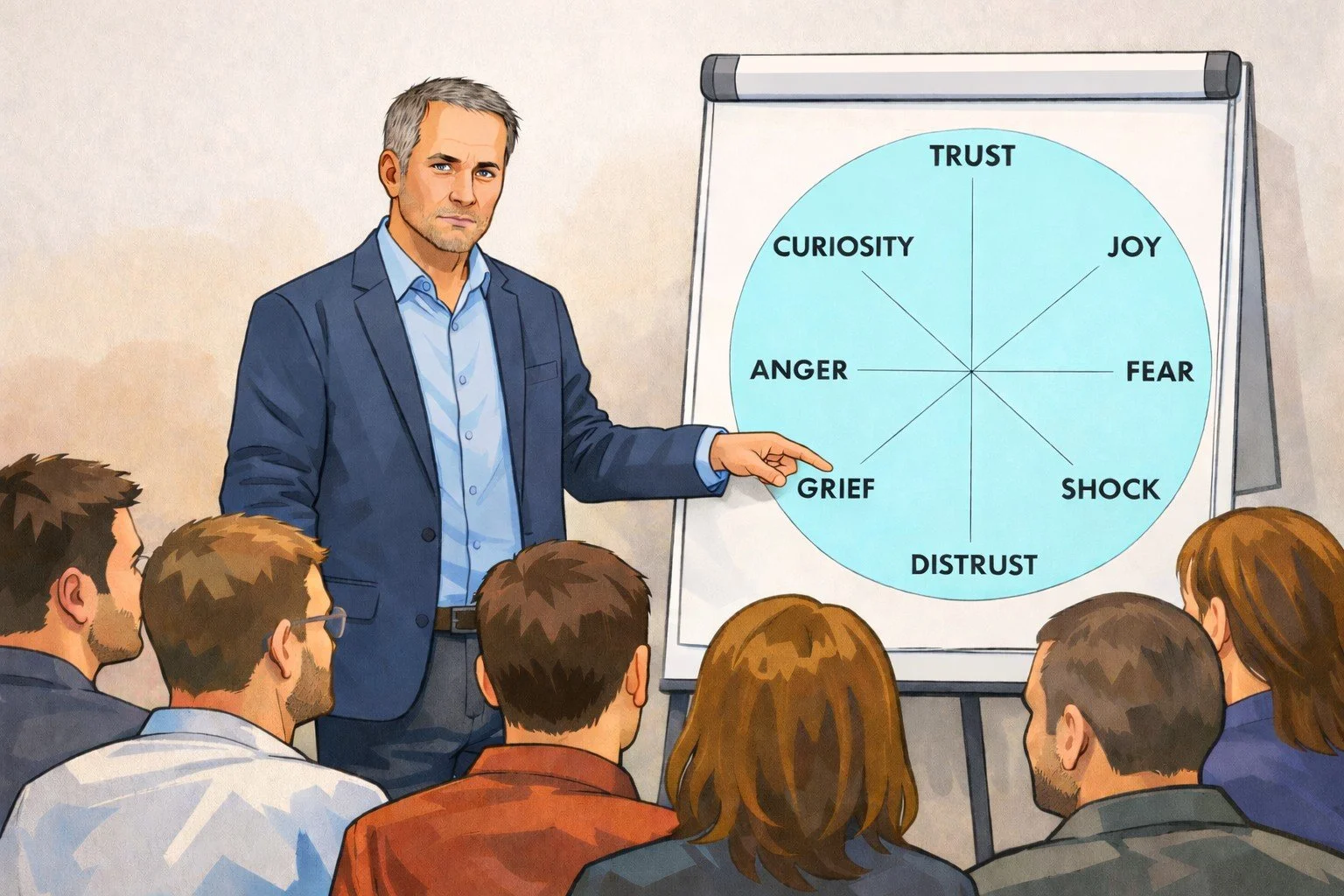
Image: The Temper DV ‘emotions wheel’. Created using AI image generation (ChatGPT) with prompts by John Barry.
Irritated by a REFUGE speaker’s dire dictum in 1994 that violent men were all the same and that they wouldn't change, a colleague and I set about building an “anger management” programme for domestic abusers. Domestic Violence at that time was seen as being about “anger management”: it was later redefined as “abusive behaviours” but particularly the behaviours of all males (who have become “toxic perpetrators”) to a woman (who is now a victim / survivor).
From couple counselling backgrounds we knew that a woman in an intimate relationship was just as capable of being violent, aggressive, abusive as a man. We also knew that men killed more women, than women killed men. We did not know about the deaths of children.
All that was 32 years ago. We devised the programme over a 15-month period and delivered it for the first time almost exactly 30 years ago. It was based on “anger management” and was also open to women.
TEMPER is both a noun and a verb.
How long? We based our estimate on the only UK model at that time which was 40 hours long. We asked the first 15 people which format they would prefer to attend: 16 / 18 evenings, once a week, or 4 Saturdays in a row, 4 Sundays in a row, or two whole weekends. The people chose two whole weekends, 9 – 6 on a Saturday and Sunday and then 2/3/4/5 weekends later the second half, but always in a closed group. In the early days a group might have been 10,12,14 people strong. People dropped out. We discovered groups needed to be no bigger than 8 people. We adjusted accordingly.
“We quickly realised that “anger management” was misplaced. The clients were mainly men and they seemed to have troubles “managing” (later regulating) their sadness and grief, also their anxiety and fears”.
We also quickly learnt people couldn’t attend a first meeting in Northampton - too disruptive of work and travel schedules. We travelled to them; met them in their homes or near to where they lived. Clients were from all Northamptonshire, the Luton area, a little later the Coventry area and, for about 6 months, the Norwich area. We delivered 6 courses a year in Northampton and likewise 6 in first Luton and then Coventry before moving to London and Birmingham. For a brief period we delivered 4 courses in Norwich.
Working with emotions
We quickly realised that “anger management” was misplaced. The clients were mainly men and they seemed to have troubles “managing” (later regulating) their sadness and grief, also their anxiety and fears and in some cases their disgust and shame. We had realised from the outset that the work would need to be conducted to a background of “attachment theory”. The problem was now how to bring those observations to a meaningful, visual picture.” A ruptured Achillies tendon in Germany laid me up for three months and in this time we came up with our “basic emotions” wheel, which we later learnt needed to be called a primary, categorical emotions wheel.
For Attachment we used the word TRUST and its opposite, DISTRUST (Disgust) and, in line with Attachment theory, we placed ANGER and FEAR, as paired opposites, at 90 degrees to it. JOY and SADNESS (GRIEF) were paired and “positioned” and then finally CURIOSITY and SHOCK. We saw and see these 8 emotions as linked and capable of “flipping”.
We wanted our clients to be able to see and understand themselves in “emotional situations,” understanding how they would tend to react / behave in those emotional situations and, of course, how other people would be and behave in their “emotional situations.” We recognised it was the “reactions” that got them into trouble. They needed to learn how to “respond”, rather than to react.
According to professor of Psychiatry, Dr Dan Siegel, emotions are named, as nouns, but they are really verbs, doing words; like TEMPER – both a noun and a verb.
We also knew that many emotional situations and their primers would have been developed in a client’s childhood in their families of origin and against their cultural backgrounds. The work needed to explore and develop each individual’s auto-biographical memories.
It was clear that clients would need to explore their origins and from a Co-counselling course I had undertaken in the 1970’s, the model of pair-talking was adapted for this purpose. One person talks on the subject, the other listens, then vice versa. The second listener feeds back and then vice-versa. This oft repeated activity builds in a “listen and feed-back” practice and strategy. The pairings are always changed so that an individual gets to explore himself or herself, but without exposing himself or herself too much to others, which might expose and hence inhibit them via their own shame mechanisms.
“[We] role-played the individuals into the positions of their partner and, in other scenes, their children. The objectives of these exercises are mainly the building of insight and empathy.”
In a conducive environment people learn by experiences and mistakes. We developed a number of “experiential exercises” which focussed on TRUST, FEAR, ANXIETY, SADNESS and HURT and also role-played the individuals into the positions of their partner and, in other scenes, their children. The objectives of these exercises are mainly the building of insight and empathy. The co-operative way of working together potentially builds and sustains TRUST, in ways which many men understand all too well.
An alternative to the Duluth model and patriarchy theory
Duluth, initiated in America as a “male battering programme”, was very quickly endorsed by a radical feminist mindset, highlighting the hated “Patriarchy”. It became the norm in America and in about 1990 it was also imported into the UK by the Domestic Violence Intervention Project (DVIP) in London. To “intervene” means to come between and separate. DVIP achieved funding and gradually spawned the charity RESPECT, which later became the “accreditor” of mainly the DVIP’s revised model for working with domestic abusers. The revised DVIP model came as a result of the critical research by the Joseph Rowntree Trust sponsored research, (1998) which pointed out major problems with the sheer volume of dropouts and the tensions between the “women’s support unit” and the “male only” abuser programme. The revised version of DVIP was produced by the woman who was later elected CEO of RESPECT.
By 2007 DVIP’s dropouts, in presumably the new programme, had very significantly increased. Less than 25% of the men were completing the DVIP programme, but nevertheless it became the first accredited programme in 2009. The accreditation officer was one Neil Blacklock, former CEO of DVIP. Meanwhile DVIP, heavily indebted, was absorbed into The Richmond Fellowship c. 2016, which was then absorbed into “Humankind” and then morphed into “Waythrough”. None of those entities exists on in the current list of RESPECT accredited programmes.
Until June 2022, RESPECT had become and was the “proxy accreditor” for Cafcass. It took 12-15 years for the MOJ to recognise the previously well-documented problems of ineffectiveness, the MOJ paper of 2011 for example. Many Cafcass agents still seem not to have digested those implicit problems and somewhere in Cafcass documentation nearly four years later, you will still find reference to Duluth and “male power and control”.
For us, what had been an anger management programme had become an emotional regulation programme. More than 90% of the men complete our work, 100% because we have learnt how and manage to engage with them.
Where until about 2012 we used to see 10% of clients in Northampton being women and about 15% in the West Midlands, we now do not see even 1 woman a year. Why is this? Women, according to radical feminism, are “victims” or the more emotionally termed “survivors”.
Men are labelled as “perpetrators”, an implied criminalising label. “Alleged abusers” would be more appropriate, as is indeed recognised by Practice 12J for the workings of the Family Courts.
From strength to strength
With the decommissioning of the RESPECT accredited DAPPs in June 2022 we have seen clients coming to London, Birmingham and Wakefield from three of the four corners of the UK.
Zoom, interactive online via 8 x 3-hour sessions plus homework and a one whole Sunday face-to-face day have become our alternative way of working. It allows people to attend from all over the country without costing them large additional amounts in travel and overnight accommodation.
When funding and the ability to pay personnel appropriately occurs we will return to offering work in up to 6 face-to-face venues as well as an online version for those people that live more than an hour away from a face-to-face centre.
I would like to add how delighted I was to hear that the MOJ had decommissioned the so-called accredited work in June 2022. That decommissioning was heralded in 2011 by Dr Louise Dixon. It was long overdue.
Now is the right time for more level heads to set the standards, something best done ‘on the shoulders of giants’. For those people with a more academic mindset, the work and research particularly of Drs John Bowlby and Mary Ainsworth, Drs Joseph LeDoux and Dan Siegel, Drs Alan Schore and Steven Porges, and Drs Lisa Fedman-Barrett and Louann Brisendine have all contributed significantly to our work, and, of course many others, too many to name. A more recent line of research comes from Sarah Blaffer Hrdy who very notably wrote about “Alloparenting”. She has now pulled together the research into her new book “Father Time”, which details the very positive changes that go on in men in couple relationships and particularly their hormonal changes when they are brought into contact with babies.
We have learned a developed our ideas over more than three decades, in order to best help families who are experiencing domestic violence. As we continue to improve our understanding, we hope others will do so too, so that intimate partner violence can be more effectively eliminated.
Scroll down to the comments section to join in the discussion
Disclaimer: This article is for information purposes only and is not a substitute for therapy, legal advice, or other professional opinion. Never disregard such advice because of this article or anything else you have read from the Centre for Male Psychology. The views expressed here do not necessarily reflect those of, or are endorsed by, The Centre for Male Psychology, and we cannot be held responsible for these views. Read our full disclaimer here.
Like our articles?
Click here to subscribe to our FREE newsletter and be first
to hear about news, events, and publications.




















Have you got something to say?
Check out our submissions page to find out how to write for us.













.