

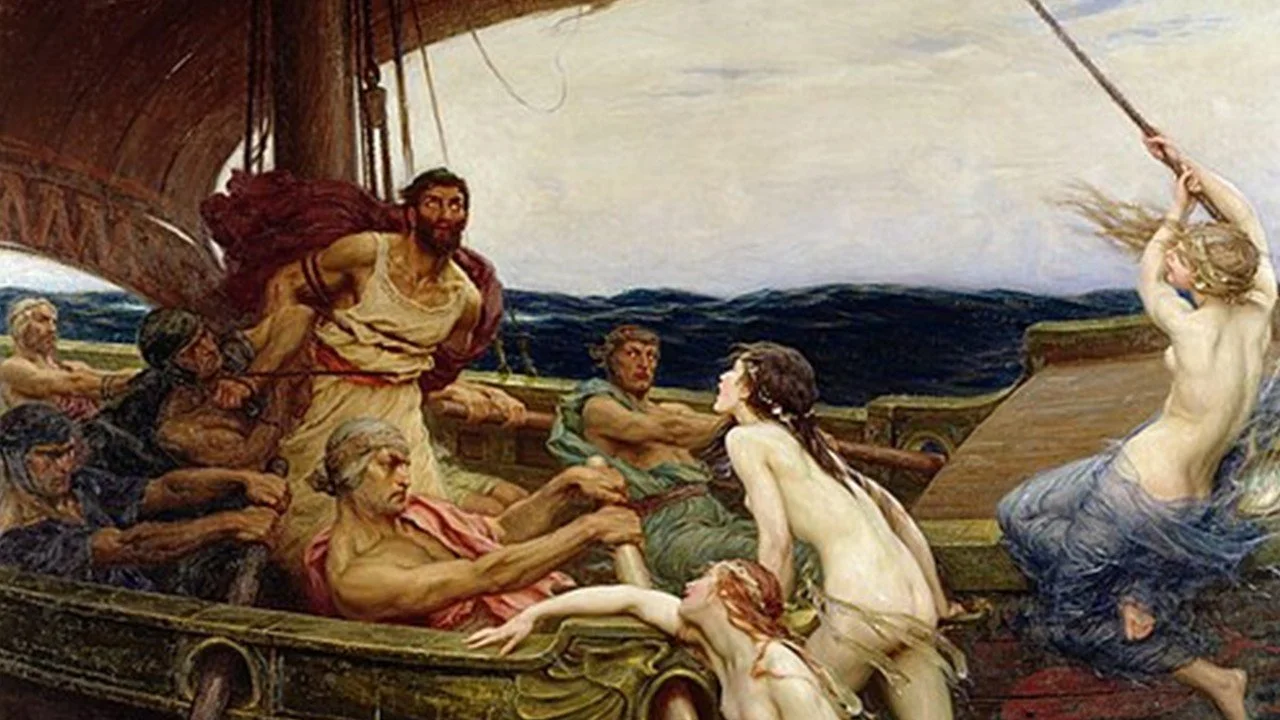
Image: Ulysses and the Sirens as a metaphor for addiction. Created using AI image generation (ChatGPT 5.6 Luna) with prompts by John Barry.
The long way to your self
Almost three thousand years ago, Homer told the story of a man who, after the Trojan War, wanted only one thing: to come home. But the short crossing turned into ten years. Odysseus gets caught in storms, loses companions, is seduced, stunned, held and repeatedly dissuaded from his goal. Strictly speaking, he keeps losing sight of his own goal. His story is therefore more than a distant adventure. It tells the story of a person who almost loses himself and his self – and yet in the very end finds his direction again. His path to Ithaca is the long way to himself.
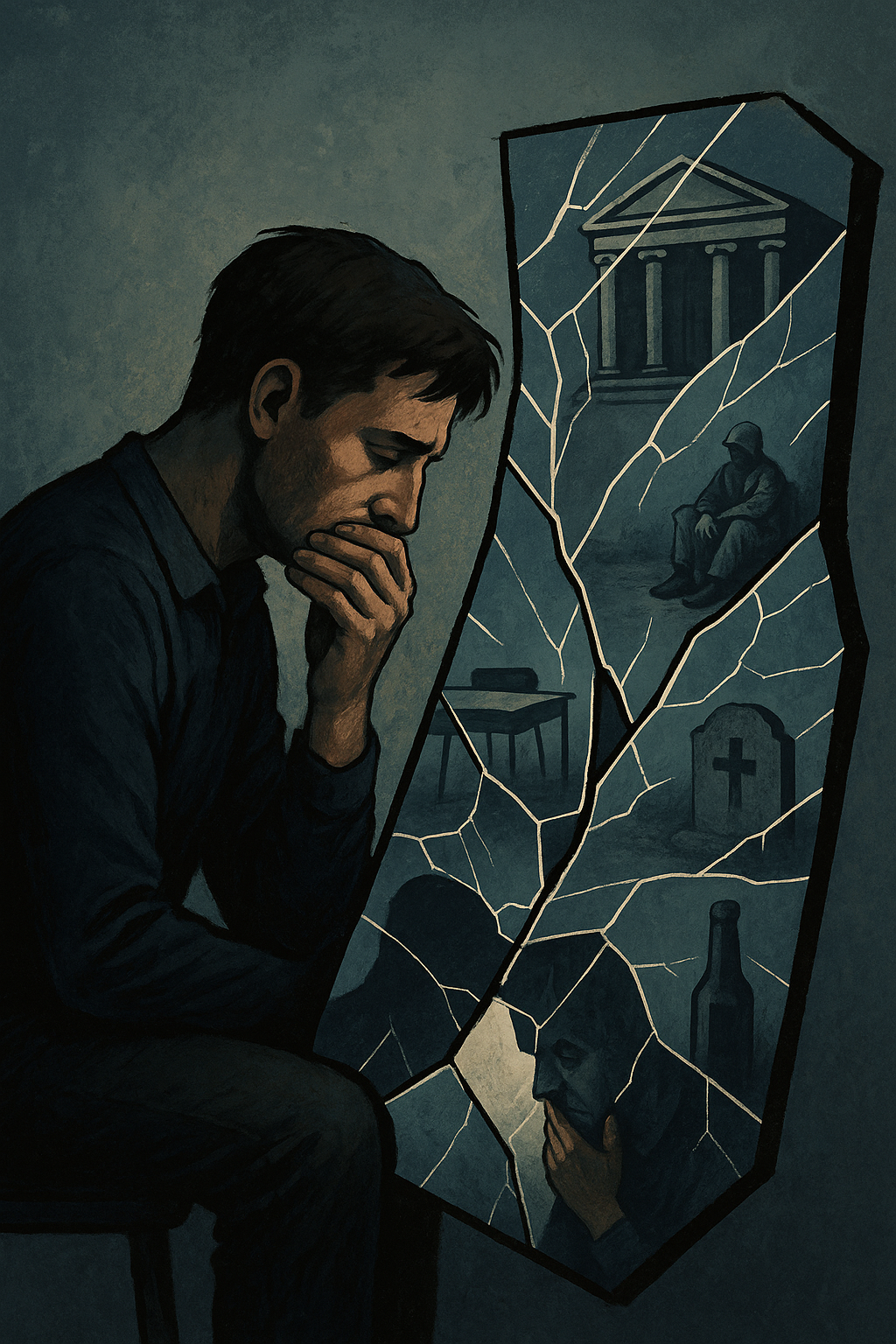
For chronic substance abusers and addicts, this narrative can become an inner map. An addiction also leads to many detours, lows, and catastrophes. The substances initially promise relief, security or oblivion and gradually take away people's freedom, time, health and relationships. The path out of addiction is rarely straightforward. It leads through defensiveness, ambivalences, desires, relapses, shame and often also severe losses. Returning home does not mean becoming exactly the person of the past again. It means finding a life that is led consciously and responsibly. Just like Odysseus, the homecoming is a new beginning, especially. for men that represent for than 70% of all substance addicts.
The Odyssey as an inner map
The islands and monsters of the Odyssey can be read as images of mental states. The one-eyed Polyphemus stands for a world in which only the momentary impulse and its immediate satisfaction count. Circe, the witch on a lonesome island, transforms people into beings who only follow their instincts. The sirens promise the highest pleasure and knowledge, but lead to death. Scylla and Charybdis force a decision in which there is no safe solution. They stand for a dangerous, insoluble ambivalence, esp. when it seems to be too late for other decisions in life. Calypso, the seductive nymph and goddess, offers protection and freedom from pain at the price of dependence and inner imprisonment, but thus keeps Odysseus away from his own path. And, above all, she intoxicates him with lotus, a substance to calm down and to forget trauma and psychological pain.
“alcohol relieves anxiety and tension, cannabis creates serenity and pleasant thoughts, medication dampens pain, cocaine imparts mental strength, gambling creates pleasant arousal, digital worlds make loneliness and emptiness disappear for a while. […] What later becomes a problem […] was often an unconscious but targeted attempt to overcome a serious problem.”
Addicts are familiar with such images from their everyday lives. Craving can narrow thinking to a single object. Under the influence of addiction, risks are played down and consequences are ignored. There is a lot of denial and repression, just as Odysseus, severely traumatized by ten years of war, tries at first. A seemingly reassuring retreat becomes isolation. Short-term relief costs health, trust and self-esteem in the long run. The Odyssey does not describe this dynamic in modern psychological-diagnostic terms, of course, but in strong, touching scenes. This is precisely why it can help to look at one's own experience from a distance and to understand it in a new way. Christopher Nolan's film "The Odyssey" shows how the former war hero and later traumatized veteran rushes through sea and time to distance himself from himself. In the end, he discovers that he cannot escape from himself and his inner problems. Just like an addict today, he has to get in touch with his traumas and anxieties.
Addiction often begins as an attempt for personal problem solving
No one takes addictive substances with the intention of becoming addicted to them. In the beginning there is the positive or dampening effect, which is welcome: alcohol relieves anxiety and tension, cannabis creates serenity and pleasant thoughts, medication dampens pain, cocaine imparts mental strength, gambling creates pleasant arousal, digital worlds make loneliness and emptiness disappear for a while. Each addictive substance has its specific functionality that meets a deficit in the consumer. What later becomes a problem, when control over consumption is gradually lost, was often an unconscious but targeted attempt to overcome a serious problem in the beginning.
“the following questions are part of recovery: What did consumption protect me from? What did I flee from? What feelings, memories or conflicts should it dampen up? And what more sustainable options can I develop to deal with it?”
The addiction develops insidiously. This makes it particularly dangerous, as it is not recognized for a long time. Since addiction is an emotional, cognitive and also physical event, mere appeals to reason or willpower are not effective. Anyone who only takes away the addictive substance without understanding its psychological functions leaves a painful gap that quickly leads to relapse. Therefore, the following questions are part of recovery: What did consumption protect me from? What did I flee from? What feelings, memories or conflicts should it dampen? And which sustainable options can I develop instead to deal with it?
After ten years of war, Odysseus is on the one hand a celebrated hero. That's the façade. Inside, he became more and more torn apart and in the end also severely traumatized by death and violence. He is a veteran who has experienced violence, loss, and guilt. His journey home begins where the external struggle is over and the inner processing can only just begin. Many addiction biographies also begin with experiences that could not be sufficiently processed: neglect, shame, violence, loss, death, separation, excessive demands, loneliness or chronic stress. Addictive substances can then become a form of self-medication. They help in the short term – and prolong the suffering they are supposed to protect against in the long term.
Calypso and the Lotus: Stunning as a golden cage
In Homer, the lotus eaters and Calypso are two separate stations. Both they are important references to the use of psychoactive substances. The companions who taste the lotus lose the desire to return home. Calypso, on the other hand, keeps Odysseus on her island of Ogygia for seven years, often feeds him with lotus and even offers him immortality. The price is forgotten. Christopher Nolan combines both motives in his film: Calypso gives the exhausted Odysseus lotus blossoms, which dampen his mental pain just as his companions have become in an earlier episode, but at the same time lotus weaken memory and sense of identity.
This connection is a metaphor for addiction. The lotus does not seem like a brutal enemy. He comforts. It calms the overexcited nervous system, interrupts tormenting memories and makes time meaningless. But all this is only possible with a permanent supply of the substance. Calypso does not simply appear as an evil seductress, but as an ambivalent saviour. She cares for Odysseus, even sexually, protects him from new dangers and temporarily relieves him of worries and tormenting memories. But the price of this care is high: he should stop remembering, be independent and never set off for Ithaca again.
“Consumption takes away the sharpness of pain, but at the same time life its direction.”
This is also how the effect of an addictive substance can feel. It is initially comfort, companion, shelter or reward. It seems more reliable than humans and faster effective than any psychotherapy. But anesthesia does not only affect the unbearable. Over time, joy, bonding, shame, responsibility and the future also become unimportant. Days are similar to each other. Projects are postponed. Relationships are lost sight of. Consumption takes away the sharpness of pain, but at the same time life its direction.
The dangerous thing about Calypso's island is therefore the temptation to consume and its long-term consequences. The path leads directly into a dungeon in the outer paradise. Odysseus could remain pain-free there. He would not have to work through guilt, mourn losses and explain to anyone what has become of him. This is precisely where the trap lies: a life without acute pain is not yet a successful life. Recovery begins when the person realizes that the calming, relaxing substance effect on the one hand and security and carefree on the other are not the same thing.
“he lets himself be tied to the mast […] relapse prevention follows the same principle […] avoid places and people that are closely associated with consumption!”
Saying goodbye to the Lotus therefore requires more than abstinence. Memories and feelings return. Time is felt again, and what has been missed and damaged is also remembered. This can be harder to bear at first than the prison of anesthesia. This is the ambivalence of addiction. But only in this waking state do decisions, relationships and development become possible again. Calypso can be understood as an image of a vital intermediate station between traumatization and mental illness. It only becomes a prison when there is no end to the protection provided by anesthesia.
The Sirens: Willpower alone is not enough
The sirens promise Odysseus to know everything and fulfill all secret wishes. Their seductive singing is a symbol of the often indomitable desire (craving) in the end: In the situation of desire, the world shrinks to a single promise. The memory of negative consequences becomes quiet, the prospect of immediate relief overwhelming. Those who then rely only on spontaneous self-control usually overestimate their strength.
Odysseus does something psychologically very clever. He does not decide under the influence of the sirens when it is too late. Before that, he lets himself be tied to the mast and instructs his companions, whose ears are clogged with wax, not to untie him under any circumstances. He creates an external boundary, an effective external control, for the state in which his inner boundary is likely to fail. This is not a weakness, but realistic self-knowledge and anticipation of the risk of relapse.
Relapse prevention follows the same principle. Central messages are: Remove addictive substances from your environment! At first, avoid places and people that are closely associated with consumption! Block access to money or gambling sites if necessary! Determine who you call immediately if you have a strong desire or unbearable craving! Accept help before it's too late! Such an emergency plan does not senselessly restrict freedom. It protects the freedom that the addict wants to maintain or regain.
Odyssey and relapse – the long way to oneself
Odysseus comes close to his goal several times and is thrown back again and again. The episode with the windsock of the wind god Aeolus is particularly bitter. Ithaca is already in sight when the companions open the sack without permission and the unleashed winds drive the ship back. A sign of curiosity and novelty seeking which is especially typical for young men. Proximity to the destination does not guarantee safety. Exhaustion, mistrust, carelessness or a single thoughtless moment can endanger a painstakingly built stability (abstinence).
Regarding relapse: “Don't ask yourself, "Why was I so weak?" More helpful are specific questions: What happened in the hours and days before? What feelings, thoughts, places or relationships played a role? What is my personal risk profile?”
Addiction management also usually does not run in a straight line to the goal. A relapse can occur after weeks, months or years. It does not make achieved changes worthless, but it is also not inconsequential. Denial and trivialization are then just as wrong as complete self-condemnation and self-abandonment. It is crucial to interrupt the relapse as early as possible, to honestly examine its precursors, course and to improve the protection plan for the future. Don't ask yourself, "Why was I so weak?" More helpful are specific questions: What happened in the hours and days before? What feelings, thoughts, places or relationships played a role? Where did I miss warning signs? Who could I have addressed? What needs to happen earlier next time? Thus, the relapse does not become an acquittal, but a learning experience. Resilience is not shown by never falling, but by getting up again after falling.
Polyphemus: When the field of vision becomes narrow
The one-eyed Cyclops Polyphemus psychologically stands for a narrow consciousness that only knows its own hunger and the immediate satisfaction of its needs. In addiction, a similar one-eyedness develops. The addiction is often referred to as short-sightedness ("alcohol myopia") in American scientific sources. The addictive substance takes precedence over health, partnership, children, work and the future. This does not happen because all this is really indifferent to the person concerned, but because the addictive dynamic increasingly dominates perception and decisions.
Odysseus escapes the Cyclops after much personal suffering through cleverness, but then puts himself in danger again out of a desire for recognition: he calls Polyphemus his real name, in order to let him remember his name.
The scene shows that successful crisis management does not automatically protect against overestimation of oneself and narcissistic acts. Especially after initial successes, the thought of having everything under control again can arise. This creates recklessness and again distortion of perception. For many relapses, this illusion of control is significant. Humility here does not mean self-abasement, but a sober assessment of one's own risk.
No one can return home (recover) alone
The image of Odysseus as a lonely hero is misleading. Odysseus survives because others help him: Athena gives him orientation and protection, Hermes protects him from Circe's spell, Nausicaa meets him without prejudice and devaluation, and the Phaeacians finally take him to Ithaca by ship. Sometimes he accepts help wisely, sometimes not at all or too late. His achievement is not to not need anyone, but to recognize support for his own goals and to use it wisely.
“Accepting help is not a weakness, but strength and resilience at the right moment.”
For addicts, close and helpful relationships are a central antithesis to dependence. Counselling, psychotherapy, medical treatment, self-help groups, aftercare, reliable friends and relatives can take on different tasks. They are part of the way out of addiction, the return to oneself. The decision to return home, to change, must be made by each addict himself. What comes next, withdrawal, shame, desire and reorientation, no one has to cope with alone. Accepting help is not a weakness, but strength and resilience at the right moment.
Relatives of addicts also need protection and support. Penelope and Telemachus do not wait 20 years without being damaged. The absence of Odysseus changes her life, and his return does not automatically solve everything. Similarly, addiction leaves its mark on families. New trust cannot be created overnight, but can only grow anew through openness and reliable behaviour. The responsibility for recovery remains with the patient; the responsibility for boundaries and self-care also lies with the relatives.
The special resilience of Odysseus – man of many paths and deeds
Odysseus is not invulnerable. He screams with powerlessness, cries, despairs, makes mistakes, overestimates himself and at times loses all external security. His particular strength lies in the fact that, despite these low blows and catastrophes, he always finds his inner direction in the end. Homer calls him polytropos: a man of many paths and turns. With enough resiience when it comes to existential crises. He is capable of learning and adapting without giving up his last and great goal.
This mental power distinguishes resilience from mere harshness towards oneself. Those who are only tough can break under a permanent burden for which their previous strategy is no longer suitable. Odysseus can fight, wait, negotiate, remain silent, tell, hide, accept help and devise a new plan. He does not survive, because he is always stronger than the danger, but because he adapts his behaviour to reality.
“Hope is also not just a mood for Odysseus. It is an activity. He builds a raft, examines a coast, endures a night, tells his story and plans the next step.”
Resilience in addiction, therefore, does not mean enduring everything without complaint or relying on fighting. It means not giving up on oneself after stress and regaining orientation. This can include starting therapy again, seeking support immediately after a relapse, ending a harmful relationship or looking at a previously repressed traumatization. Sometimes the most resilient behaviour is not perseverance, but a change of course. Hope is also not just a mood for Odysseus. It is an activity. He builds a raft, examines a coast, endures a night, tells his story and plans the next step. This form of hope is particularly important for addicts. You don't have to believe that everything will be okay all the time. It is sufficient to carry out the next helpful action and thus build up new self-efficacy.
You cannot fool reality
The deeper wisdom that Odysseus learns is: "You cannot fool reality" (appropriately quoted from the American physicist and Nobel Prize winner Richard Feynman). This is also the central finding in coping with an addiction. All self-deception and deception of others will collapse in the end.
For overcoming addiction, the breakthrough to reality is a central process. To do this, the denial of the obvious and real must be ended and broken through. The breakthrough to reality is shown by the fact that new skills are gradually learned: Odysseus has a goal, can wait for reward, learns from mistakes and defeats and uses friendly and helpful relationships. He is increasingly aware of his dangerous impulses and creates external and internal boundaries. He endures pain without considering it to be the entire meaning of his life. Above all, however, he does not permanently lose sight of Ithaca, which stands for his healthy inner compass. All these are central factors in the recovery of an addict.
Athena: The Inner Compass
Athena accompanies Odysseus as the goddess of wisdom, prudence and strategic foresight. She does not take the necessary tests from him. She intervenes only when new orientation is necessary, slows down thoughtless impulses and helps him to recognize the situation more precisely. Psychologically, it can stand for the inner voice that helps with necessary insights in crises and low points. Spiritually, Athena stands for the principle of salvation by a higher power.
At the beginning of a recovery, this voice is often quiet. Then it needs external representatives: a therapist, a doctor, a sponsor, a self-help group or a person who clearly and benevolently disagrees. All are instances that help with orientation, give a necessary compass. Over time, external orientation can become self-control, again. Spirituality does not necessarily have to be understood religiously. It can mean the experience that your life is more than desire, loss of control, disappointment and shame. Just as Athena leads Odysseus to his deepest inner being, the spiritual orientation can give the addict the decisive impulses for change and recovery. This is the principle of the inner compass that is present in every human being.
After anesthesia: make feelings tangible again
Those who leave the island of anesthesia like Odysseus do not immediately experience freedom and happiness. Difficult times, rough seas and storms often come first. Specifically, in the life of the addict, these are constant restlessness, agonizing sleep problems, lots of shame, grief, anger or inner emptiness. These feelings are not automatically a sign that abstinence is not working. They can indicate that psychological self-perception is improving again. What has long been anesthetized chemically or by excessive behaviour must now be processed, understood and expressed differently.
Therefore, withdrawal is not the same as recovery. After physical stabilization, the task begins to endure feelings without blindly following them and without numbing them again. This includes a reliable daily rhythm, regular sleep, plenty of exercise, good food, intensive conversations, therapeutic work and meaningful tasks. These things seem unspectacular compared to the lotus. However, it is precisely their regular repetition that gives the nervous system security and a new order in everyday life.
“When Odysseus reaches Ithaca, he is no longer the man who set out twenty years earlier. The homeland is not unchanged either. […] The same applies after an abstinence […] Some relationships can be healed, others cannot. Losses, health consequences or lost years do not disappear.”
Joy and enjoyment must also be relearned. The addictive reward system is used to fast, intense effects. A walk, a good conversation, the taste of an apple or a completed task can seem flat or bland at first. But that doesn't mean that the sober life has to remain joyless. Rather, it means that perception needs time to recover. Odysseus also does not reach Ithaca quickly. It takes many stages and steps. The ability to perceive small advances protects against the dangerous expectation that recovery must immediately feel great.
Self-care is not convenience in the sense of Calypso. The difference lies in the plot. Anesthesia is supposed to stop perception and change. Self-care strengthens so that someone can once again perceive, decide and act for himself. A break from everyday life, a medication prescribed by a doctor or a protected treatment are not a retreat from life if they serve to return to life. Not every rest is flight, and not every pain has to be heroically endured.
Homecoming does not mean returning to the past
When Odysseus reaches Ithaca, he is no longer the man who set out twenty years earlier. The homeland is not unchanged either. The punters rule in the house, Telemachus has grown up, Penelope has borne sole responsibility for years. Homecoming, therefore, does not consist of turning back time. It requires recognition, self-reflection, but also engagement, confrontation and reorganization.
The same applies after an abstinence decision in the case of an addiction. Abstinence is a crucial start, but it does not automatically restore health, confidence and meaning in life. Some relationships can be healed, others cannot. Losses, health consequences or lost years do not disappear. Recovery means accepting reality, taking responsibility and still building a future.
Ithaca is therefore less a place than a direction. The Ithaca of an addict can be a reliable relationship, a return to work, a clarified and new relationship with one's own children, restored physical health, healthy nutrition, truthfulness or an everyday life that is no longer organized by desire and consumption. It is important that this goal is concrete enough to lead to permanently stable decisions and lively enough to make effort meaningful.
What you can take away from Odysseus
Finally, some tips for your own life:
(1) Take the former function of your addiction seriously without trivializing its consequences! The lotus had an effect, otherwise Odysseus would not have eaten it for seven years. But effective anesthesia is not a cure. What have been the secret functions of your addictive substances?
(2) Don't rely on willpower alone when you have strong desires! Build your mast of safety and bind yourself to these things as long as you can think clearly: binding rules, accessible contact persons, safe places and rehearsed alternatives!
“For addicts, the crucial message is: You are more than your addiction and more than what happened under its influence.”
(3) Consider a relapse neither as proof of complete failure nor as an insignificant slip-up! Interrupt it as soon as possible, talk about it and learn as accurately as possible from its course!
(4) Strengthen relationships with trusting people in whom clarity and goodwill come together! People who excuse everything help just as little as people who only shame you. You need support that respects your dignity and takes your responsibility seriously.
(5) Imagine your personal Ithaca. Write down your goals as precisely as possible! Formulate your Ithaca! What do you want to be sober, abstinent or free of addictive behaviour for? What should become possible again in your life? What makes your life meaningful? A sustainable goal is more than the absence of an addictive substance.
The long way is worth it
The odyssey does not promise a quick rescue. It takes detours, losses and contradictions seriously. This is precisely where their comforting power lies. Odysseus is allowed to be exhausted without being abandoned by Athena. He may need help without losing his dignity. He is allowed to make mistakes without being fixed on his mistakes forever.
For addicts, the crucial message is: You are more than your addiction and more than what happened under its influence. The way home does not only begin when all problems have been solved. It begins the moment you recognize the anesthesia as anesthesia, remember your goals and dreams, and take the next step toward your own life.
Odysseus' resilience does not consist of perfect heroism. It consists in the ability to realign one's inner compass after storm, temptation and failure. It is precisely this ability that can also grow during recovery. Homecoming is then not a one-time triumph, but a daily practice: staying awake, taking advantage of help, taking responsibility and becoming faithful and connected to one's own Ithaca.
Scroll down to join the conversation
Disclaimer: This article is for information purposes only and is not a substitute for therapy, legal advice, or other professional opinion. Never disregard such advice because of this article or anything else you have read from the Centre for Male Psychology. The views expressed here do not necessarily reflect those of, or are endorsed by, The Centre for Male Psychology, and we cannot be held responsible for these views. Read our full disclaimer here.
Like our articles?
Click here to subscribe to our FREE newsletter and be first
to hear about news, events, and publications.





















Have you got something to say?
Check out our submissions page to find out how to write for us.












.