

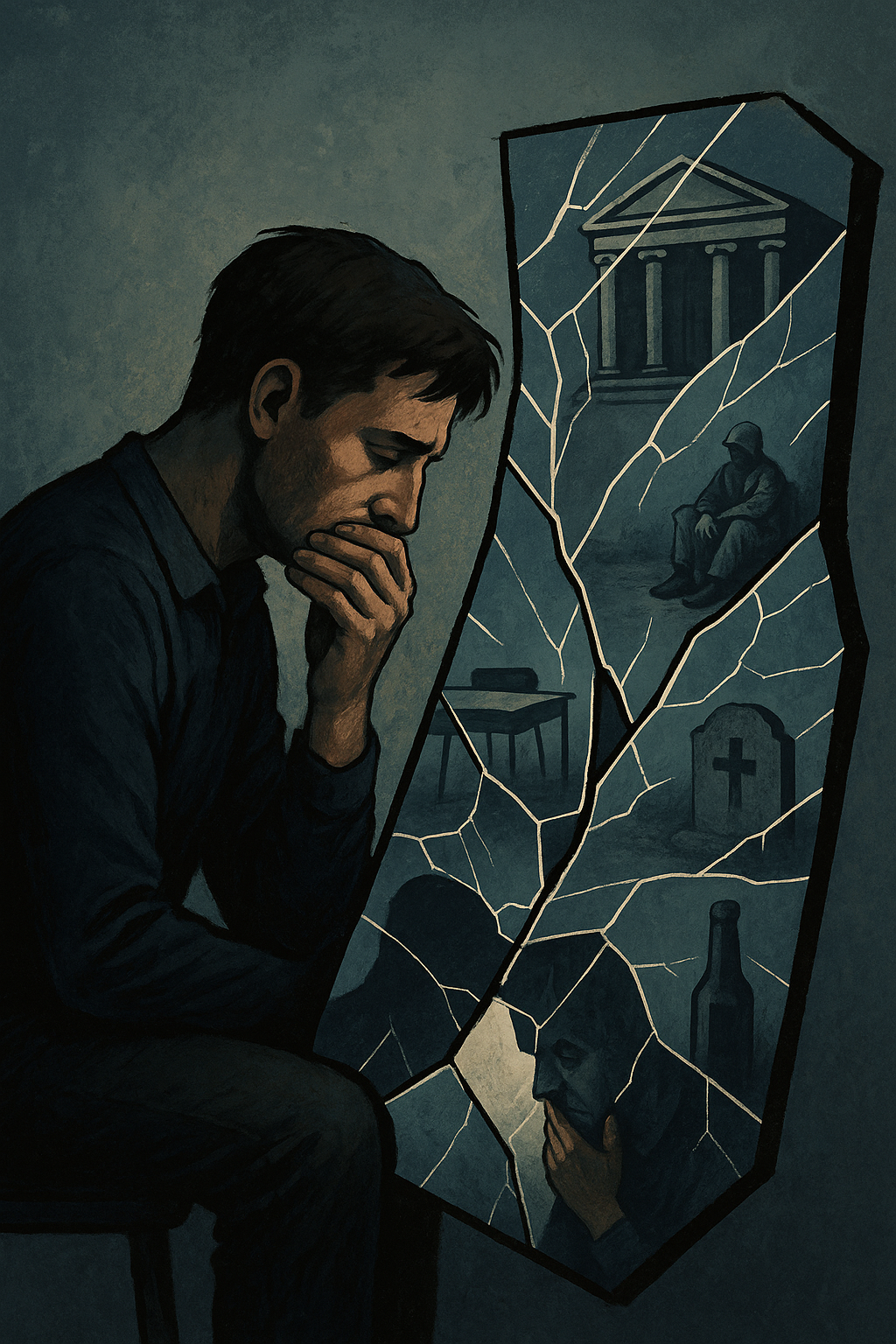
The main reasons the boys were referred to me, a psychotherapist, were: (a) a diagnosis of ADHD with a strapline that nurture had been strongly implicated in causation, (b) self-harm where the referrer had sensed a vaguely seen family issue as part of the causation, and (c) predatory sexual behaviour recognised as similarly reactive. I discovered that the absence of the father was implicated throughout each of these types of referral.
The father’s role in so-called conventional families is to support the mother by helping her calibrate her approach to the baby, and throughout infancy and childhood. It is also to be a different parent to the mother, so that the baby/child recognises difference. This recognition is the beginning of learning that carries on through all situations in life. My case notes revealed that the absence of the father had allowed for an overly close relationship between mother and son. Further, nearly all the children I saw could be said to be under-achieving at school because of a disinterest, through failure to recognise, an inability to learn. Experiencing difference in early infancy acts like a blueprint for apprehending new phenomena through life. By definition, new situations bring difference because they are new and different. Similarly, so too does new information like that constantly available at school. An early appreciation of difference is therefore a strength factor for learning in life and the classroom.
I want to spend a few moments outlining the absent father’s role in the three main referral types mentioned above.
ADHD
The psycho-social and emotional problems of children diagnosed with ADHD are discussed by various authors, for example, regarding how such children find relationships with family, friends and peers very difficult because they appear to find self-regulation problematic. There may be a lack of regulatory control that children usually have over their own minds, emphasising their difficulties with their executive functioning in the classroom. They cannot calibrate themselves in relation to the tasks they are required to perform.
Calibration and regulation is an essential part of the father’s role. Working individually with the mothers and the boys I was able to help them begin to recognise, and then change, their relationship. Speaking for nearly all such cases, one boy said “I can see now that being in class felt so claustrophobic. It was my only space away from Mum and I filled it up with the feeling of needing to be free of her. I couldn’t concentrate. I couldn’t organise myself. I was disruptive to others.”
Self-Harm
The need for escape implied in the previous quotation featured in all three referral types. Self-harm is usually seen by mental health professionals as a cry to release feelings that cannot be expressed verbally or through other means. This is as true of those who cut themselves as it is for those who poison themselves, often through overdoses.
When there is only the mother to confide in, and if and when this relationship is felt to be the cause of the feelings that become unbearable to the young person, then self-harm can provide an escape route for feelings. My work with one young boy ended with him recognising that I had provided a mental space away from his relationship with his mother. He memorably told me – “I realise now that I needed Dad to have been at home giving me a different person, like you have, to feel things with instead of Mum and all her issues.”
Predatory Sexual Behaviour
In no way am I reducing the seriousness of predatory behaviour for the perpetrator, and certainly not for the victim, when I say that the mother with issues played a very large part in the actions of the boys I saw. Whilst some fathers are violent and eventually leave (or are required by law to leave) the family home, it is also the case that some mothers push out non-violent partners because they do not fit with the historical script of these mothers.
Many mothers I saw had very serious issues with men. Some had been abused by their own fathers or grandfathers. Having sons presented them with a problem. How were they to live with a male in their house once they had expelled the boy’s father, but then lived with their memories of being abused by their own fathers? Some mothers pulled their sons close to them, saying that they were their pride and joy whilst, in the next breath, saying they were just like (whoever had abused them). The claustrophobia released by self-harm for other boys was, for these boys, only released by behaving in the intrusive way that these mothers had been at the receiving end of with their own fathers. So disturbing was the relationship with their mothers, so non-existent were the opportunities to find another escape route, that these boys repeated the offences already a feature of their families.
So, in brief, the absence of the father can have profound consequences on both mother and son. There are a great many young boys and, without doubt, young girls with absent fathers who would benefit from an approach to their mental health that takes into account his role and the consequences of his absence.
This article was first published on the Male Psychology Network website in 2018
Scroll down to join the discussion
Disclaimer: This article is for information purposes only and is not a substitute for therapy, legal advice, or other professional opinion. Never disregard such advice because of this article or anything else you have read from the Centre for Male Psychology. The views expressed here do not necessarily reflect those of, or are endorsed by, The Centre for Male Psychology, and we cannot be held responsible for these views. Read our full disclaimer here.
Like our articles?
Click here to subscribe to our FREE newsletter and be first
to hear about news, events, and publications.







When a male is in a power imbalance, at least two masculine instincts are disempowered…

…people – men and women alike – respond less positively to male-favouring sex differences than they do to female-favouring sex differences.
hyper-masculine gender norms are typically embedded within military institutions, and while adherence to these norms can contribute to combat and military success, they conversely make clinical work challenging
Men might benefit greatly from a government strategy aimed at improving their health. Here are suggestions from the Centre for Male Psychology on how that might be done. This article ends with some comments on potential pitfalls in the process of putting this strategy in place.




…people – men and women alike – respond less positively to male-favouring sex differences than they do to female-favouring sex differences.


… many papers do not even bother to identify or justify the nationality of their samples…
Have you got something to say?
Check out our submissions page to find out how to write for us.
hyper-masculine gender norms are typically embedded within military institutions, and while adherence to these norms can contribute to combat and military success, they conversely make clinical work challenging
hyper-masculine gender norms are typically embedded within military institutions, and while adherence to these norms can contribute to combat and military success, they conversely make clinical work challenging
hyper-masculine gender norms are typically embedded within military institutions, and while adherence to these norms can contribute to combat and military success, they conversely make clinical work challenging

hyper-masculine gender norms are typically embedded within military institutions, and while adherence to these norms can contribute to combat and military success, they conversely make clinical work challenging

hyper-masculine gender norms are typically embedded within military institutions, and while adherence to these norms can contribute to combat and military success, they conversely make clinical work challenging

Much of our attitudes, theorizing and public debate around men and masculinity is influenced by high profile feminist and Gender Studies scholars in academia. But what is the scientific quality of publications from these scholars?

Some people blame drill music – a form of rap - for the rising murder rate in London. Drill is known for aggressive lyrics about gang violence, but rather than seeing this as a valuable way for young men to express their feelings, some people want to ban it.

To survive… cultures have to use men and women effectively and … in fact, most cultures have used men and women in different ways… what our culture does is [grant] greater status to men and greater protection to women

hyper-masculine gender norms are typically embedded within military institutions, and while adherence to these norms can contribute to combat and military success, they conversely make clinical work challenging
There are around 300,000 veterans living with hearing loss in the UK, according to The Royal British Legion. In addition to being at a greater risk of PTSD, depression, and anxiety, many vets are also battling psychological distress from hearing problems.

The book begins with a description of her therapeutic approach, and an illustration of how to understand and work with the rage often seen in male CSA clients.

I felt in my dealings with some police officers, as though I were treated firstly as a man (assumed to be a perpetrator), but they’d overlooked risks associated with my impairment. Example: How can you dodge a missile you don’t see coming?

The Panorama programme on domestic violence failed to adequately highlight two important issues: male victims and female perpetrators.

your photograph, name and address, might appear in the local and national press and on TV, insinuating what an evil monster you are

…an attack upon masculinity is an attack upon one’s sense of self, of identity. …What, then, is the right psychological defence against such an attack?

The male has been designed to “look”, not only at the female, but to “look out” for prey, for danger, and for ways to protect his family unit.

If his child is allowed to live, this man must be available, for the rest of his life, to love and provide for his child… If, on the other hand, it is decided that his child is to be destroyed, he should be able to go about his life as if nothing has happened
Socialising is a basic human need. The opposite – social isolation – is one of the worst forms of torture. Some people look down on the local pub as a place for undesirable riff raff, but that narrow viewpoint misses entirely the community value of the pub

Male psychology is a recent development in academia. Unlike gender studies, feminism, and men’s studies, male psychology takes the view that we can gain more by recognising and harnessing the positive aspects of masculinity than we can by taking a relentlessly negative approach to men.

.
people are more aware of the fact men can be victims of this type of violence, but this often isn’t translated into policy, practice or indeed provision of resources