
Sexist hate starts with people, not just men: A response to EE’s recent campaign

In July, mobile network operator EE launched a campaign, consisting of number of adverts, videos and posters, aimed at tackling sexist hate ahead of a women’s football tournament, the EUFA Women’s Euro 2022. These resources included the following messages:
“Sexist hate starts with men so it can end with men”
“But sexist hate… it’s not her problem… it’s ours”
“Sexist hate stops with men”
“She’s not the one sending death threats”
With wording such as this you’d be forgiven for thinking the campaign was less about tackling online sexist hate, and more about demonising men.
EE representatives have responded to criticism by saying “When it comes to online sexist hate, we want to turn men from bystanders to upstanders,” and “Sexist hate isn’t something women should have to tackle. We aren’t saying all men are to blame, but we are asking all men to step up.”
EE justifies this view by referring to a recent YouGov survey they commissioned, finding that 52% of the UK public do not feel the internet is a safe space for women, and 60% believing that not enough is being done to tackle online and offline misogyny. Furthermore 63% of UK males, and 70% of women, feel men are more responsible than women for misogynistic behaviour online.
“The EE campaign seems to create the impression that only men can perpetrate sexism and that only women can experience it, but this, however, is quite simply not the case.”
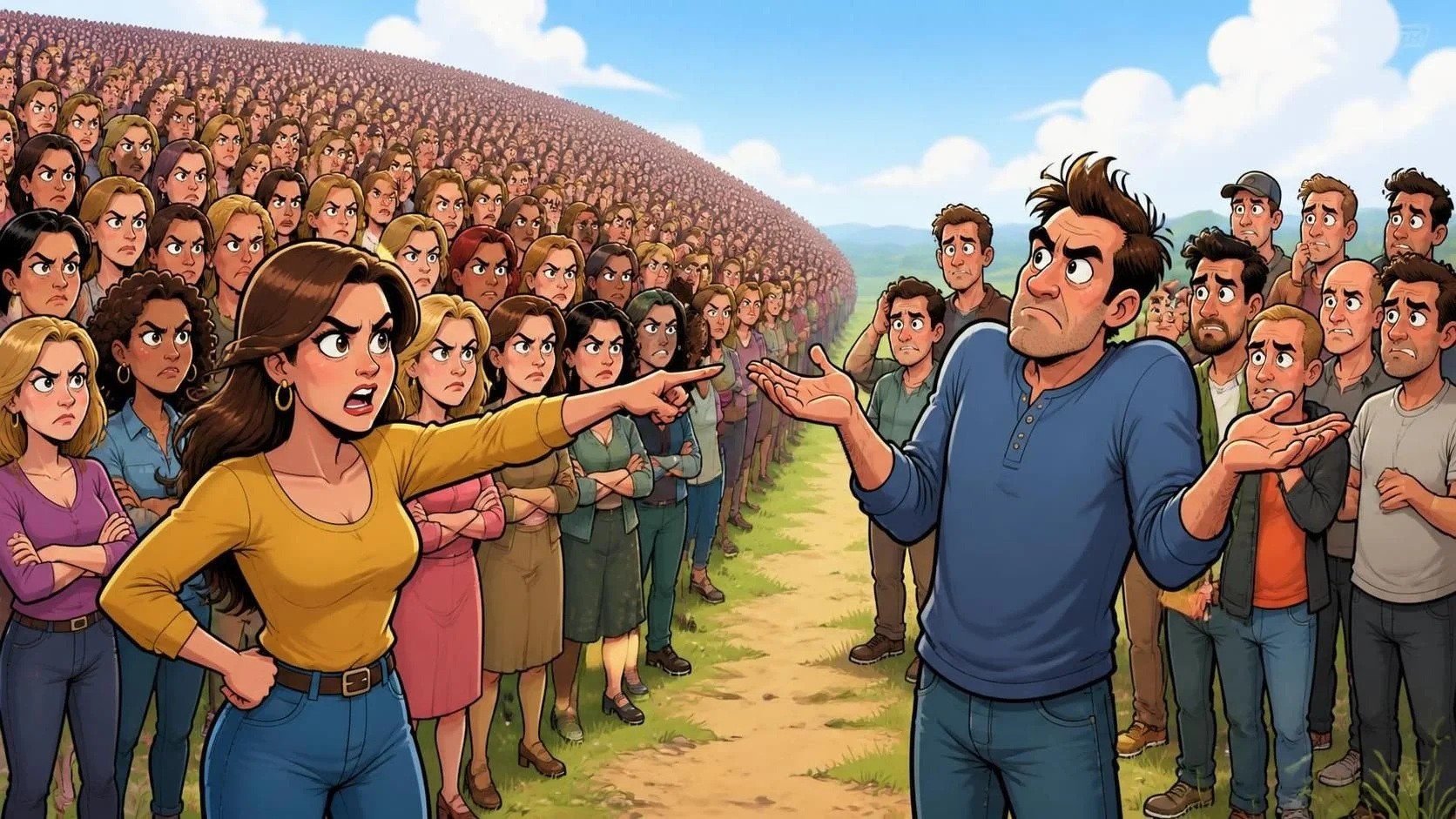
Do these findings justify the campaigns? The answer has to be a resounding: NO. Should we negatively judge an entire demographic because of the harm a minority of them do? That would be unacceptable for any other demographic, yet somehow is deemed acceptable for men.
Whilst the YouGov survey states that 63% of UK males feel men are more responsible than women for misogynistic behaviour online, their feelings are not evidence that the majority of men are misogynistic. It is also worth noting that despite many requests to EE, the full YouGov survey findings have not as of yet been made public.
The EE campaign seems to create the impression that only men can perpetrate sexism and that only women can experience it, but this, however, is quite simply not the case. In response to the EE’s campaign, many people cited a study from 2016 showing that half of misogynistic tweets came from women. Also in 2016, Digital Awareness UK stated that “recent studies show girls are twice as likely than boys to be to the victims of cyber-bullying - but they are also twice as likely to be the bullies themselves”. The tragic suicide of 15-year-old Phoebe Prince in the US in 2010 was linked to a three-month campaign of emotional and physical bullying on the part of nine of her peers, seven of whom were girls. In the UK in 2021 model Sasha Attwood disclosed how she was sent 200 death threats a day during Euro 2020, “many of them from teenage girls”. Workplace Bullying Institute found that it is very common for women to bully other women.
Other research shows that the ‘men are perpetrators and women are victims’ stereotype does not fit the reality of online abuse and sexploitation. In Sweden, one study found that men were exposed to cyberbullying to a higher degree than women. Studies in the USA, Norway and Australia have found that men are more likely than women to be victims of online harassment.
Although it can be difficult to identify the sex of perpetrators of cyberbullying, there is evidence that both genders are more likely to experience cyberbullying from the opposite gender. In addition to pejorative terms such as “mansplaining” and “manspreading”, the phrase ‘Kill All Men’ remains on Twitter and TikTok, much more commonly than ‘Kill All Women’.
“Good men don’t need to be told and bad men won’t listen.”
Some men have been criticised for saying “Not all men” engage in online sexism, but when men in general are targeted with adverts that berate them for being either sexists or bystanders, then “Not all men” is a perfectly reasonable response. However, perhaps because of social cognitions around gender, we tend to focus more on a person’s gender when it is a man doing something wrong than when it is a woman doing something wrong.
Ideas like ‘a woman needs a man like a fish needs a bicycle’ are now so much a part of our culture that appeals for male protectors may well fall on jaded ears. Men face a double bind here: if they do not intervene when a sexist comment is made towards a woman, they are bystanders who don’t do enough, but if they do intervene, they may be called mansplaining misogynists who are patronising strong independent women who can look after themselves. For many men, helping women looks like a lose / lose situation.
The message from EE based on how 63% of UK males feel (or to be more specific, how approximately 2783 of males in the UK survey said they felt), seems to suggest that online sexism is a problem created by men, so it’s a problem that can be solved by men… but solved by which men? By saying “men” they are targeting men in general. Does a person’s gender make them responsible for the behaviour of someone else simply because they share the same gender? As Joe Hildebrand stated: “Good men don’t need to be told and bad men won’t listen.”
So, with that in mind who are EE targeting? All those men who are allegedly bystanders? When I look around I don’t see bystanders, I see men running to women’s aid when they are being threatened; I see men intervening when they think women are being sexually harassed; I see men fighting off assailants attempting to sexually assault school girls; I see men sustaining injury after stepping in to save women from abuse, and that’s before we even start to talk about the men, some of whom tragically die, risking their lives running towards danger attempting to save the lives of other people in need. It’s hard to take the suggestion that men in general are bystanders when there are countless examples that suggest anything but.
It is worth noting that the Advertising Standards Authority (ASA, 2022) states that ads ‘must not include gender stereotypes that are likely to cause harm, or serious or widespread offence’. It is hard to see how the EE advert is not playing up to the stereotype of ‘woman as victim’ and ‘man as perpetrator’ when it states that “Sexist hate starts with men so it can end with men.”
It doesn’t seem likely that EE’s message will end online sexism, but because it aligns with the fashionably negative view of men, many people won’t object to it’s portrayal of men. In a more egalitarian world, businesses like EE would take a step back and think about how they might actually help to reduce sexist bullying, rather than fanning the flames of distrust between men and women.
Scroll down to join the discussion
Disclaimer: This article is for information purposes only and is not a substitute for therapy, legal advice, or other professional opinion. Never disregard such advice because of this article or anything else you have read from the Centre for Male Psychology. The views expressed here do not necessarily reflect those of, or are endorsed by, The Centre for Male Psychology, and we cannot be held responsible for these views. Read our full disclaimer here.
Like our articles?
Click here to subscribe to our FREE newsletter and be first
to hear about news, events, and publications.





When a male is in a power imbalance, at least two masculine instincts are disempowered…

…people – men and women alike – respond less positively to male-favouring sex differences than they do to female-favouring sex differences.
hyper-masculine gender norms are typically embedded within military institutions, and while adherence to these norms can contribute to combat and military success, they conversely make clinical work challenging
Men might benefit greatly from a government strategy aimed at improving their health. Here are suggestions from the Centre for Male Psychology on how that might be done. This article ends with some comments on potential pitfalls in the process of putting this strategy in place.



…people – men and women alike – respond less positively to male-favouring sex differences than they do to female-favouring sex differences.

… many papers do not even bother to identify or justify the nationality of their samples…
hyper-masculine gender norms are typically embedded within military institutions, and while adherence to these norms can contribute to combat and military success, they conversely make clinical work challenging

Have you got something to say?
Check out our submissions page to find out how to write for us.
hyper-masculine gender norms are typically embedded within military institutions, and while adherence to these norms can contribute to combat and military success, they conversely make clinical work challenging
hyper-masculine gender norms are typically embedded within military institutions, and while adherence to these norms can contribute to combat and military success, they conversely make clinical work challenging
hyper-masculine gender norms are typically embedded within military institutions, and while adherence to these norms can contribute to combat and military success, they conversely make clinical work challenging

hyper-masculine gender norms are typically embedded within military institutions, and while adherence to these norms can contribute to combat and military success, they conversely make clinical work challenging

hyper-masculine gender norms are typically embedded within military institutions, and while adherence to these norms can contribute to combat and military success, they conversely make clinical work challenging

Much of our attitudes, theorizing and public debate around men and masculinity is influenced by high profile feminist and Gender Studies scholars in academia. But what is the scientific quality of publications from these scholars?

Some people blame drill music – a form of rap - for the rising murder rate in London. Drill is known for aggressive lyrics about gang violence, but rather than seeing this as a valuable way for young men to express their feelings, some people want to ban it.

To survive… cultures have to use men and women effectively and … in fact, most cultures have used men and women in different ways… what our culture does is [grant] greater status to men and greater protection to women

hyper-masculine gender norms are typically embedded within military institutions, and while adherence to these norms can contribute to combat and military success, they conversely make clinical work challenging

There are around 300,000 veterans living with hearing loss in the UK, according to The Royal British Legion. In addition to being at a greater risk of PTSD, depression, and anxiety, many vets are also battling psychological distress from hearing problems.
The book begins with a description of her therapeutic approach, and an illustration of how to understand and work with the rage often seen in male CSA clients.

I felt in my dealings with some police officers, as though I were treated firstly as a man (assumed to be a perpetrator), but they’d overlooked risks associated with my impairment. Example: How can you dodge a missile you don’t see coming?

The Panorama programme on domestic violence failed to adequately highlight two important issues: male victims and female perpetrators.

your photograph, name and address, might appear in the local and national press and on TV, insinuating what an evil monster you are

…an attack upon masculinity is an attack upon one’s sense of self, of identity. …What, then, is the right psychological defence against such an attack?

The male has been designed to “look”, not only at the female, but to “look out” for prey, for danger, and for ways to protect his family unit.

If his child is allowed to live, this man must be available, for the rest of his life, to love and provide for his child… If, on the other hand, it is decided that his child is to be destroyed, he should be able to go about his life as if nothing has happened
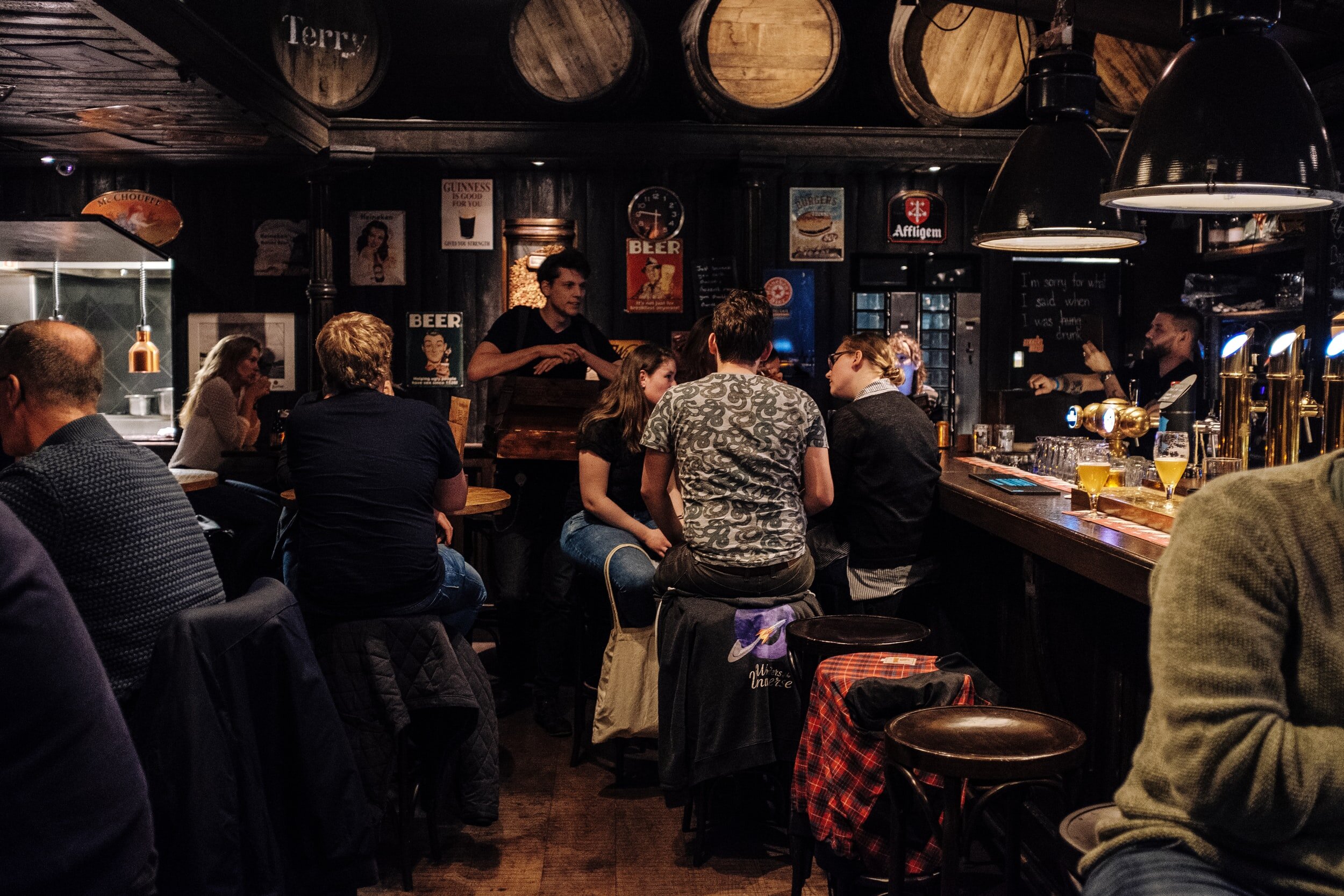
Socialising is a basic human need. The opposite – social isolation – is one of the worst forms of torture. Some people look down on the local pub as a place for undesirable riff raff, but that narrow viewpoint misses entirely the community value of the pub

Male psychology is a recent development in academia. Unlike gender studies, feminism, and men’s studies, male psychology takes the view that we can gain more by recognising and harnessing the positive aspects of masculinity than we can by taking a relentlessly negative approach to men.

.
 Phil Mitchell
Phil Mitchell is a senior accredited counsellor and psychotherapist and trainer and has over 19 years’ experience specialising in working with boys and men who have experienced recent and/or historic abuse in all its forms. You can follow Phil on Twitter, visit his website and find his book here on Amazon.