
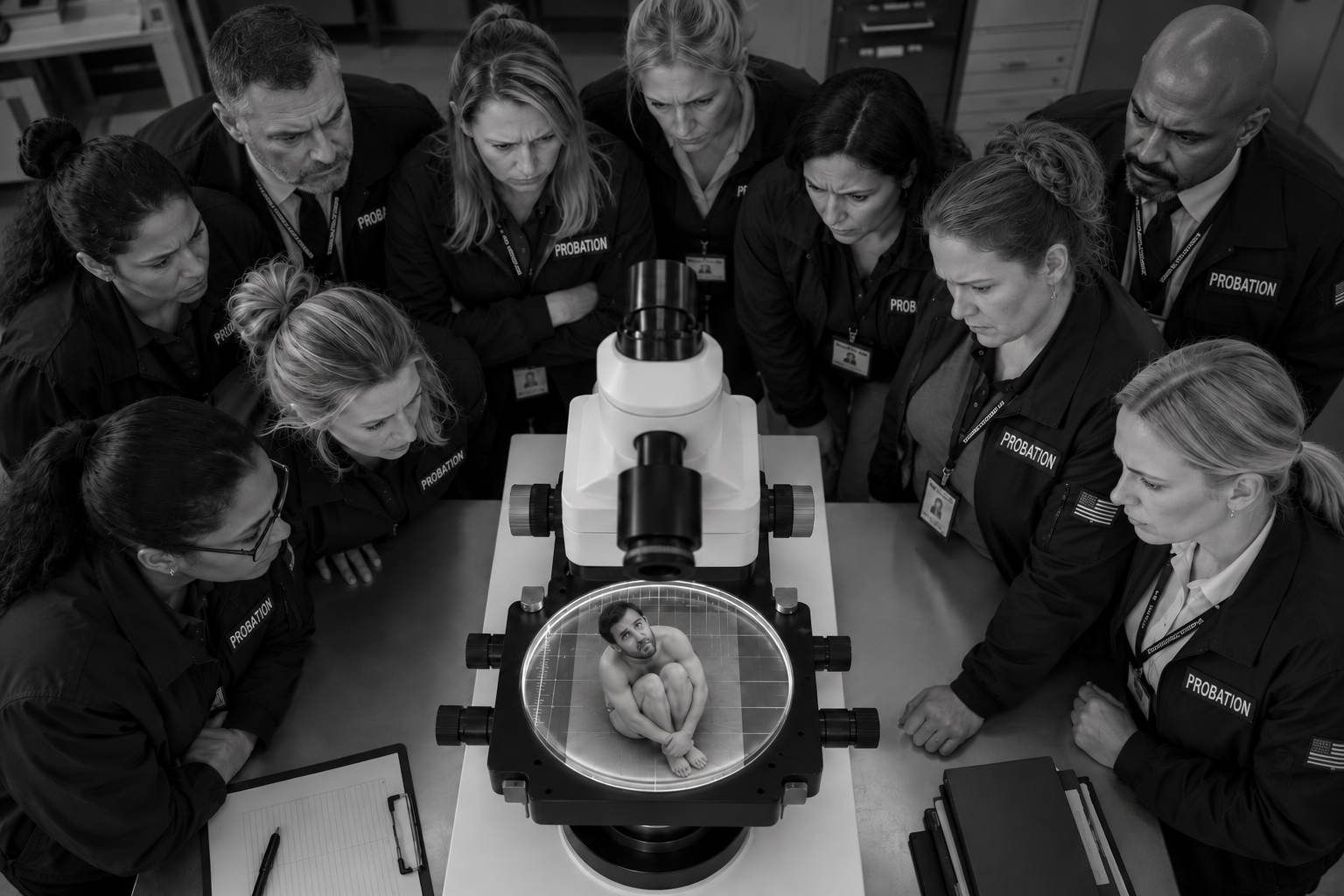
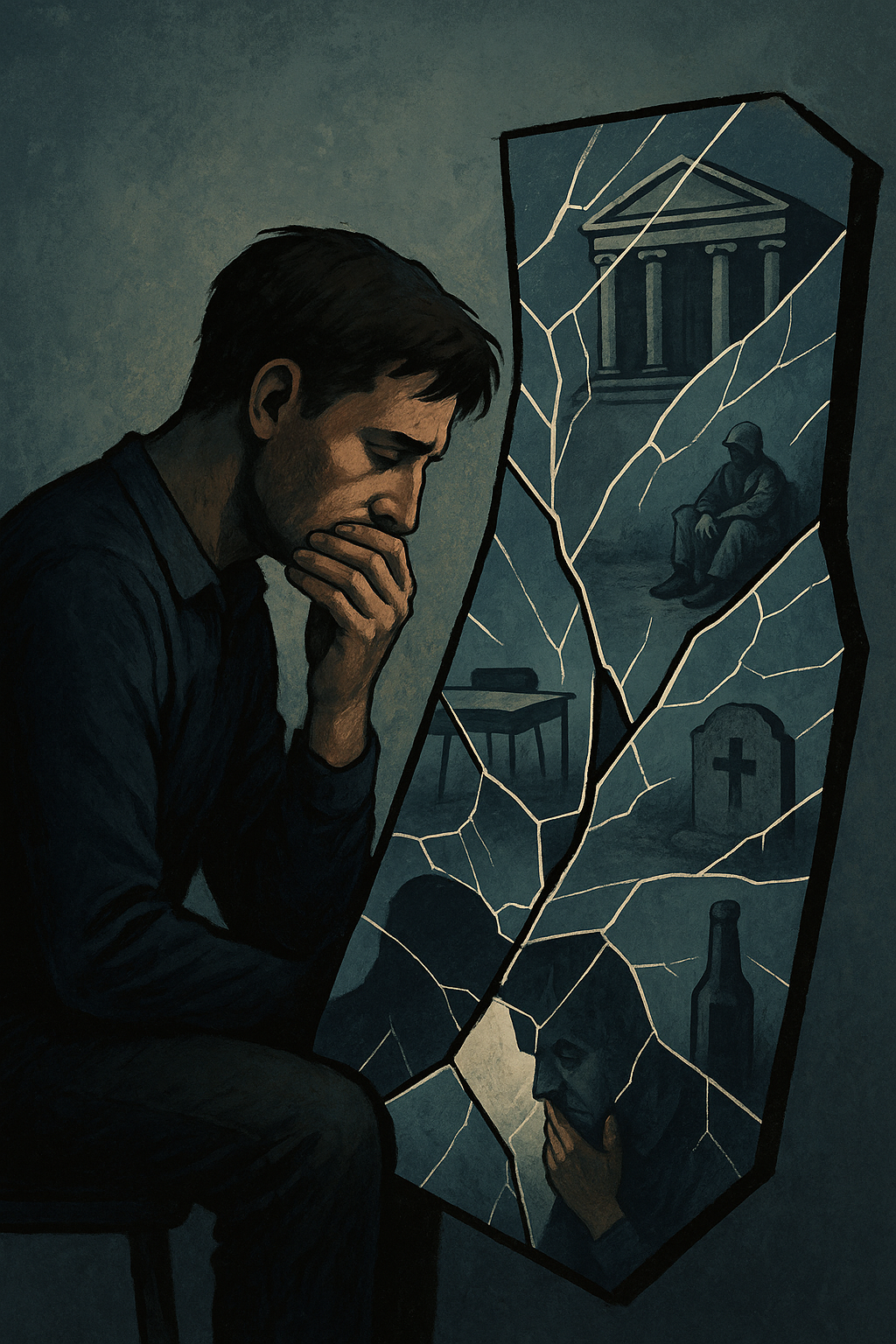
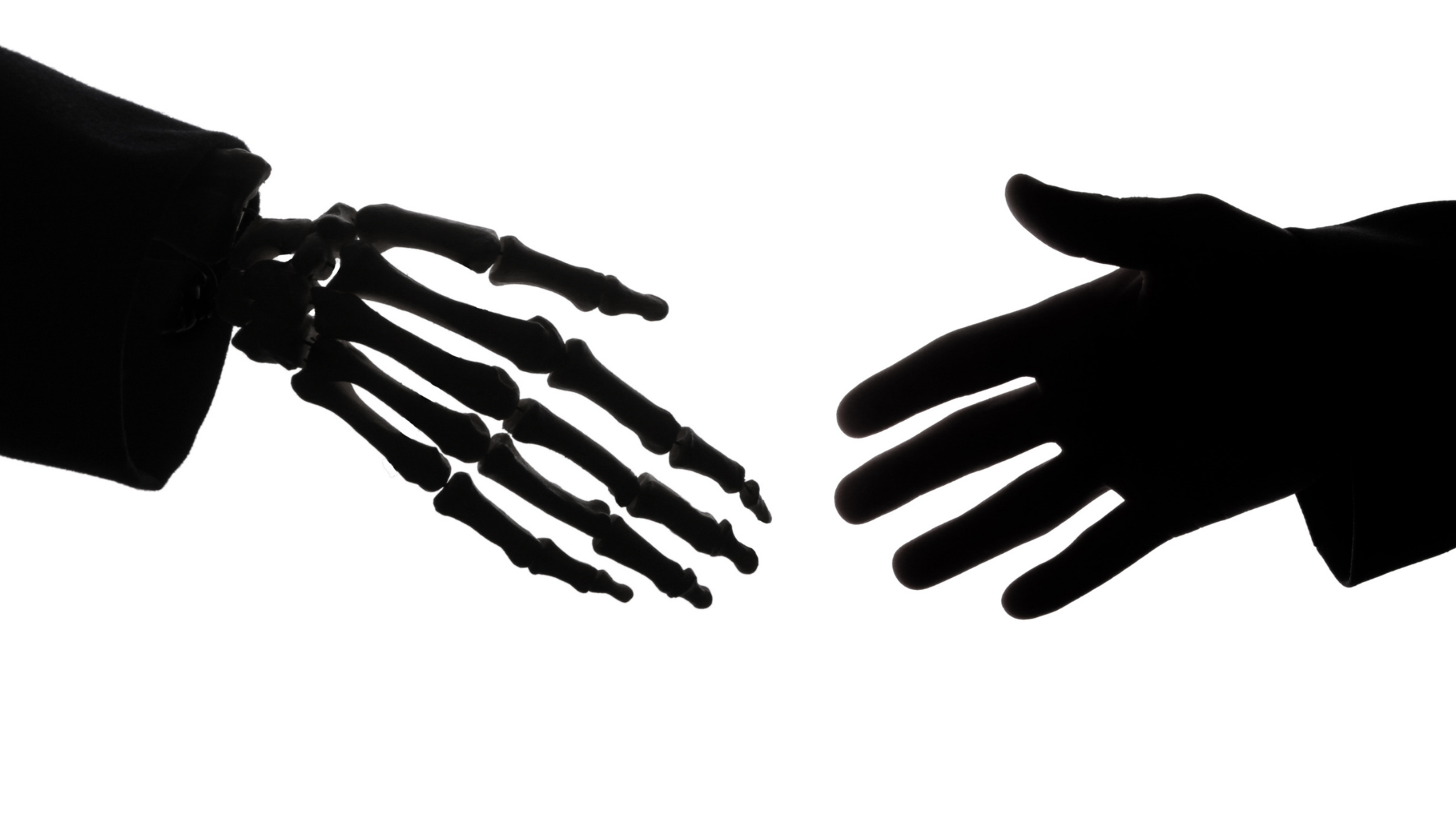
Image: On probation, under the microscope. Created using AI image generation (GPT Image 2) with prompts by John Barry.
I was on probation from 2018 until 2026. My main finding from this period is that the experience you have in this bizarre process is entirely dependent on your probation officer (henceforth PO). Sadly, I had ten different POs over these years. Almost entirely female dominated, the focus is entirely now on ‘risk’, a long way from the ‘hand to hold on release’ which probation was originally set up for over 100 years ago. This ‘risk’ is monitored by something called an OAsys report, which is updated after meetings.
Two of these ten POs were men, the other eight women, and the ‘churn’ was unbelievable to witness. In prison the POs generally monitor progress and how the prisoner is doing; on the out, they are there to make sure they keep on the straight and narrow. Many people on probation appreciate this oversight, recognising there is something in them that needs this kind of support; but there are many who don’t, who found themselves on probation for a number of reasons requiring neither ‘rehabilitation’ or scrutiny.
It is counter-intuitive for those maintaining innocence for POs to endlessly monitor their charges according to a risk criteria based on police or court records, when those records may have been fabricated or otherwise manipulated. I have a Subject Access Request (SAR) that deminstrates probation’s ignoring the stance and claims of my detailed points of maintaining innocence. This is the probation service ‘cleaning up’ after the individual has been put through the wringer of a broken justice system. When this purgatorial waste of time is put to the PO, their training is to say ‘we need to treat you based on the findings of the courts’ - which is the victory of Starmer-era bureaucracy over the humanistic founding principles of probation in Britain.
Many new PO staff are now being recruited on a ‘trauma informed’ basis, with government materials seemingly quite proud of this fact. What this in effect means is that people who consider themselves to have been victims of certain kinds of crime in the past, tried or untried, are getting themselves into positions of judicial power in order to either ‘protect society’ as they see it, or quietly carry out some institutional revenge. So while nine of my POs may have been objective, care-focussed professionals of the old school, I counted at least one or two who had a specific animus against the crime of which I had been convicted. In terms of rape allegations ‘trauma informed’ means reframing why a complainant may have stayed friends with the accused long after the alleged event, why she might be accused of lying or forgetting details, etc., with these questions answered as being ‘due to past trauma’. The past trauma of the accused is never considered.
This suspicion was confirmed when I ordered a Subject Access Request (SAR) on all notes about me and my case: it made for illuminating reading. While all the POs were reasonably polite to my face, any complaints I made about the system were minimised and even ridiculed, in notes going back years.
“Polygraphs are not permitted as evidence in Crown Court trials. Polygraphs are, however, allowed during probation.”
Early on in my time on probation in the community I surprised my (trauma informed?) PO by being offered a job as the editor of an industrial trade magazine. Having done editorial and copywriting before my conviction, I had used my time inside on Tor Times, the Dartmoor prison magazine, and got myself a Proofreading and Copywriting certificate from The Writer’s Bureau, following a course I had pursued in the evenings.
It’s difficult enough to get such a job without a criminal conviction, and my family and friends were very proud of this ‘progress’, but when I told my PO she said I would have to disclose about the convictions - even though they hadn’t asked or mentioned it at interview or afterwards. This disclosure is dictated by the probation officer on a case-by-case basis. When I did then disclose, the manager promptly withdrew the trial offer. What I knew then applies now: if people in positions of authority hear about a conviction straight away, they will respond in this recoiling way. If the person on probation is given four or five months to become ‘known’, a more open and honest conversation about the conviction can be had. Sadly, in my case this excellent opportunity was immediately extinguished by ‘trauma informed’ probation practices. This risk-aversion in employers requires education in the processes of wrongful convictions and miscarriages of justice, in order to right an imbalance against the falsely or spuriously convicted.
Just before this happened, in another early probation meeting I reported that I had been in contact with a well known justice reform campaigner, and had done some media interviews and podcasts about my own case. The next week I had two new, extra conditions added to my licence - not to be in contact with people with certain criminal convictions (how would I be able to know that?), and not to talk in the media about my case. The reason given was that complaints had been received, but I could find no evidence of these complaints in the SAR (Subject Access Request).
A year or so into my time on probation in the community I made a new friend via social media, who came to visit me once, staying overnight. She was splitting up with her partner at the time, and he accessed her phone while she was sleeping after she got home, investigated who I was, and reported it to probation. Without being asked, I was sent a ‘Notice Not To Recall’ (to prison) letter, and given another licence condition requiring me to take polygraph tests, even though I had disclosed to the friend as a matter of course (and we weren’t ‘romantic’ anyway).
I complained about this, and was then in a months-long struggle session with probation about the legality of polygraph tests - which don’t measure ‘lies’, just emotional responses. Polygraphs are not permitted as evidence in Crown Court trials. Polygraphs are, however, allowed during probation in order to try to locate deception. This is totally counter-intuitive, and I challenged it with the help of Luke Gittos’ Freedom Law Clinic at the time. Probation eventually dropped the requirement. Polygraph use is not without risk, for example, while suicide rarely has one direct cause, after the suicide of a Jeremy Kyle Show guest, many commentators maintain his suicide was related to his responses to a polygraph test asking about his private relationships.
Being on probation in the community is a good incentive for people to behave well while inside, and despite an intense start, other POs were excellent, professional, understanding etc, and my time eventually came to a more peaceful, less scrutinised end. However, as a result of these sanity-testing experiences, I am determined to push that people consistently maintaining innocence be released with NO licence conditions, only having them added if, after proper investigations, there can be proved there is a real ‘risk’ factor. Because as it stands, while there are good people within probation, it suffers from a ‘victory of bureaucracy’ over humanity. While people like Lord (James) Timpson may say ‘all cases are judged on an individual basis’, probation is very much failing to ‘hold the hand’ of the released prisoner.
Licence conditions are unfair to someone who is innocent, but so is the whole process of investigation, trial, prison. According to SAFARI - Supporting All Falsely Accused with Reference Information - many of those contacting them are maintaining innocence, with strong reasons for doing so. The whole process is a disaster for an innocent man, even after he is released from prison.
~~~~~~~~~~~~~~~~~~
If you have been falsely accused, you can contact The False Allegations Support Organisation (FASO) helpline number is 03335 779 377, and is for those experiencing false allegations of various types. Their email is support@false-allegations.org.uk
or visit their website http://www.false-allegations.org.uk
Scroll down to the comments section to join the discussion
Disclaimer: This article is for information purposes only and is not a substitute for therapy, legal advice, or other professional opinion. Never disregard such advice because of this article or anything else you have read from the Centre for Male Psychology. The views expressed here do not necessarily reflect those of, or are endorsed by, The Centre for Male Psychology, and we cannot be held responsible for these views. Read our full disclaimer here.
Like our articles?
Click here to subscribe to our FREE newsletter and be first
to hear about news, events, and publications.




















Have you got something to say?
Check out our submissions page to find out how to write for us.















.