

Essential reading in the psychology of men and boys

Book: Perspectives in Male Psychology: An Introduction (BPS Textbooks in Psychology)
Author: Louise Liddon and John Barry
A Review by Rick Bradford
This is an important book. Do not even think of not buying it.
It is important, not only because it provides a much needed ‘primer’ on male psychology, but because it presents an opportunity to begin a new era in psychology. There is no point in dissembling, and the book itself does not do so. Psychology is intrinsically personal, so when the personal was made political, so was psychology. The ethos the authors promote is that science, as an empirically grounded discipline, is not politics, and so male psychology, if it is to be a science, is not gender politics. That the book will be controversial is inevitable, but the reason does not lie in the book itself but in the prevailing academic environment. The authors are to be congratulated on facing this prospect bravely.
The book is male psychology 101 – or it would be if undergraduate courses on male psychology were the norm. They are not. In the UK there is currently only one such course, at Sunderland under Dr Rebecca Owens. But Perspectives provides ideal material for similar introductory courses to be included within psychology degrees.
The book is intended to be the first in a series, the remainder concentrating on more specialist areas. Perspectives, however, is extremely broad in scope. After an elucidation of the aims and orientation of male psychology, the scene is set with a brief discussion on the hazards of researching sex differences. The bulk of the book systematically addresses a wide range of issues in terms of their impact on male psychology – or the impact of male psychology on them – including child development, education, sport, work, criminality, the armed forces, and physical and mental health. These are followed by a chapter on masculinity (thankfully expressed in the singular not the plural).
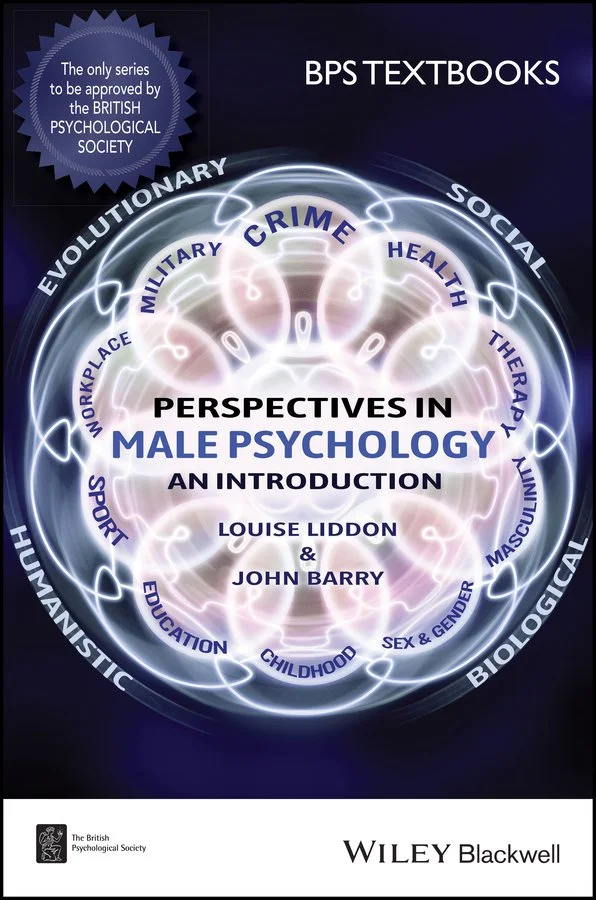
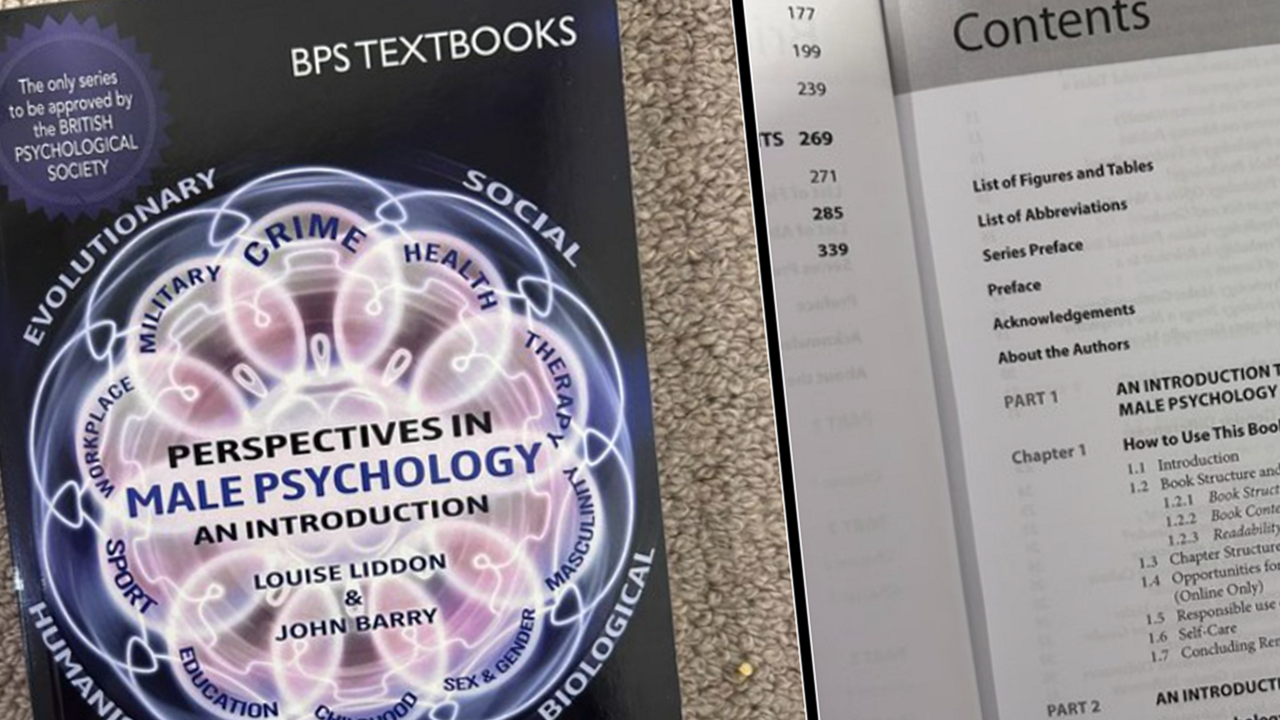
The book is well structured, being divided into relatively short sections and so is easy to assimilate rapidly. The use of text boxes to highlight certain issues is also an aid to accessibility. Similarly, technical terms are generally defined where they arise. Throughout, at key points, the authors refer forwards to the final chapter which draws out some good advice and common themes distilled from the topics overall. In short, the book is ideal as an introduction at a level undergraduates and the general public will find easy to read.
I was particularly pleased to see a discussion of the impact on boys of growing up in a culture of pervasive negative portrayal of masculinity. That the same sources of opinion who are so sensitive to the harms of gender stereotyping in one context have themselves created and promoted negative stereotyping in another context is one of the reasons why this book is so badly needed.
Perhaps as a hallmark of a successful book, one is stimulated to think of additional topics which might have been included. However, virtually every sub-section could be expanded to the length of a major academic publication, with the addition of fifty references where just one or two are used. But to burden individual topics with too much detail would defeat the purpose of the book which, in the approach actually taken, it successfully achieves. Hence I struggle to have grounds for criticism, which is an uncomfortable position for a reviewer. In that spirit I offer a few observations, none of which greatly detract from the book.
In the context of education, the book mentions assessment bias against boys, citing evidence from Israel and France. Actually, there is similar evidence in the UK, though I doubt it has been published in the academic journals. That fact is, in itself, a concern.
In the chapter on criminality, one causal factor which is not discussed is IQ. Our prisons are not packed with people of high intelligence. In an increasingly technology-driven world, gainful employment has become increasingly difficult for the less intellectually gifted. And men have a larger IQ variance than women, so there are more men with especially low IQ. The preponderance in prisons of men with a history of exclusion from school is undoubtedly related. Add to this the importance to men of being providers, and the frustration of being unable to do so by the legal means of gaining employment is likely (one surmises) to encourage criminality.
It was good to see veterans discussed. But I would point out that is not only mental ill-health issues directly from which they commonly suffer. Important though PTSD is, it can be addressed if the man seeks help. What proves more intractable in practice is veterans’ contact with their children, because partner separation is disproportionately common amongst veterans – perhaps as a result of their mental state. So one problem creates another.
Perhaps the most important issue that the book mentions is that, in the context of gender, women tend to have in-group preference whereas men have stronger out-group than in-group preference. Arguably this is a cause of much misunderstanding. It is an especially important observation whose implications for our changing society have not yet been grasped. Women dominate as lecturers in tertiary education as regards “people” oriented subjects, which are also strongly dominated by women students. Consequently, women dominate as professionals in areas such as teaching, mental and physical health, social work and domestic abuse services, the latter two being of central importance after parental separation and hence impacting fathers as much as mothers. The implications of skewed gender-group preference should be of concern, but currently is not precisely because it is perceived as “right and proper”.
That the book encourages thoughts like those above is a measure of its success, for surely that is one of its key aims. The book is an excellent entry point to the literature across a very broad range of issues. But more importantly it provokes the reader into thinking more deeply about what lies behind the many phenomena involving male psychology whose treatment at present is either neglected or unconvincing. As such it will make an ideal undergraduate text in psychology as well as being suitable for a general audience.
Book: Perspectives in Male Psychology: An Introduction (BPS Textbooks in Psychology)
Author: Louise Liddon and John Barry
A Review by Rick Bradford
Scroll down to join the discussion
Disclaimer: This article is for information purposes only and is not a substitute for therapy, legal advice, or other professional opinion. Never disregard such advice because of this article or anything else you have read from the Centre for Male Psychology. The views expressed here do not necessarily reflect those of, or are endorsed by, The Centre for Male Psychology, and we cannot be held responsible for these views. Read our full disclaimer here.
Like our articles?
Click here to subscribe to our FREE newsletter and be first
to hear about news, events, and publications.









When a male is in a power imbalance, at least two masculine instincts are disempowered…


…people – men and women alike – respond less positively to male-favouring sex differences than they do to female-favouring sex differences.
hyper-masculine gender norms are typically embedded within military institutions, and while adherence to these norms can contribute to combat and military success, they conversely make clinical work challenging
Men might benefit greatly from a government strategy aimed at improving their health. Here are suggestions from the Centre for Male Psychology on how that might be done. This article ends with some comments on potential pitfalls in the process of putting this strategy in place.





…people – men and women alike – respond less positively to male-favouring sex differences than they do to female-favouring sex differences.



… many papers do not even bother to identify or justify the nationality of their samples…


hyper-masculine gender norms are typically embedded within military institutions, and while adherence to these norms can contribute to combat and military success, they conversely make clinical work challenging

Have you got something to say?
Check out our submissions page to find out how to write for us.
hyper-masculine gender norms are typically embedded within military institutions, and while adherence to these norms can contribute to combat and military success, they conversely make clinical work challenging

hyper-masculine gender norms are typically embedded within military institutions, and while adherence to these norms can contribute to combat and military success, they conversely make clinical work challenging
hyper-masculine gender norms are typically embedded within military institutions, and while adherence to these norms can contribute to combat and military success, they conversely make clinical work challenging

hyper-masculine gender norms are typically embedded within military institutions, and while adherence to these norms can contribute to combat and military success, they conversely make clinical work challenging

hyper-masculine gender norms are typically embedded within military institutions, and while adherence to these norms can contribute to combat and military success, they conversely make clinical work challenging

Much of our attitudes, theorizing and public debate around men and masculinity is influenced by high profile feminist and Gender Studies scholars in academia. But what is the scientific quality of publications from these scholars?

Some people blame drill music – a form of rap - for the rising murder rate in London. Drill is known for aggressive lyrics about gang violence, but rather than seeing this as a valuable way for young men to express their feelings, some people want to ban it.

To survive… cultures have to use men and women effectively and … in fact, most cultures have used men and women in different ways… what our culture does is [grant] greater status to men and greater protection to women

hyper-masculine gender norms are typically embedded within military institutions, and while adherence to these norms can contribute to combat and military success, they conversely make clinical work challenging

There are around 300,000 veterans living with hearing loss in the UK, according to The Royal British Legion. In addition to being at a greater risk of PTSD, depression, and anxiety, many vets are also battling psychological distress from hearing problems.

The book begins with a description of her therapeutic approach, and an illustration of how to understand and work with the rage often seen in male CSA clients.

I felt in my dealings with some police officers, as though I were treated firstly as a man (assumed to be a perpetrator), but they’d overlooked risks associated with my impairment. Example: How can you dodge a missile you don’t see coming?

The Panorama programme on domestic violence failed to adequately highlight two important issues: male victims and female perpetrators.

your photograph, name and address, might appear in the local and national press and on TV, insinuating what an evil monster you are

…an attack upon masculinity is an attack upon one’s sense of self, of identity. …What, then, is the right psychological defence against such an attack?

The male has been designed to “look”, not only at the female, but to “look out” for prey, for danger, and for ways to protect his family unit.

If his child is allowed to live, this man must be available, for the rest of his life, to love and provide for his child… If, on the other hand, it is decided that his child is to be destroyed, he should be able to go about his life as if nothing has happened

Socialising is a basic human need. The opposite – social isolation – is one of the worst forms of torture. Some people look down on the local pub as a place for undesirable riff raff, but that narrow viewpoint misses entirely the community value of the pub

Male psychology is a recent development in academia. Unlike gender studies, feminism, and men’s studies, male psychology takes the view that we can gain more by recognising and harnessing the positive aspects of masculinity than we can by taking a relentlessly negative approach to men.

.
 Rick Bradford
Rick Bradford is a semi-retired engineer and theoretical physicist. He is the author of the book The Empathy Gap under the pen name William Collins. He has been married since the dawn of time and has two sons in their mid-30s who show encouraging signs of being men.