
Midterm election in the US: can the techniques of marriage therapy save the nation from a messy divorce?
In 1840, John Stager, wrote a letter to a magazine with advice for people planning a steamer voyage, which included: “Never discuss religion or politics with those who hold opinions opposite to yours; they are subjects that heat in handling until they burn your fingers.” Nearly 200 years later, people who ignore his advice are still getting burned.
Here is some advice for you for 2022: buckle up, because the US midterm election is fast approaching. So whether you are on a steamer voyage or not, unless you are hunkered down in an online an echo chamber, it’s going to be very difficult for you to avoid discussions about politics with people who hold opinions opposite to yours. This applies in the UK too, where politics today is just as fractious, though our team colours - reds vs blues - are reversed, with our ‘Democrats’ (the Labour Party) in red instead of blue.
Top tip: if you are in the UK, you can usually get out of an awkward conversation by deflecting onto the topic of the weather, but for the next few weeks if you try talking about the weather, you risk being challenged about your views on climate change and asked to prove what specific action you are personally taking to save the planet.
So on Tuesday, November 8, the 2022 United States midterm elections (aka ‘the midterms’) will determine the landscape of the 118th US Congress. The kinds of topics you will be finding yourself screaming insanely at your friends and family about are: inflation, crime, unemployment, abortion, the economy, trans rights, racism, guns, Biden, Trump, Ukraine, and student debt cancellation. You will find other things to shout about too, especially if you use Twitter.
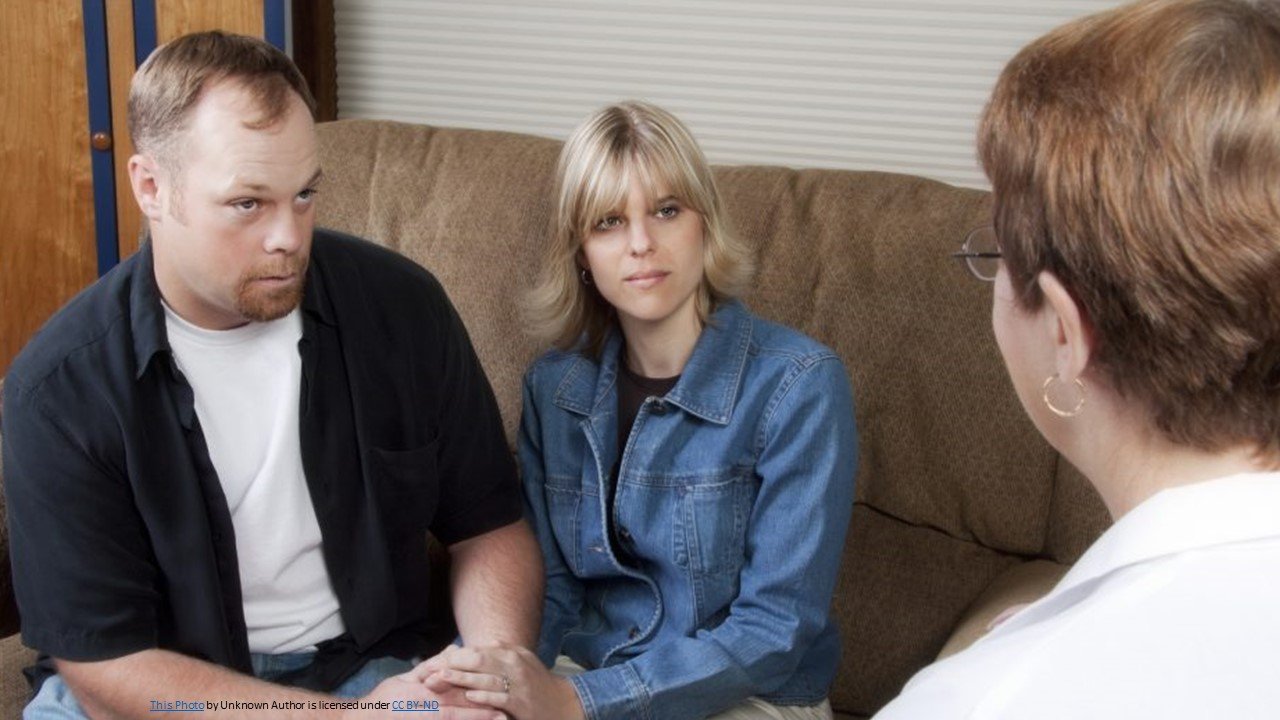
It is well known in social psychology that people tend to identify with opposing groups extraordinarily easily, so amidst all of the coming hysteria, it is good to know that there are people who aim to have a calming influence on us all. One example is US psychologist Professor William J Dougherty. He is an experienced marriage and family therapist, and an advocate of ‘citizen therapy’ i.e. a therapist who works groups of people within community settings, not just individuals or couples in a therapy room.
With his background in couples therapy and his interest in the community, Dougherty started to notice in the run up to the 2016 US election that many of the problems experienced in a marriage had correlates in the political tensions and hostilities driving divisions in communities.
This insight led him to start a project called Citizen Therapists for Democracy (now called Braver Angels) where he applied his marriage therapy skills to improving the relationship between Republicans and Democrats. This started immediately after the 2016 general election, with a weekend in Ohio with ten Hillary Clinton voters and ten Donald Trump voters. It was a weekend of dramatic moments, but one where people were eventually able to find – with the help of Dougherty and his two group facilitators – enough common ground to get beyond the stereotypes they had of each other, and to achieve depolarization.
“We tried divorce once (see The Civil War) and we are still fighting a custody battle for the American soul”.

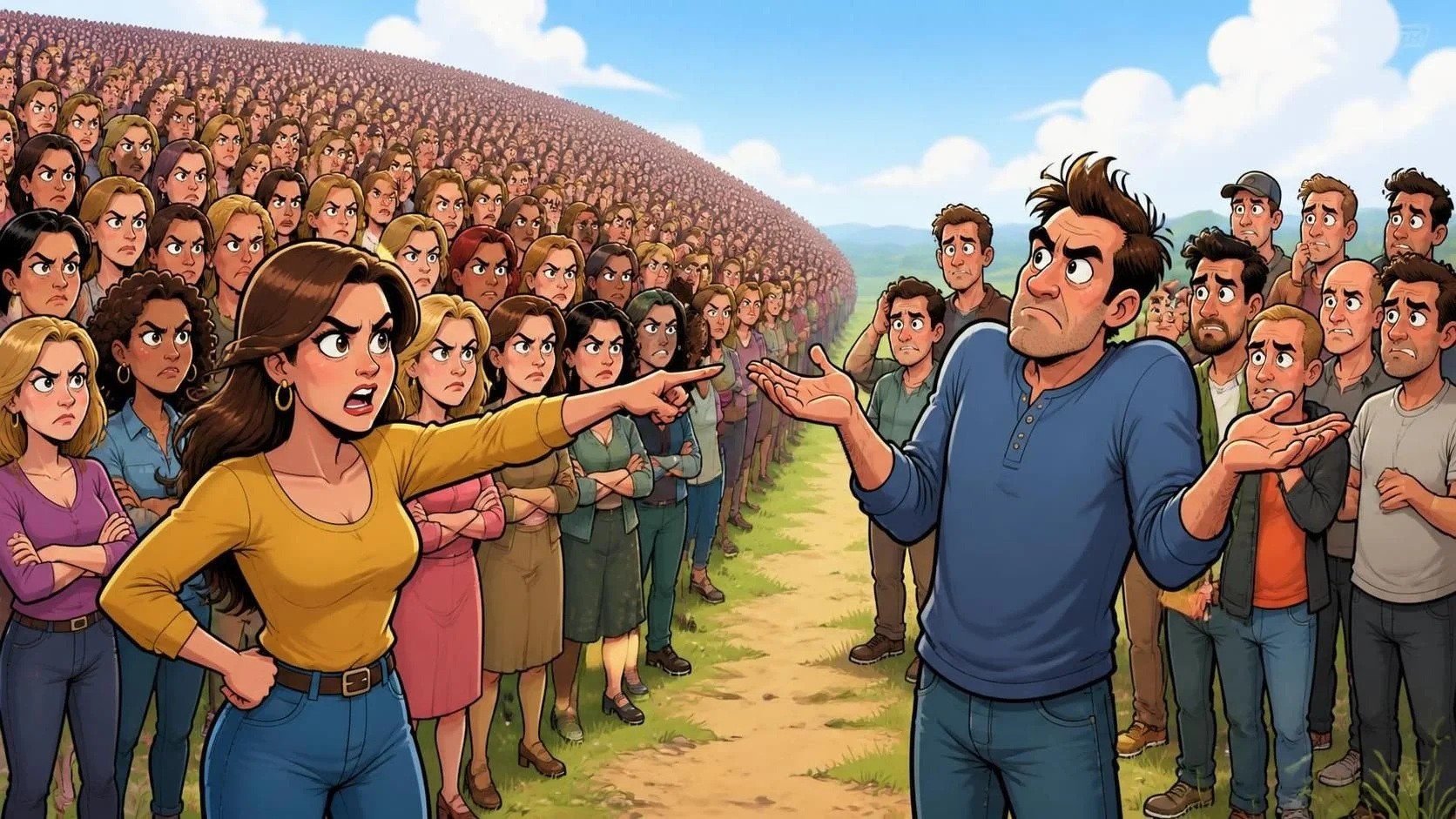
Dougherty’s aim is to gain some sort of reconciliation between the two halves of America, thus avoiding a very messy divorce. The comparison between community tensions and relationship breakdown is not trivial: “We tried divorce once (see The Civil War) and we are still fighting a custody battle for the American soul”.
Dougherty sees therapy and democracy as having the common elements of encouraging agency and efficacy. The difference with politics is that it is about collective agency, collective efficacy, problem solving, and developing other abilities and insights that help create a healthy society.
“the majority of people in psychology and the social sciences are left-leaning [which] could be an impediment to impartiality[…] To reduce this risk Braver Angels have a policy of ensuring that their leadership must always consist half of people who are […] right-leaning.”
It is well known that the majority of people in psychology and the social sciences are left-leaning, so it’s not a shock that Dougherty once wrote a manifesto called Citizen Therapists Against Trumpism, which attracted over 2,500 signatures. Clearly, having strong views on either side of the spectrum could be an impediment to impartiality, and be perceived by potential workshop attendees as a sign of being manipulated by ‘the other side’. To reduce this risk Braver Angels have a policy of ensuring that their leadership must always consist half of people who are left-leaning and half of people who are right-leaning.
Braver Angels continues to run workshops like the original one in 2016, as well as other workshops, such as ‘How to talk to family members who differ politically’. The organisation has grown rapidly, and now has hundreds of workshop moderators spread across most states of the US.
Dougherty has combined marriage therapy and social psychology, and come up with a formula to hear divided communities. Let’s hope that people like Dougherty can help us all move beyond the dilemma many are facing in the run up to the 2022 midterms: either having raging arguments about politics, or not having any discussions about politics at all. We need to get out of our silos and talk, and Dougherty’s method offers a credible way of doing this.
You can read more about William Dougherty’s work in his paper, published in 2020, called My Journey as a Citizen Therapist (available free here).
Scroll down to join the discussion
Disclaimer: This article is for information purposes only and is not a substitute for therapy, legal advice, or other professional opinion. Never disregard such advice because of this article or anything else you have read from the Centre for Male Psychology. The views expressed here do not necessarily reflect those of, or are endorsed by, The Centre for Male Psychology, and we cannot be held responsible for these views. Read our full disclaimer here.
Like our articles?
Click here to subscribe to our FREE newsletter and be first
to hear about news, events, and publications.






When a male is in a power imbalance, at least two masculine instincts are disempowered…

…people – men and women alike – respond less positively to male-favouring sex differences than they do to female-favouring sex differences.
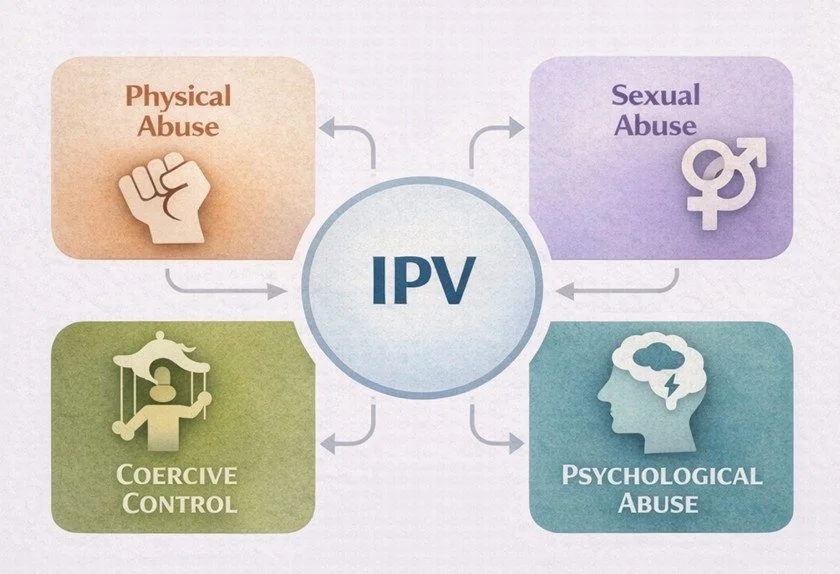
hyper-masculine gender norms are typically embedded within military institutions, and while adherence to these norms can contribute to combat and military success, they conversely make clinical work challenging
Men might benefit greatly from a government strategy aimed at improving their health. Here are suggestions from the Centre for Male Psychology on how that might be done. This article ends with some comments on potential pitfalls in the process of putting this strategy in place.



…people – men and women alike – respond less positively to male-favouring sex differences than they do to female-favouring sex differences.


… many papers do not even bother to identify or justify the nationality of their samples…

hyper-masculine gender norms are typically embedded within military institutions, and while adherence to these norms can contribute to combat and military success, they conversely make clinical work challenging

Have you got something to say?
Check out our submissions page to find out how to write for us.
…people – men and women alike – respond less positively to male-favouring sex differences than they do to female-favouring sex differences.
There is social power, there is structural power, and there is physical power. What women have in our society is the power of the state behind them, and men do not. Men only have that physical power, and most men don’t want to use it



Masculinity may be just the tonic (remedy) needed by society at a time when it has recently suffered so many fractures.

“The place that people feel least free to speak their minds are oftentimes university, which I found absolutely stunning.”

Peer reviewers seem to be more accepting of my research on physiological differences between men and women (e.g., muscle fatigability) and less accepting of my research on psychological differences.

Generally speaking men’s humour is a good predictor of relationship satisfaction, as long as the woman appreciates it. A lot of studies show that men try to impress women with humour.

I was left with no doubt that men were struggling in myriad ways with stress and psychological illness – yet it has always been the discourse of the ‘desperate housewife’ that has attracted the most publicity, both in medicine and popular culture

…many professionals seem to interpret the evidence “most convicted child sex offenders are men”, as “children are more at risk from their father than their mother.

…people – men and women alike – respond less positively to male-favouring sex differences than they do to female-favouring sex differences.
IMD is not recognized by the UN because many believe we live in a patriarchal world and that the focus of the UN should be on women and children.

I’ve become curious why people, including very smart people with Ph.Ds, tend to leap at moralistic conclusions, adhere to them and consider them “science” when they are no such thing.

…critical gerontology focuses on the political-economic approach and consequently had a limited perspective on women and men: economically the former were seen as deprived and men privileged. Men were therefore disregarded.

…There is a reason why men who speak up on these issues tend to be retired or unemployed.

People depart a man in trouble [but as] soon as a man's got someone to talk to he will pour his heart out.
people are more aware of the fact men can be victims of this type of violence, but this often isn’t translated into policy, practice or indeed provision of resources
The brutality of the person's offence is generally related to the brutality of what they've experienced during childhood.

There is social power, there is structural power, and there is physical power. What women have in our society is the power of the state behind them, and men do not. Men only have that physical power, and most men don’t want to use it

90% of men in prisons have come from generational family violence… So when they're violent - which is what they've learned - we then perpetuate the violence by putting them in prison.

“I feel very strongly that the pendulum has swung too far, as it always does, the swing from a very male dominated patriarchal society to a very, very female dominated society where men …”

…the feminist movement has done inestimable damage to the mental health of boys and men. Making boys second class at school, teaching them that males are bad by nature and that women have suffered at the hands of men inevitably leads to boys feeling unhappy about themselves and adopting the unruly, delinquent behaviour which is expected of them.

Some people blame drill music – a form of rap - for the rising murder rate in London. Drill is known for aggressive lyrics about gang violence, but rather than seeing this as a valuable way for young men to express their feelings, some people want to ban it.

Gender scholars and activists were aghast a few years ago at the depiction of a feminist, in a documentary movie called The Red Pill, who unexpectedly learned to empathise with men. In a rare interview, director and star of The Red Pill, Cassie Jaye, reflects upon the impact the movie has had on herself and others.
.
 John Barry
Dr John Barry is a chartered psychologist, researcher, clinical hypnotherapist and co-founder of the Male Psychology Network, BPS Male Psychology Section, and The Centre for Male Psychology (CMP). Also co-editor of the Palgrave Handbook of Male Psychology & Mental Health, co-author of the textbook Perspectives in Male Psychology: An Introduction (Wiley), and presenter on Centre for Male Psychology training courses.