What is the biggest challenge to improving the wellbeing of men and boys?

[This blog was the winning entry to our competition for a free ticket to Saturday of the Male Psychology Conference 2019. We posed the question ‘What do you see as the biggest challenge to improving the wellbeing of men and boys?’ and this was the winning response].
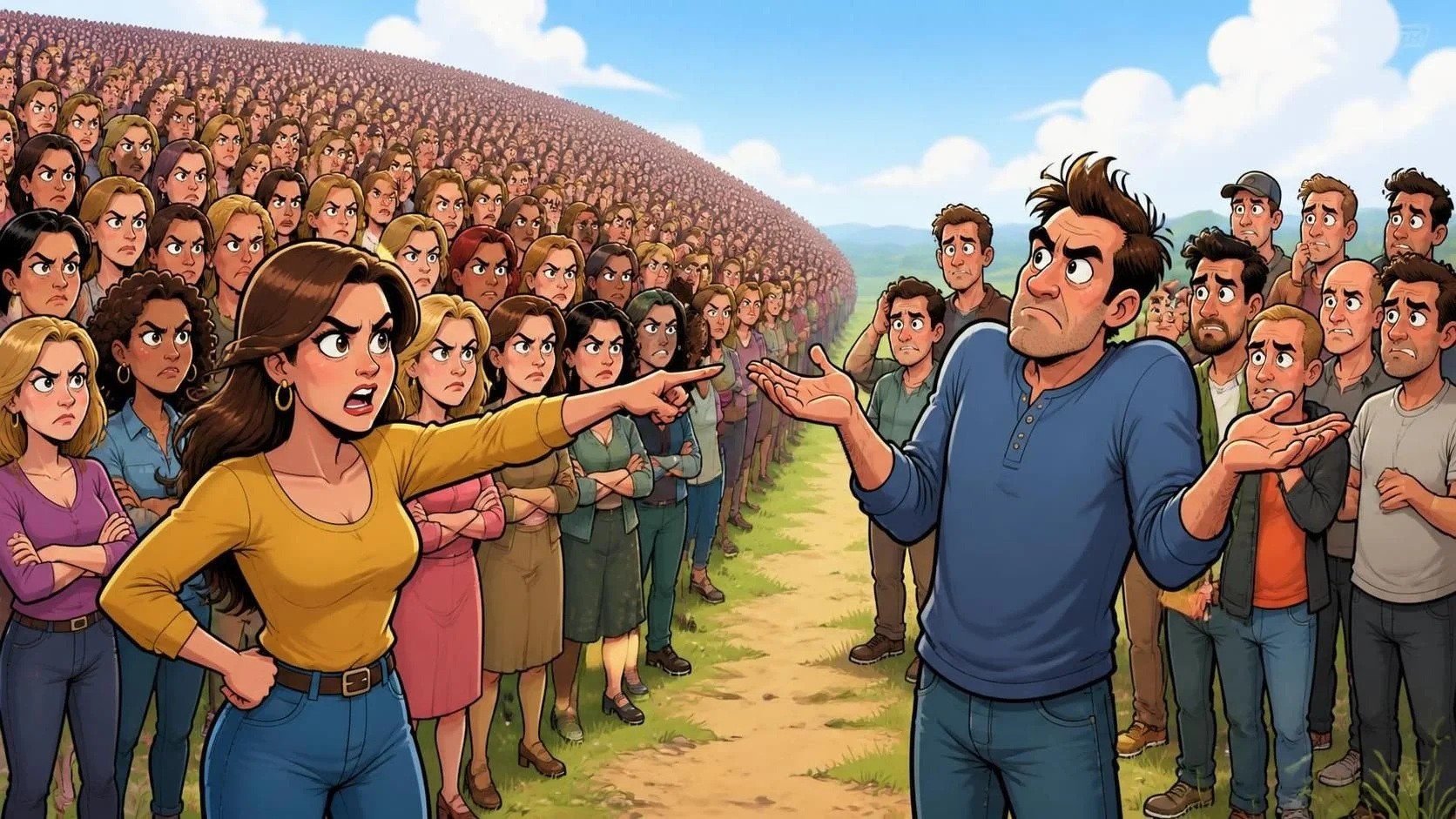
What is the biggest challenge to improving the wellbeing of men and boys? In a word, gynocentrism: the innate predisposition towards the protection and preservation of women and girls, the limiting and unique source of our species’ biological success.
Men are essential and equally unique, but vastly less limited as seed for the source. This renders them less valuable to the point that they are more readily disposable. When humans make their Sophie’s Choice, they save their daughters. Under the conditions of competing priorities, we are encoded with an algorithm that defaults to the preservation of the female or, under intense environmental pressure, perish.
This is amply illustrated in Asimov’s backstory to I Robot, where the maverick male cop was saved in statistical preference to a young girl by a non-human not programmed to make an evolutionary-scale calculation, but an immediate one. Without such a deep-running programme, Bowie’s Saviour Machine might send an equal number of men and women into the abyss to defend the tribe from predacious chaos, but with that ancient, instinctual, visceral wisdom factored in, it would only be strong young men sent to risk damage and death; its logic incontrovertible. And it has been this way for at least six million years, if not twenty or more.
Behind the apparent patriarchy lies another force. In one of the largest mammals on Earth, killer whales, this matriarchy is observable as the post-menopausal female, in the three dimensions of the deep, high and to the rear of the whale pod, navigating and supervising. In the centre swim the pups surrounded by their young mothers, and around them their parents with the males towards the edges. Front and centre, and darting all around, are the childless and virile young males, scarred from barracuda attack.
If one removes the abstract human notions of power, money and ownership, humans have a dual bi-sexual hierarchy, each hemisphere with its own modus operandi and specialization necessarily and inextricable bound together to drive the whole helix forward through time. Our nursing homes are full of elderly widows, the remaining survivors of their cohort.
The data are clear that it is testosterone in its many manifestations that shortens male life expectancy through a proclivity for high-risk, high reward, lower agreeableness strategies as juxtaposed against the risk-averse, higher-agreeableness, maternal, female strategy. The secondary relative value of male wellbeing is the stumbling block to improving it. Resources are finite; need is irrefutable; perceived need is infinite; there’s always room for improvement. In cases of acute illness and trauma, it demands a strict protocol ensuring the objective assessment of clinical need to determine which patient is a priority over which other. With chronic, sub-clinical need and lower-impact malaise, the vital signs are not so clear and are more subject to cultural, including political, pressure.
I spent some time with an ambulance operator, the survivor of a suicide attempt. He taught me that when you attend the scene of a multi-vehicle incident on a motorway, don’t pay immediate attention to those screaming for help. Instead, seek out the quiet ones slowly turning white. They are the ones in real trouble. And an acoustics engineer taught me that the brain compresses sound for processing by attenuating to the loudest sound at any given moment. On average, women experience more psychological distress and discomfort than men, and complain about it more verbally. The foundation of all social health and care policy, and of the predominate culture, therefore, is to attend more to the female scream. In competition for human, financial, healthcare and emotional support resources, women win.
This genetic preference expressed both personally and politically lies so deep it includes many males’ intrinsic sense of relative worthlessness, particularly without work, family or religion. It is embedded in the training centres of our social care, social science, and education and media institutions, and is fundamental to many our guiding myths and metanarratives.
This is not about apportioning blame, but an attempt to describe and explain. Until we learn to fully apply abstract human constructs like equality, fairness and equal value to the disbursement of our finite resources, empathies towards, and support efforts for, the male of the species, gynocentrism will remain the biggest challenge to improving the wellbeing of men and boys.
This article was first published on the Male Psychology Network website in 2019
Scroll down to join the discussion
Disclaimer: This article is for information purposes only and is not a substitute for therapy, legal advice, or other professional opinion. Never disregard such advice because of this article or anything else you have read from the Centre for Male Psychology. The views expressed here do not necessarily reflect those of, or are endorsed by, The Centre for Male Psychology, and we cannot be held responsible for these views. Read our full disclaimer here.
Like our articles?
Click here to subscribe to our FREE newsletter and be first
to hear about news, events, and publications.






When a male is in a power imbalance, at least two masculine instincts are disempowered…

…people – men and women alike – respond less positively to male-favouring sex differences than they do to female-favouring sex differences.
hyper-masculine gender norms are typically embedded within military institutions, and while adherence to these norms can contribute to combat and military success, they conversely make clinical work challenging
Men might benefit greatly from a government strategy aimed at improving their health. Here are suggestions from the Centre for Male Psychology on how that might be done. This article ends with some comments on potential pitfalls in the process of putting this strategy in place.




…people – men and women alike – respond less positively to male-favouring sex differences than they do to female-favouring sex differences.

… many papers do not even bother to identify or justify the nationality of their samples…

hyper-masculine gender norms are typically embedded within military institutions, and while adherence to these norms can contribute to combat and military success, they conversely make clinical work challenging

Have you got something to say?
Check out our submissions page to find out how to write for us.
hyper-masculine gender norms are typically embedded within military institutions, and while adherence to these norms can contribute to combat and military success, they conversely make clinical work challenging

hyper-masculine gender norms are typically embedded within military institutions, and while adherence to these norms can contribute to combat and military success, they conversely make clinical work challenging
hyper-masculine gender norms are typically embedded within military institutions, and while adherence to these norms can contribute to combat and military success, they conversely make clinical work challenging

hyper-masculine gender norms are typically embedded within military institutions, and while adherence to these norms can contribute to combat and military success, they conversely make clinical work challenging

hyper-masculine gender norms are typically embedded within military institutions, and while adherence to these norms can contribute to combat and military success, they conversely make clinical work challenging

Much of our attitudes, theorizing and public debate around men and masculinity is influenced by high profile feminist and Gender Studies scholars in academia. But what is the scientific quality of publications from these scholars?

Some people blame drill music – a form of rap - for the rising murder rate in London. Drill is known for aggressive lyrics about gang violence, but rather than seeing this as a valuable way for young men to express their feelings, some people want to ban it.

To survive… cultures have to use men and women effectively and … in fact, most cultures have used men and women in different ways… what our culture does is [grant] greater status to men and greater protection to women

hyper-masculine gender norms are typically embedded within military institutions, and while adherence to these norms can contribute to combat and military success, they conversely make clinical work challenging
There are around 300,000 veterans living with hearing loss in the UK, according to The Royal British Legion. In addition to being at a greater risk of PTSD, depression, and anxiety, many vets are also battling psychological distress from hearing problems.

The book begins with a description of her therapeutic approach, and an illustration of how to understand and work with the rage often seen in male CSA clients.

I felt in my dealings with some police officers, as though I were treated firstly as a man (assumed to be a perpetrator), but they’d overlooked risks associated with my impairment. Example: How can you dodge a missile you don’t see coming?

The Panorama programme on domestic violence failed to adequately highlight two important issues: male victims and female perpetrators.

your photograph, name and address, might appear in the local and national press and on TV, insinuating what an evil monster you are

…an attack upon masculinity is an attack upon one’s sense of self, of identity. …What, then, is the right psychological defence against such an attack?

The male has been designed to “look”, not only at the female, but to “look out” for prey, for danger, and for ways to protect his family unit.

If his child is allowed to live, this man must be available, for the rest of his life, to love and provide for his child… If, on the other hand, it is decided that his child is to be destroyed, he should be able to go about his life as if nothing has happened
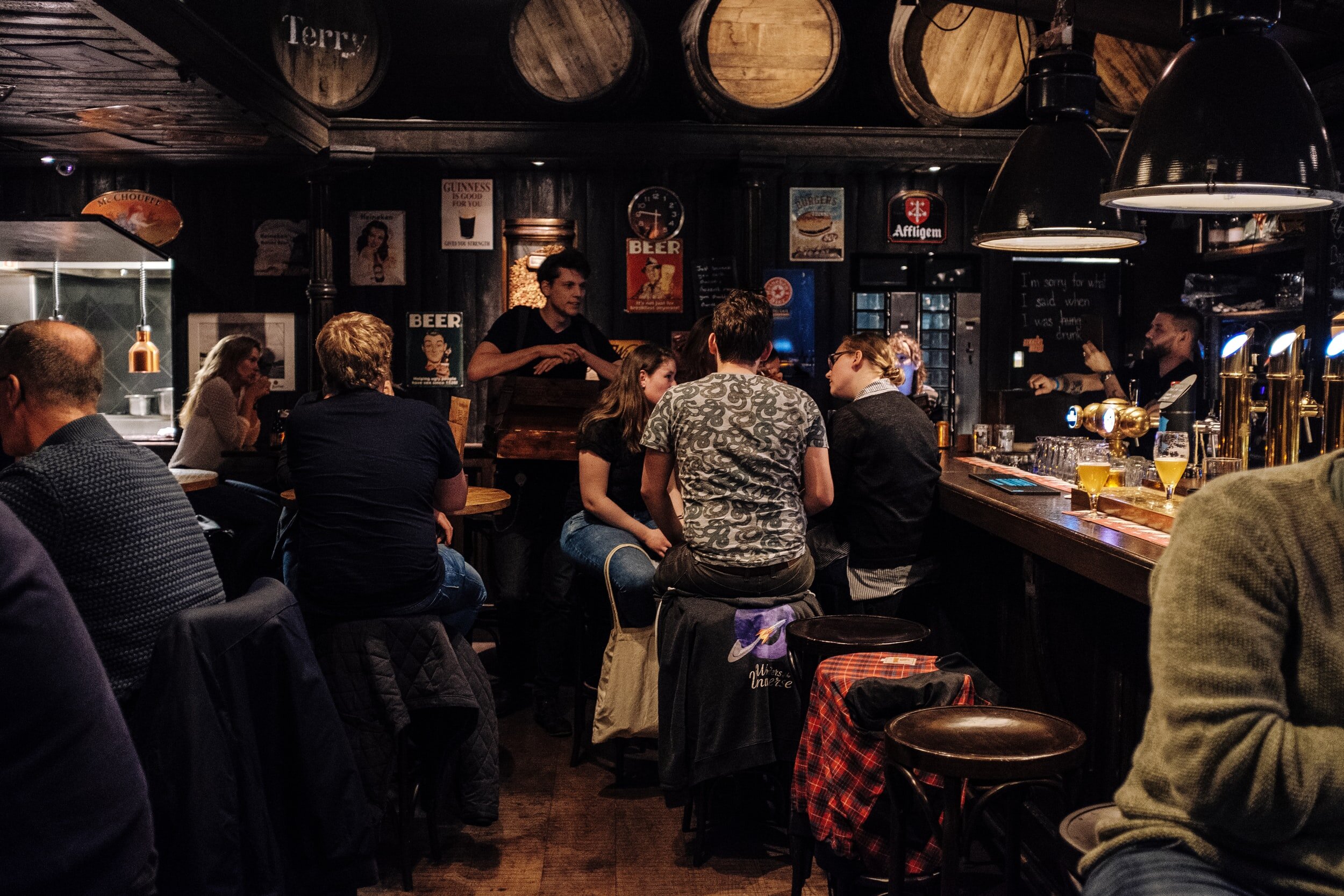
Socialising is a basic human need. The opposite – social isolation – is one of the worst forms of torture. Some people look down on the local pub as a place for undesirable riff raff, but that narrow viewpoint misses entirely the community value of the pub

Male psychology is a recent development in academia. Unlike gender studies, feminism, and men’s studies, male psychology takes the view that we can gain more by recognising and harnessing the positive aspects of masculinity than we can by taking a relentlessly negative approach to men.

.
After an earlier career in engineering, Richard Elliott switched to psychology in the late 1980s graduating with a BSc (Hons) in Psychology and Sociology from Uni. of Bath in 1992 with a dissertation on research conducted in a forensic setting. From there he moved to Avon Probation, then NACRO, the NHS and local government where he worked as a clinical auditor and commission manager. Having taken an MA in Professional Writing with Uni of Falmouth, he is soon to embark on an MSc in Biological Anthropology at Canterbury. He’s long taken a keen interest in men’s issues and was the UK promoter of Cassie Jaye’s Red Pill documentary, funding the premiere in London and 7 other cinema screenings around the country.